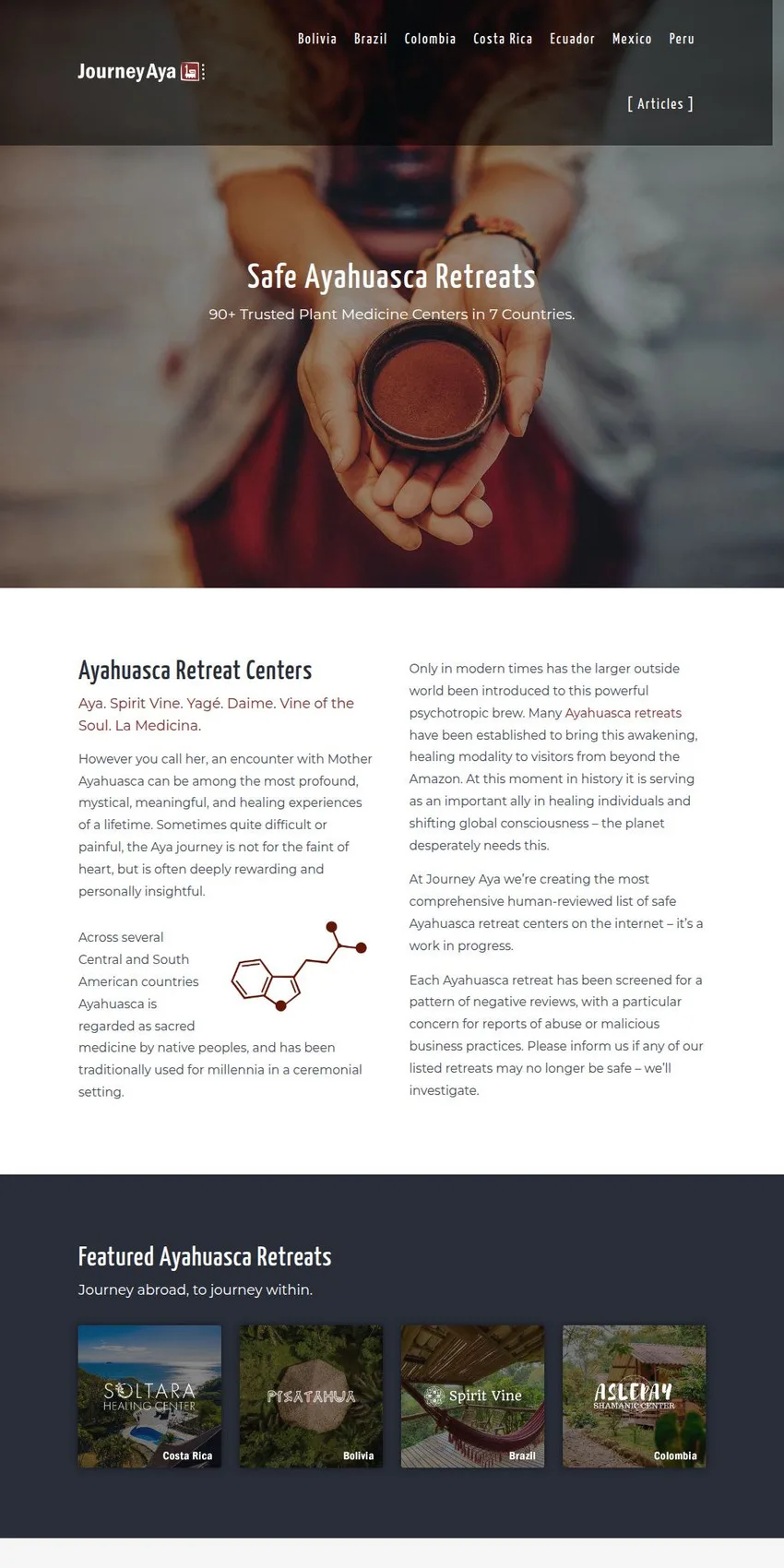
Journey Aya is an online directory of centres organising ayahuasca retreats in Latin America. The website lists centres in seven countries: Bolivia, Brazil, Colombia, Costa Rica, Ecuador, Mexico and Peru. Currently, the list features over 90 centres and is openly presented as a work in progress.
Where did the idea come from?
The founder, who simply goes by the name Chris A., had an ayahuasca experience in Peru himself. At the time, he found the search for a centre to be confusing and exhausting. So he began compiling a directory, country by country, to make it easier for others to find a suitable place.
The idea is similar to the list of tradespeople that a good friend keeps on their phone. It doesn't guarantee anything, but it saves you a lot of legwork. The website says exactly that about itself: the list is a good starting point, and every visitor must do their own checks.
How does a centre make it onto the list?
Every centre is vetted before publication. The team looks for patterns of negative reviews on Google, Facebook, Reddit, AyaAdvisors and Retreat Guru. An occasional bad review is considered normal, but repeated reports of abuse or dubious business practices result in a centre being removed from the list.
The vetting process doesn't stop after publication. Visitors can flag a centre that no longer seems safe, and the website promises to investigate every case. In my opinion, this is the project's most valuable feature, as participants' safety is prioritised over the number of centres listed.
What can you find on each country's page?
Peru has the largest section, with 41 entries for 39 distinct centres. The page presents Peru as the traditional home of ayahuasca and mentions the Shipibo-Conibo communities, who are often credited with discovering the drink. The centres are divided by region, from the northern, central and southern Amazon to the Sacred Valley in the Andes.
Each profile features a photograph, a brief description, the town and region, a link to the centre's website and a summary of the programme. Programmes are described according to their duration and the number of ceremonies, for example eight days with three ceremonies or seven days with four. Some centres also offer traditional diets (dieta) or open stays, with no fixed departure date.
The descriptions also mention other practices in the area. In addition to ayahuasca ceremonies, there are San Pedro, kambo, hapé and tutun, as well as flower baths, yoga and support for integrating the experience. Many profiles specify what the stay includes: accommodation, meals and transfers.
Each entry also has a price indicator, ranging from $ to $$$. It's a quick guide for anyone comparing dozens of centres, much like the star ratings on a hotel booking site. At the bottom of the page, a short list summarises the name, location and website of each centre.
And what if you'd rather go to the beach than the jungle?
Costa Rica has 14 centres, ranging from the beaches of Guanacaste, such as Tamarindo and Nosara, to the Osa Peninsula and Golfo Dulce. The page describes the country as a world-renowned ecotourism destination, with tropical rainforest and abundant wildlife. Styles vary greatly: some resorts are luxurious, offering spas, yoga and therapy, whilst others are rustic and traditional.
The difference between Peru and Costa Rica also lies in the journey. For those coming from Europe or North America, a beach in Costa Rica is easier to reach than a camp in the Amazon, where the final stretch of the journey is sometimes by boat. It's like choosing between a cabin on the edge of the forest and one at the end of a mountain trail.
Which centres are highlighted?
Four recommended centres appear on the homepage: Soltara Healing Centre in Costa Rica, Pisatahua Ecolodge in Bolivia, Spirit Vine in Brazil and Aslepay Shamanic Centre in Colombia. The Soltara Scarlet Valley is situated in the Central Pacific Valley, near Carara National Park. The area is covered in tropical rainforest and has a mountain climate.
Centres can choose between three types of listing. 'Basic' is free and simply means a presence on the site. 'Featured' places the centre at the top of the page, includes a gallery of five images, a blog article and a post on Reddit, whilst 'Featured First' guarantees the top spot, with only one position available per country.
What else is there to read on the site?
The articles section contains texts for those just starting out. One explains what ayahuasca is and how it is traditionally used during a ceremony led by a master or a trained shaman. Another shows how to prepare for a retreat, whilst a guest post recounts how the author chose their centre.
As a reviewer, I also appreciated the more relaxed tone of some of the pages. The website features a gallery of quotes and even one of memes about ayahuasca, which take some of the solemnity out of the subject. The footer features the logos of Chacruna and ICEERS, two well-known organisations in the field of research and education on traditional psychoactive plants.
The contact page lists the founder's email address and a form for name, email, retreat, website and message. No telephone number or opening hours are provided. The website has accounts on Instagram, Facebook, Reddit and LinkedIn, and operators wishing to be listed are directed to the Retreat Listings page.

Important pages