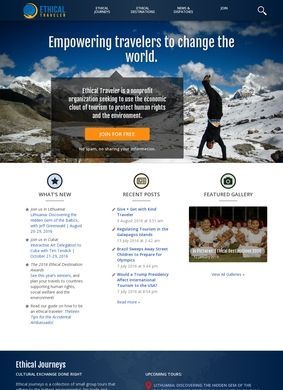
Every year a small nonprofit ranks the developing world's best-behaving countries, and the list draws genuine attention from travelers who care where their money lands. That list, the "World's Ten Best Ethical Destinations" award, sits at the centre of what Ethical Traveler does. The group runs as a project of the Earth Island Institute and starts from a simple premise: tourism moves a lot of money, and where that money goes can push governments toward better environmental policy, stronger human rights, and decent social welfare. So each year it screens close to 150 to 200 developing nations against those measures and names ten that come out ahead. That is an ambitious amount of work for a small operation, and it is the reason the name carries any credibility at all.
The annual destination award and its criteria
The award is the most concrete thing on the site, and it stands on firmer ground than comparable travel rankings because the criteria are stated openly. Countries are judged on environmental protection, human rights records, and social welfare, with the rankings limited to developing nations so the recognition can act as an incentive instead of a pat on the back for places that already have everything. That framing gives the list a purpose beyond clicks. A traveler weighing two beach destinations can look at who made the cut and why, and that is a genuinely useful input. Ethical Traveler treats the ranking as advocacy, a way of telling governments that good behaviour gets noticed and rewarded by visitors.
How rankings reward environmental and social progress
Beyond the rankings, the organization runs small-group guided trips it calls Ethical Journeys. These are built around environmental, fair trade, and human rights standards, which is the operating idea applied to an actual itinerary rather than left as policy commentary. Small groups suit this kind of travel: lower footprint, more contact with the places visited, less of the cattle-herd feel that undercuts the whole point of going somewhere to learn from it.
Ethical Journeys small-group trips
The standards attached to these journeys are more substantive than the brochure-level word "ethical" usually promises, because the same organization publishing the destination criteria is the one setting the trip rules. There is at least internal consistency between what Ethical Traveler preaches and what it sells. Whether the trips run often, and at what price, the site does not make obvious, and that is a fair thing for a prospective traveler to want answered upfront. Clearer dates and costs would help; a vague calendar is the kind of thing that quietly turns interest into a shrug.
Checking alignment between policy and practice
A resource guide called "Thirteen Tips for the Accidental Ambassador" rounds out the practical side. It is aimed at the ordinary tourist who has not thought of themselves as representing anything, and the title alone tells you the tone is approachable rather than scolding. For a movement that could easily tip into lecturing, that lightness is worth something.
Tips for travelers representing their home country
The content side is broader than expected for an outfit this size. There is a news and dispatches section, and notably its pieces are republishable under an open license, an unusual and generous choice that fits a group trying to spread ideas instead of hoarding traffic. An Ethical Traveler podcast extends the same material into audio, and photo galleries give the destinations a face. None of this is gated; community membership is free, which keeps the barrier to taking part close to zero.
Free content and open licensing model
Free membership and open-licensed content tell you the model here is advocacy, not revenue extraction. Funding runs through donations handled by the Earth Island Institute, the parent organization, which also explains why Ethical Traveler does not push hard on selling anything. The audience it wants is the socially conscious traveler who already half-agrees and needs tools, destinations, and an occasional nudge.
Tracking updates across multiple features
That said, the breadth can outpace the upkeep. A podcast, a galleries section, a dispatches feed, and an annual award are a lot of plates for a small nonprofit to keep spinning, and a visitor should check how current each one is before assuming it is all active. The flagship award tends to be the most reliably updated piece; the satellite features can lag.
Limited independent verification available
On third-party ratings there is not much to weigh for Ethical Traveler. The Facebook page shows four reviews and no aggregate star rating, sitting at "not yet rated," and nothing turns up on Google, Trustpilot, Yelp, Tripadvisor, or the BBB. For a nonprofit whose whole case rests on credibility, the near-total absence of independent ratings is worth noting plainly. A book with a similar title, "The Ethical Traveller" by Imogen Lepere, carries a Goodreads score, but it is a separate work and says nothing about this organization.
Contact is handled through a form page, and Ethical Traveler keeps a presence on Facebook, Twitter, and Flickr. The form route is reasonable for the kind of inquiries this audience tends to send, and for an advocacy nonprofit run largely online it suits the operation well.
So where does Ethical Traveler land? The destination award is a criteria-driven resource worth consulting, the open-license dispatches are a clear public good, and the trips at least practice what the rankings preach. The catch is that almost everything rests on the organization's own word, with very little independent footprint to back it up, and some features may be quieter than they look. The award archive and the ideas driving it are the real draw on the Ethical Traveler site; the rest is variable.