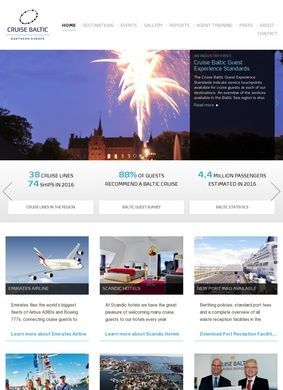
Knowing what Cruise Baltic is built for makes the whole site click into place. The Itinerary Planner is the clearest indication of that: it lets a route planner map cruise circuits across the Baltic Sea region, check port availability, and slot destinations into a workable sailing schedule. That kind of tool belongs to the people who assemble itineraries for a living. Cruise Baltic is a network and destination marketing body for the region, with a secretariat in Copenhagen, and its audience is cruise lines, port authorities, and the destinations themselves. The people who eventually book cabins are not who this site is speaking to.
Tools for route planning and port coordination
Anyone arriving here hoping to compare fares or check departure times will be in the wrong place, and Cruise Baltic does not pretend otherwise. The organization represents 31 partner ports and destinations spread across Northern Europe, from Oslo and Gothenburg down through Helsingborg and Helsingor, with Visby on Gotland in the mix as well. The job is to promote the Baltic as a cruising region to the global industry and to make the practical side of routing ships through it less complicated. Read with that framing, the content is coherent and tightly aimed, which is more than can be said for a lot of regional promotion outfits that try to appeal to everyone at once.
Shore power infrastructure tracking
The substance sits in a handful of working resources. Alongside the planner, Cruise Baltic maintains a Shore Power Map that tracks onshore power supply infrastructure at member ports. That is a genuinely useful piece of reference for a sector under real pressure to cut emissions while ships sit in dock. Shore power is one of those topics that gets discussed loudly and documented poorly, so a live map tracking which ports have the supply and which do not fills a real gap for anyone planning where a vessel can plug in. Keeping this current as a live resource, updated as infrastructure changes, says something about how Cruise Baltic sees its role. A one-off press release would not do the same job.
Sustainability assessment frameworks for ports
Sustainability runs through more than that one map. Cruise Baltic publishes assessment frameworks and resources aimed at member ports, the sort of material that helps a harbour benchmark itself and figure out where it stands against peers. This is more persuasive than a sustainability statement would be, because frameworks are things a port has to engage with and act on, whereas a statement is just words on a page. The orientation is toward giving members tools they can use internally, which fits the network model the whole organization is built on.
Destination profiles across partner ports
The destination content covers the partner ports in enough depth to be a working reference. The named ports give a sense of the geographic spread: Oslo and Gothenburg anchor the western side, Helsingborg and Helsingor sit either side of the narrow Oresund strait, and Visby brings in the medieval Hanseatic quality the Baltic is known for. For a cruise line weighing up whether to add a Baltic leg, or for a port trying to understand how it fits into a wider regional offer, this layer of content does practical work. It is destination marketing in the literal sense, but pitched at trade buyers rather than at the people who eventually walk down the gangway.
Member resources and industry focus
Capacity coordination sits underneath all of this as a quieter function. Cruise Baltic exists partly to connect cruise lines with port destinations and to help the region manage the flow of vessels, because a single small port can be overwhelmed by one large ship arriving on the wrong day. Coordinating that across 31 partners is unglamorous work, and Cruise Baltic does not dress it up. There is a partner login portal for members, which is where the deeper collaboration presumably happens, and the public side of the site is essentially the entry point to that members-only machinery.
News and press materials for stakeholders
News and press resources round out the public offering. These are aimed squarely at industry stakeholders and trade press, not at a general readership, which is consistent with everything else on the site. A journalist covering Baltic cruising or a port communications officer would find what they need; a curious tourist would find it dry. That is the right call for what Cruise Baltic is, and softening the material for a wider audience would only blur its purpose.
The consistent quality across the whole proposition is restraint. Cruise Baltic knows exactly what it is: a destination marketing and industry network serving a defined professional audience, building tools like the planner, the Shore Power Map, and the assessment frameworks that answer concrete questions those professionals have. There is no attempt to chase consumer traffic Cruise Baltic cannot serve, and no padding to make a focused operation look bigger than it is. In a field full of regional bodies that exist mainly to issue optimistic press releases, that focus counts for something.
What works, what does not
The flip side is clear: this is a closed-loop resource for a narrow slice of people. The most valuable functions live behind the partner login, so a non-member browsing the public pages sees the outline of the work without the substance. The destination pages and the Shore Power Map are the parts a general visitor can genuinely use, and they are good, but they cover a small fraction of what Cruise Baltic does day to day. Visitors outside the cruise and ports world will reach the edge of the useful material fairly quickly.
For its intended audience, Cruise Baltic is a sensible, well-aimed resource, and the planner plus the shore-power tracking alone justify a bookmark for anyone working the Baltic cruise trade. The published evidence points clearly in one direction: the organization has built something tight and purposeful, but that purpose is narrow by design. The public pages offer a genuine window into how a regional cruise network operates, and the destination content is detailed enough to be useful on its own terms. The real operational depth sits behind the member login, and Cruise Baltic makes no secret of that arrangement.