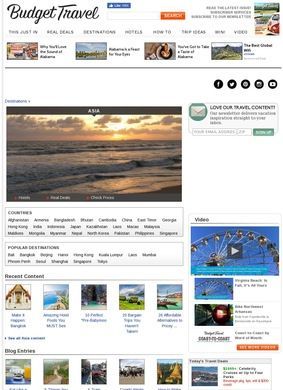
Knoji, a coupon and consumer-review aggregator, files Budget Travel alongside Priceline, Expedia and CheapOair, which places it in the crowded lane of online travel booking sites where a visitor searches for flights, hotels and packages and hopes the price beats the one they already found elsewhere. That framing is about as far as the picture gets before the wheels come off, because the Budget Travel site would not load during this review. A direct fetch returned a 403 Forbidden, and a second pass through a scraping tool came back with a 500 error. Two different methods, two failures, no page to walk through.
Site access problems during review
So the starting point here is a shrug. Whatever sections, search tools, destination guides or deal feeds Budget Travel puts in front of a real visitor, none of it could be confirmed here. The competitor comparison is a secondhand description, not something observed on the page. A booking platform lives or dies on the actual search box, the breadth of inventory, the clarity of pricing and how the checkout behaves, and every one of those is a blank in this case. Anyone can guess what a flight-and-hotel site probably contains. Guessing is not reviewing.
An unreachable homepage is not automatically a verdict on the business. Regional blocks, aggressive bot filtering, a firewall that treats automated requests as hostile, or a plain outage during the window of this check can all produce a 403 or a 500 without meaning the site is dead for ordinary browsers. It does, though, sit as a mark against convenience. A booking service that turns away visitors depending on how they arrive is a booking service that loses some of them, and there is no way from the outside to tell whether this was a one-off hiccup or a standing condition.
Reputation across multiple domains
The reputation trail is where this gets genuinely tangled, and it is worth slowing down for, because the name is common enough that several unrelated companies wear it. Knoji holds nine reviews for the Budget Travel domain with an overall score of 3.8 out of 5. That is a modest sample and a middling score, the kind of number that says a handful of customers had a mixed-to-decent time and not much more can be read into it. Nine data points is not a trend. It is closer to anecdote.
Similar names, different businesses
Search also turns up far shinier ratings, and they belong to other sites. A Trustpilot profile for budgettravel.ie, an Irish domain, carries a four-star rating across roughly 1,800 reviews. A separate Trustpilot profile for budgettraveluk.co.uk, a UK operation, shows five stars over about 777 reviews. Both are strong on paper, and neither is budgettravel.com. Pinning those numbers onto this listing would be an easy mistake and a dishonest one. They are different businesses on different domains, and their good standing says nothing about the site under review here. ReviewCentre adds a Budget Travel entry with nine reviews under a travel heading, though whether that points at the same company is unclear.
What did not surface is telling in its own quiet way. No Google reviews for budgettravel.com specifically, no Yelp presence, no Better Business Bureau file, no Glassdoor footprint. For a site pitched as a rival to the Expedias of the world, that is not much to go on: nine reviews on one aggregator and nothing on the platforms travelers usually check first. The larger booking names generate thousands of reviews across every platform almost by gravity. Budget Travel, on the evidence gathered here, generates a single-digit count on one niche aggregator and a lot of confusion with its near-namesakes.
Missing contact and transparency details
Transparency and a way to make contact are the usual second half of a credibility read, and here both are simply unavailable. With the page refusing to load, there was no way to check for a phone number, a mailing address, a contact form, support hours or any of the details that separate a real operator from a shell.
That is not a criticism of the business, since the details may well be sitting on the page for a browser that gets through. It is just another item that could not be verified, and on a booking site, where a traveler may need to reach a human about a charge or a cancellation, a visible way to reach support is exactly what a nervous buyer looks for. For a service like Budget Travel, that gap sits heavier than it would elsewhere.
Put the pieces together and Budget Travel occupies an awkward spot. The one concrete thing that could be established, the framing as a flight-and-hotel booking competitor, comes from a third party rather than the site itself. The one review score that clearly attaches to this domain is a 3.8 from nine people. The impressive four- and five-star tallies belong to other companies that happen to share the words in the name. And the site would not open to let any of this be checked at the source.
Why accessibility matters for booking sites?
None of that adds up to a warning to stay away, but it is a long way from an endorsement. A traveler weighing where to book has plenty of options that load on the first try and carry a public review history deep enough to actually mean something. Budget Travel might turn out to be perfectly capable once the door opens, and the modest Knoji score is hardly a red flag. The trouble is that a booking site asks for a credit card and personal details, and the case for handing those over is built on exactly the transparency this one did not put on display during the review.
The measured take, then, is caution over commitment. If someone lands on Budget Travel through a working browser, sees a clean interface, finds visible contact and cancellation terms, and gets a fare that genuinely undercuts the big platforms, there may be a real reason to use it. Short of that, the safer move is to treat the promising ratings for the Irish and UK namesakes as belonging to someone else, read the 3.8 for what it is, and keep this listing on the maybe pile until the site proves it can at least open its own front door.