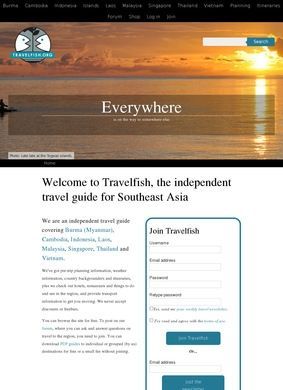
Accommodation reviews on Travelfish.org are written after the reviewer has checked in incognito, which tells you a lot about how the site approaches its subject. This is a travel guide built around eight countries: Burma (Myanmar), Cambodia, Indonesia, Laos, Malaysia, Singapore, Thailand, and Vietnam. Travelfish.org has been running since 2004 under Travelfish Pty Ltd, an Australian company, and it has stayed narrow on purpose. There is no pretence of covering the whole planet. The focus is Southeast Asia, and the depth shows in how the destination pages are organised.
Structure for eight Southeast Asian countries
Each country gets an introduction and then breaks down into sub-destinations, so a traveller heading to Vietnam, say, can drill from the national overview into specific towns and regions without leaving the structure. Itineraries sit alongside the guides: one set per country, plus regional routes that string several countries together for people doing a longer overland trip. The planning section is practical and unsentimental, dealing with packing, money, and travel insurance. That is the unglamorous part of trip prep, and it is good to see the site treat it as a first-class section instead of an afterthought. A traveller can move from broad inspiration down to the specific question of how much to budget for a week without bouncing between unrelated pages, which is the kind of structure a guide earns only by being maintained for years.
Long-form editorial and book reviews
The written content goes beyond logistics. Travelfish.org runs long-form editorial pieces filed under "Longreads," covering regional topics in more depth than a standard guide entry, and it reviews books about Southeast Asia for readers who want to go in better informed. The founder also writes a regular column called "Couchfish," which wanders beyond the region and reads more like a personal dispatch than a guidebook. Taken together, the site is part reference and part ongoing publication, with fresh editorial arriving over time instead of a static set of pages frozen at launch. That mix is one of the things that separates Travelfish.org from a guide that was written once and then left to age.
PDF guides and member forums
A fair amount of the site is open, but two of the better resources sit behind membership. The first is a library of PDF guides, which suits anyone who wants offline material to carry on the road where data can be patchy or expensive. The second is the member travel forum, split into country-specific boards and general discussion. Forums like this tend to live or die on whether real travellers and locals show up, and the fact that an external Tripadvisor thread points back at the Travelfish.org forum's content shows that people elsewhere treat it as a useful reference point.
There is also a newsletter for people who want the editorial pushed to them instead of remembering to check back. None of this is presented as a hard sell. The membership model lines up with how Travelfish.org funds itself, which the site is unusually direct about, and that honesty colours how the rest of the content reads. Paying for the deeper material is the deal, and it is laid out without games.
Affiliate partnerships and funding model
On money, Travelfish.org is transparent about affiliate partnerships. Accommodation bookings run through Agoda, activities through GetYourGuide, transport through 12Go Asia, and travel insurance through SafetyWing. Those are named outright on the page instead of tucked into fine print, which is the right way to handle it. Travelfish.org also makes a point of saying it is fully self-funded, summed up in its own line about paying its own way, so the recommendations are not driven by a single advertiser holding the purse strings.
No AI-generated content
One claim stands out in the current climate: the site states it is 100% AI-free. For a travel resource, that is consequential, because the value of an in-person hotel inspection collapses if the copy turns out to be machine-spun filler. A reader can weigh that promise against the writing itself, and the editorial voice in pieces like Couchfish does read as a person with opinions, not a content mill. It is a clear position to take, and Travelfish.org leans into it.
External reputation amounts to very little once you go looking for it. The site has a Trustpilot profile, but it carries only two reviews with no aggregate score showing, which is far too little to draw any conclusion from in either direction. MyWOT lists a community scorecard for the domain. Beyond that, searches turn up no ratings aimed at the site itself on Google, Yelp, Facebook, or Tripadvisor; the Tripadvisor mention is a thread citing the forum, not a verdict on Travelfish.org itself. So third-party feedback is mostly absent, which is common for a long-running niche publisher whose audience engages on the site itself instead of leaving star ratings elsewhere. The clearest external endorsement is indirect: people on other forums treat the Travelfish.org boards as a place worth quoting.
Getting in touch runs through a page reachable from both the main menu and the footer, with email available there. The homepage names LinkedIn and Bluesky as the best first points of contact, which is a slightly unusual choice and tells you the operation is small and reachable through the founder more than through a support desk. There is no phone number or physical address, which for a digital travel guide is reasonable. A media kit and a jobs page round out the footer, which points to a working business behind Travelfish.org instead of a dormant domain.
What undercuts a simple verdict, in a good way, is the consistency between the parts. The incognito hotel checks, the disclosed affiliate links, the AI-free stance, and the twenty-year history all push in the same direction: a publisher that wants to be trusted on the specifics. The trade-off is range. If a destination falls outside those eight countries, Travelfish.org has nothing for it, and the column aside, that boundary is firm. For its chosen patch, the coverage is dense; outside it, look elsewhere.
Best for independent travellers in the region
Travelfish.org is best suited to independent travellers planning a trip through one or more of the covered countries, especially backpackers and overlanders who want vetted accommodation notes and ready-made itineraries instead of starting from a blank map. People doing a multi-country route across the region get the most value, since the cross-border itineraries are exactly the sort of thing generic guides skim over. For a question about a specific town or guesthouse, the country forum is the place to ask, and Travelfish.org is set up to answer it from people who have been there. If offline access matters, taking out membership before departure means the PDFs are downloaded and the boards are open when connectivity drops in remote areas.