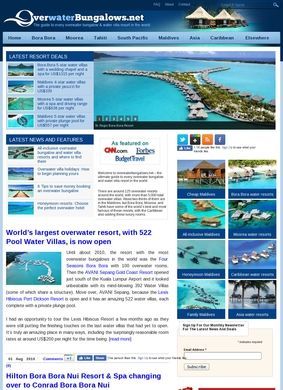
What does a website that does nothing but write about overwater bungalows give you that a general booking site does not? A narrower, deeper map of one very specific kind of holiday. Overwater Bungalows is an editorial travel guide built around a single idea: the thatched villa sitting on stilts above a lagoon, with a ladder into the water and a glass panel in the floor. The site catalogues roughly 250 overwater resorts and somewhere north of 9,000 individual villas, sorting all of that by where a traveller would actually want to go, so the Maldives, Bora Bora, Moorea, Tahiti, the Caribbean, Bali, Sri Lanka, the Seychelles, and a handful of others each get their own treatment.
How the site filters overwater properties
The reason someone ends up here is usually impatience with the alternative. Search a mainstream travel platform for an overwater room and you get a flood of results where a genuine stilted villa over a reef sits next to a beachfront cabana that happens to use the word "water" in its name. Overwater Bungalows solves that filtering problem by refusing to cover anything else. Every property in the Overwater Bungalows catalogue belongs to the category, which is a minor thing until you have spent an afternoon trying to confirm whether a given resort's bungalows are truly over the lagoon or merely near it.
Ranked lists and destination guides
Content is organised the way someone planning this trip thinks. There are ranked lists for the cheapest overwater options, the all-inclusive resorts, the luxury properties with private plunge pools, and the picks aimed at honeymooners. Underneath the rankings sit destination guides and individual resort write-ups that go into amenity detail: does the villa have a private pool, is it adults-only, how far is the swim to the house reef. That granular level of information is what decides bookings at this price point. The audience is clearly defined: couples on a honeymoon, families willing to splurge, and travellers chasing the upper end of the bracket. The site does not try to serve anyone outside that group.
Overwater Bungalows is not a hotel, a tour operator, or a booking engine in its own right. It holds no inventory and processes no payments. What it does is aggregate and refer: read a resort review, decide you like it, and the site points you to a booking engine where the actual reservation happens elsewhere. It describes itself as the best place to book these rooms, which is a marketing claim about convenience and curation, not a statement that any transaction lives on its own pages.
Referral model and newsletter
For a reader, that arrangement is worth understanding before leaning on the site too hard. The reviews and rankings are the product; the booking is outsourced. A free newsletter rounds out the model, pushing deals and newly added listings to anyone who signs up, which fits a publication that earns through referral and wants to keep an audience warm between trips. None of this is hidden, and the referral model is standard for travel-content sites, but it does mean the incentive structure leans toward getting you to click through and book. The rankings are best read as informed editorial opinion rather than a neutral audit.
That caveat matters less than it might because the niche is so specific. A site that only ranks overwater resorts has a smaller universe to be wrong about, and the sheer count it claims to track, hundreds of resorts and thousands of villas, points to a catalogue doing real work even if the ordering carries a commercial tilt. Overwater Bungalows is not a general business directory; it is a specialist publication with a single, well-defined subject, and that focus is precisely what makes the depth possible.
Authorship and online presence
The other thing in the site's favour is authorship. It is run by a named individual, Roger Wade, and a real person attached to a travel publication tends to read with more of a point of view than the anonymous, committee-written pages that dominate the genre. Wade's name turns up across the site, and Overwater Bungalows is cited as a reference by other travel publishers, including priceoftravel.com, which is itself one of his projects. That cross-referencing is a modest marker of standing within travel-content circles, though it stops short of independent endorsement from outside them.
Limited customer review footprint
On the question of how the wider internet rates Overwater Bungalows, the honest answer is that there is not much to report. A search turns up no Google, Trustpilot, Yelp, or Tripadvisor profile for overwaterbungalows.net itself. No star rating, no review count, nothing that would let a visitor measure the quality of the guidance against a crowd of other users. The site is referenced by other travel-content outlets, which is a form of recognition, but it is recognition from peers in the same business, not verdicts from travellers who used it to plan a trip. For a publication this old in internet terms, the absence of any consumer-review footprint is a genuine blank space, and it leaves Overwater Bungalows harder to independently assess than comparable travel publications of similar age.
Editorial depth over logistical support
Contact follows the same lean pattern. There is an email address and the name Roger Wade, and that is the whole of it. No phone number, no postal address, no booking desk. For a site that refers people to spend thousands on a honeymoon, a single email channel is consistent with a one-person editorial project rather than a travel agency, and a referral publisher genuinely does not need a phone bank, but anyone expecting hand-holding through a booking should understand up front that the support here is a guide to read. The resort write-ups, the ranked lists, and the destination comparisons are where Overwater Bungalows puts its effort, and what Overwater Bungalows delivers is exactly that: editorial depth, not logistical support.
Weighing it as a planning tool, Overwater Bungalows does what it claims in a category that general sites handle badly. The destination breadth is real, spanning the Maldives through the South Pacific and into the Caribbean and Asia, and the amenity-level detail in the resort write-ups is the sort of thing that saves hours of cross-checking elsewhere. If you already know you want a stilted villa over a lagoon and you want one source that has looked at most of the options and sorted them by price, luxury, family-friendliness, and romance, this is a sensible place to start. The newsletter is a low-commitment way to keep an eye on deals.
The reservations are about distance and accountability. Ranking advice comes from a site whose income depends on you booking through its referral links, and the booking itself happens on a third-party engine Overwater Bungalows does not control. There are no consumer reviews to tell you whether past visitors found the guidance reliable. The curation may well be excellent and the niche focus is a real advantage over the alternatives, but a traveller committing honeymoon money has every right to want more than one person's editorial opinion and a referral incentive, and on that score Overwater Bungalows leaves the most important question unanswered: the published evidence is strong enough to shortlist a resort, not necessarily strong enough to book on without cross-checking.