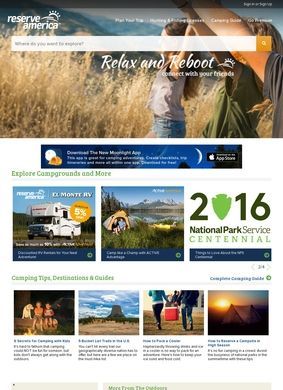
A camper with a long weekend free, a tent or an RV, and a specific state park in mind faces one immediate problem: confirming whether a site is available on chosen dates and locking it in before someone else does. That narrow, time-sensitive task is exactly what Reserve America is built to handle. The platform sits between campers and the agencies that run public and private campgrounds, turning a vague plan into a confirmed booking with a payment receipt. It covers the United States and Canada, which matters if a trip crosses a border or the goal is comparing parks in two different jurisdictions.
Facility search and booking
The core of Reserve America is a facility finder that lets a traveler search by location, by the dates of the stay, and by the type of site they need. A tent camper, a family towing a trailer, and a couple after a cabin or a yurt all start from the same search box but filter toward very different results, and the system handles those distinctions instead of presenting a single undifferentiated list. Amenity filters narrow things further, so a search can account for the practical details that decide whether a site actually works for a given party. Once a match is found, booking and payment happen in the same flow, keeping the whole transaction in one place.
Accommodations beyond camping
What broadens Reserve America well past simple campsite booking is the range of recreation it folds in. Beyond tent and RV pads, the platform handles cabin, yurt, and lodge stays, reaching travelers who want a roof and a bed without leaving the public-lands setting. It also processes boat slip and marina reservations, which pulls in a boating audience that overlaps with but is distinct from the camping crowd. Day-use areas and picnic spots can be reserved through Reserve America too, useful for a group gathering that does not involve an overnight stay. For partner agencies, the same infrastructure processes hunting and fishing licenses, putting a regulatory function alongside the recreational booking.
Agency partnerships and coverage
Reserve America runs on a dual model that shapes how the whole thing is structured. On one side are the consumers: the campers, RV travelers, and boaters who arrive looking to reserve something. On the other are the government and park agencies that contract Reserve America as their reservation technology. This is the part that most users never see directly, and it explains why the booking experience can feel slightly different from one park system to the next. State parks, provincial parks, local government parks, and private campgrounds all plug into the same engine, so the coverage map is wide.
State-specific reservation portals
That agency relationship surfaces in the state-specific subdomains Reserve America operates, such as the one carrying the New York State Parks brand. A camper searching within a single state may land on a version of the site dressed in that agency's identity while still drawing on the shared reservation backbone underneath. The arrangement lets each park system present its own front door without building a booking system from scratch. For a traveler, it means the inventory and the booking rules reflect the actual policies of the agency that owns the land, which is the right way for it to work.
Mobile app and company history
Operating since 1984 and based in Saratoga Springs, New York, Reserve America has had a long run in this space, and it now sits within Aspira, the company formed from what was previously the Active Network. That lineage is why some consumer-facing pieces, including the mobile app, carry Aspira branding instead of the Reserve America name. The app, available for iOS and Android, mirrors the website's main functions: searching for sites, saving favorites, and managing existing reservations. For anyone who books a trip and then wants to adjust it from the trailhead or the road, having that control in a phone app is a genuine convenience rather than a bolt-on.
Interface consistency challenges
There are rough edges worth naming. The split identity between Reserve America and Aspira can confuse a first-time user who books on one branded site and then downloads an app under a different name, and the variation across agency subdomains means the experience is not perfectly uniform. None of that undercuts the central value, which is reliable access to a large pool of public and private camping inventory across two countries, bookable in a single sitting with payment handled on the spot. For the specific job of finding an open site on chosen dates and securing it, Reserve America does what it sets out to do.
Catalog depth and scope
The depth of the catalog is the real argument. A platform that only covered a handful of marquee parks would be easy to outgrow, but Reserve America reaches into local government parks and private campgrounds alongside the big state and provincial systems, which is where a lot of trips actually end up. The license processing and marina reservations push it beyond a pure camping tool into something closer to a general outdoor-recreation booking hub, at least for the agencies that have adopted its full feature set. A camper who plans several trips a year across different states benefits from learning one interface instead of a dozen.
Comparison with Recreation.gov
Set against Recreation.gov, the federal system that handles national parks, national forests, and other federally managed lands, Reserve America occupies a clearly different lane. Recreation.gov is the place to book a campsite in Yosemite or a permit for a federal wilderness area, and it does not cover the state and provincial parks that make up the core of Reserve America's inventory. A traveler planning a full year of trips will likely use both, because the two split the map between federal and state, provincial, local, and private land. For destinations on the non-federal side of that line, which accounts for a very large share of the camping people actually do, Reserve America is the more directly relevant tool, and its four decades of operation alongside broad agency partnerships give that claim real weight.