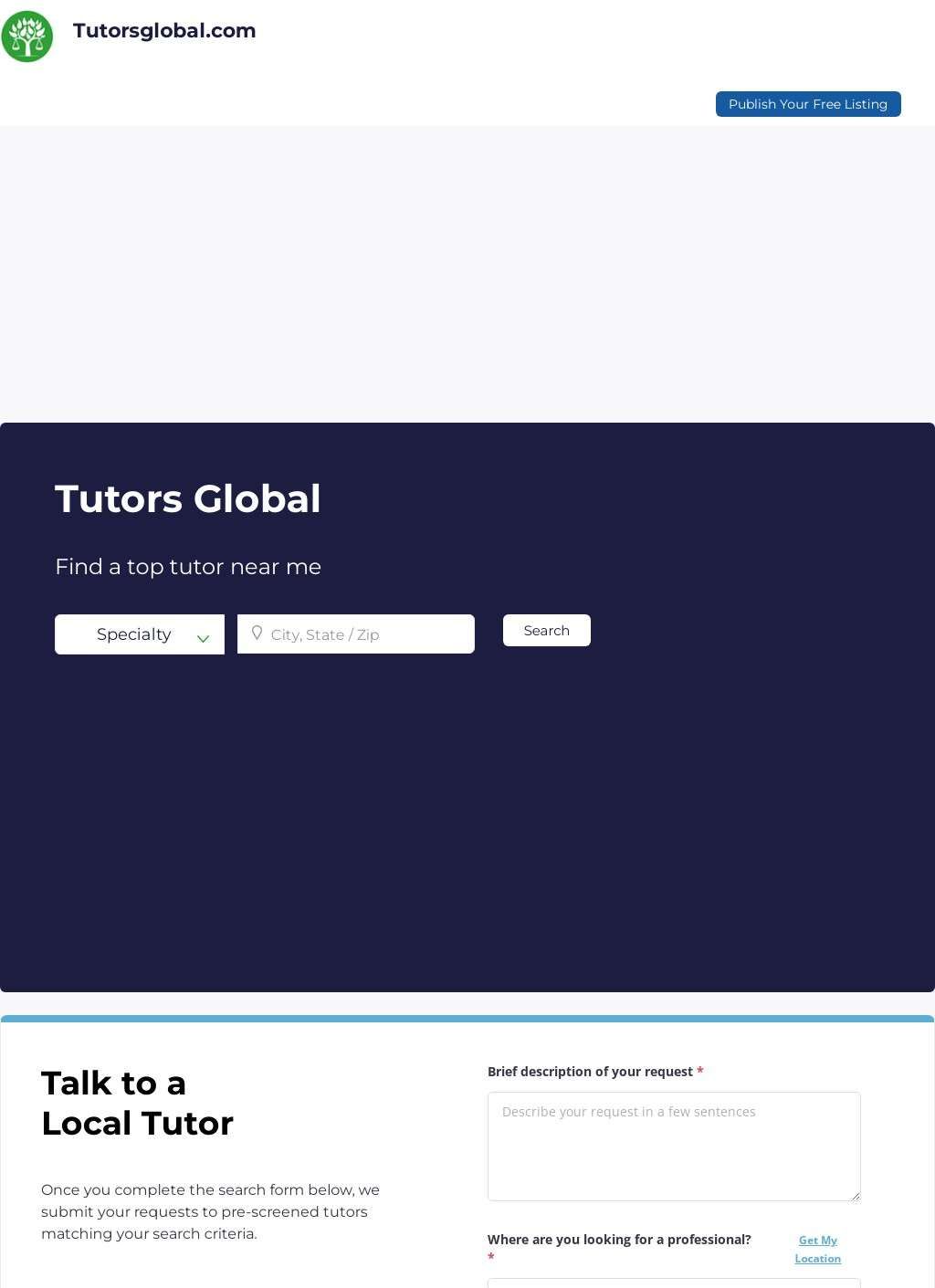
A family in Sydney and a student in Toronto need a tutor. Both could plausibly reach Tutors Global, which covers the United States, Australia, Canada, and the United Kingdom from a single platform. That four-country scope is specific and deliberate, not vague aspiration: it keeps the language of instruction consistent and the curriculum expectations broadly compatible, while giving the platform scale that a purely local service cannot offer.
How the matching marketplace works
The core mechanic is a matching marketplace. Students either browse pre-screened tutor profiles or submit a request describing what they need, and Tutors Global pairs them with candidates who fit. Service categories span Academic Tutoring, In-Person Tutoring, Language Tutoring, Online Tutoring, STEM Tutoring, and Test Preparation. Keeping in-person and online as separate tracks throughout the search and matching flow is a sensible call: a family wanting someone at the kitchen table on Tuesday and a university student happy with a video call have different constraints, and collapsing both into one undifferentiated list would make filters nearly useless.
Search filters and request submissions
Search on Tutors Global filters by city and location. For in-person sessions, that does obvious necessary work. For online categories the geographic constraint loosens, which is the correct behaviour. The platform offers a second entry point alongside profile browsing: post a request describing what you need and wait to be matched, skipping profile review entirely. Two routes into the same workflow accommodate students who shop differently, and that kind of path flexibility is underrated in tutoring platforms where a parent under time pressure wants to describe a problem and get candidates, not browse forty profiles.
In-platform messaging and response times
Once matched, communication runs through in-platform messaging. The site sets a 24-hour expected tutor response time, which gives a first-time user a concrete expectation and a calibration point if tutors miss it. Tutors Global also states that tutors are pre-screened before appearing on the platform.
Tutor screening and verification
The exact nature of that vetting is not spelled out in any detail a visitor can see: no mention of background check providers, qualification verification processes, or pass/fail criteria appears on the pages users navigate. Open listing platforms with no screening at all are plentiful, so stated vetting does place Tutors Global above that end of the market. But the claims are entirely self-reported, and a prospective student cannot audit the process from outside: the vetting is either accepted on trust or treated as insufficient. Where a platform handles money and places strangers with children, that opacity is worth naming plainly.
External support system location
One operational detail worth noting: help resources for Tutors Global point to a third-party support system at help.heritageweb.com. The domain is external to the main site, so a student seeking guidance gets handed off to an outside knowledge base rather than staying within the product environment. Many SaaS platforms run support this way, and it is not unusual, but it does mean the help experience is a step removed from the rest of the product.
Contact options for users
A newsletter signup and the ability to browse profiles and compare tutors without posting a request are genuine affordances for cautious users who move carefully. Contact on the main site is channelled through in-platform messaging; no phone number or street address appears prominently on the homepage, and anyone who expects those details upfront will not find them. For arranging lessons, that is the channel that counts, but for reaching the business itself if something goes wrong, the path is less clear.
From missing external reviews to platform credibility
Tutors Global has not accumulated a visible review footprint on any major external rating platform. Searches for the service surface a separately named company whose marks do not apply here; no platform returned results tied specifically to tutorsglobal.com. In tutoring, where the whole value proposition rests on whether a stranger can teach your child, outside review volume from real families is close to the primary decision variable, not one factor among several. The published credentials of the platform, its multi-country scope, and its structured workflow are coherent, but they describe infrastructure. Whether the tutors on the other end of that infrastructure are actually good is the question the platform's own pages cannot answer, and right now neither can anyone else publicly. That is the weight a prospective customer has to carry into any engagement with Tutors Global.
Tutors Global is a functioning, structured platform: geographic search, profile browsing, a request form, multi-country reach, and a defined response-time expectation all work as described. The four-country coverage is the single most specific claim the service makes, and it is a genuine distinguishing characteristic when most tutoring platforms anchor to one country or one city. The rest is architecture, and architecture without tutor quality data behind it is not enough to make a confident choice.