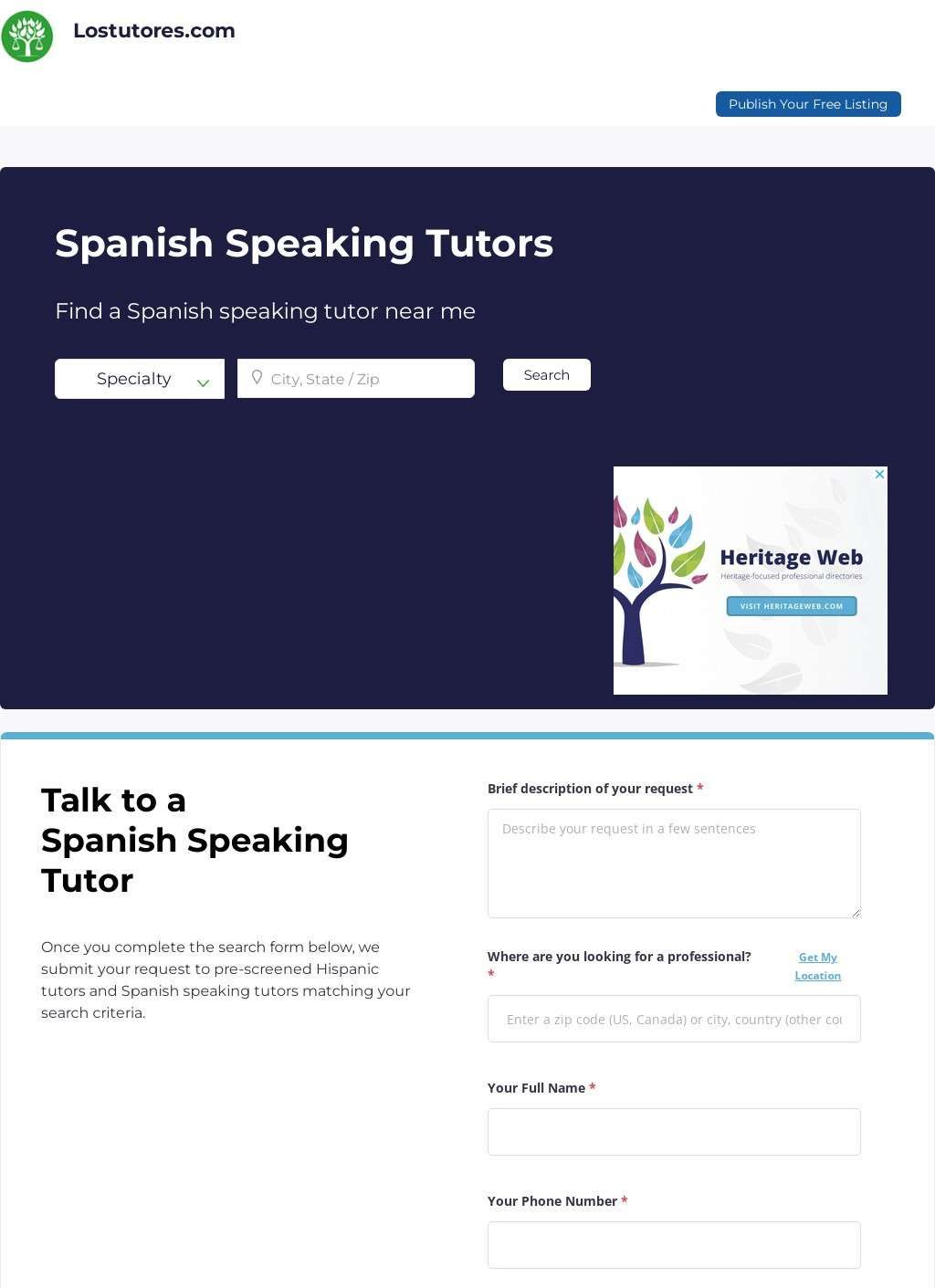
What does a family get when they land on Spanish Speaking Tutors looking for someone who can explain algebra in the same language the kid speaks at home? A matchmaking service, essentially. The site collects tutors and educators who share Spanish and Hispanic cultural background, then puts a request form between the visitor and the person they end up working with. You describe what you need, staff routes it, and a tutor gets back to you. That framing sets expectations before anyone reads a single profile.
Tutoring categories and subjects covered
The categories are broad enough to cover most of what parents and adult learners come looking for. Academic tutoring sits alongside language tutoring, and there is a split between online and in-person help, so a student in a smaller town is not forced into video calls if a local tutor happens to be available. STEM subjects get their own lane, and there is test preparation for the families gearing up for standardized exams. None of these are exotic promises. They are the standard shape of tutoring demand, and Spanish Speaking Tutors organizes them cleanly instead of burying them.
How the matching service works
What the site does not do is teach anyone directly. It is the connective layer, and every actual lesson happens between a student and whichever independent tutor the match produces. That distinction shapes how much weight the platform itself can carry. It can surface a good candidate, but the outcome still rides on the person who shows up, so a user should approach it as a starting directory and do their own homework on the individual.
Checking tutor availability by location
Geography is where the site tries to stretch. It lists tutors across large U.S. metros, Los Angeles, New York, Austin, Miami among them, and then reaches past the border into Canada, Colombia, the Dominican Republic, and Mexico. Whether every one of those locations has real depth of tutors is not something the homepage proves, and a family in a mid-sized city should check what is genuinely on offer near them before assuming the map is full. The breadth is a selling point and a caution at the same time.
Cultural matching as core mission
The cultural premise is the actual reason this exists. According to its About page, Spanish Speaking Tutors is one of more than 300 professional-directory publications run by the same parent company, each built around connecting communities through shared language, culture, faith, and lived experience. That is a real and defensible idea. A Spanish-speaking student often learns faster with someone who understands the household, the accent, the reference points, the way a concept was first taught back home. The site leans on that instinct, and for a lot of families it will land.
Network model behind the site
It also means this is a network product, not a boutique. The same infrastructure powers hundreds of sibling sites, which explains the polish and also the sameness. You are getting a template applied to a Hispanic-education niche. For the user that is mostly fine, as long as they understand the tutor they meet was matched through a system, not personally vouched for by someone who sat in on a lesson.
Tiered listings for tutors
On the professional side, Spanish Speaking Tutors runs a tiered listing model. There is a free tier and paid tiers billed monthly or annually, and submissions go through staff review before they appear. That review step is worth something. It is not the same as vetting a tutor's teaching quality, but it does mean listings are not published entirely unchecked, which puts the site a notch above a raw free-for-all.
Disclosure of paid endorsements
The part a careful reader should sit with is in the legal pages. Spanish Speaking Tutors keeps a Security Policy, a Legal Disclaimer, and Terms and Conditions, and the disclaimer states plainly that the company may receive compensation for reviews or endorsements of listed professionals. Read that for what it is. This is a directory funded in part by listing and advertising fees, so a tutor's prominence can reflect what they paid as much as how good they are. That is not a scandal, plenty of reputable platforms work this way, but a parent should weigh a glowing on-site endorsement accordingly and judge the tutor on their own credentials.
To its credit, the site does not hide any of this. The disclosure is right there in the terms, written in language a normal person can follow. Transparency about the money is itself a mark of a directory that expects to be taken seriously, and Spanish Speaking Tutors clears that bar even if the pay-to-be-featured mechanics ask a bit of skepticism from the visitor.
Contacting the platform
Getting in touch is the weakest part of the experience. The homepage carries no phone number, no email, and no street address. Contact runs through a footer link that opens a request form, with a reply promised inside two business days. For a matchmaking service that is a reasonable design, since the form is the product, and the two-day window at least sets an honest expectation. Someone who wants to talk to a human ahead of signing up for a lesson may find that distance frustrating, and it is fair to note the absence of a direct line. Spanish Speaking Tutors is asking visitors to trust the form and wait, which suits a matching model but tests the patience of anyone used to picking up a phone.
On outside opinion there is little to lean on. A search for independent reviews of lostutores.com turns up the site's own pages and some unrelated entities that happen to share a similar name, but no genuine third-party ratings or review counts for this service specifically. That is not evidence of a problem. It is simply an absence, and it means a prospective user cannot yet check the crowd's verdict and has to judge the platform on what it shows and on the tutor they are eventually matched with. For a service built on trust and cultural fit, that missing outside voice is the one gap worth keeping in mind as Spanish Speaking Tutors builds a track record.
So where does that leave a parent or an adult learner weighing Spanish Speaking Tutors? For a Spanish-speaking family that specifically wants a tutor who shares their language and cultural frame, it is a sensible place to start a search, especially in one of the larger cities it covers. Submit the request form, ask the matched tutor directly about their qualifications and rates, and confirm they actually serve your area in person if that is what you need. Treat the on-site endorsements as a starting point, not a guarantee, and this stays one reasonable option among several for that search.