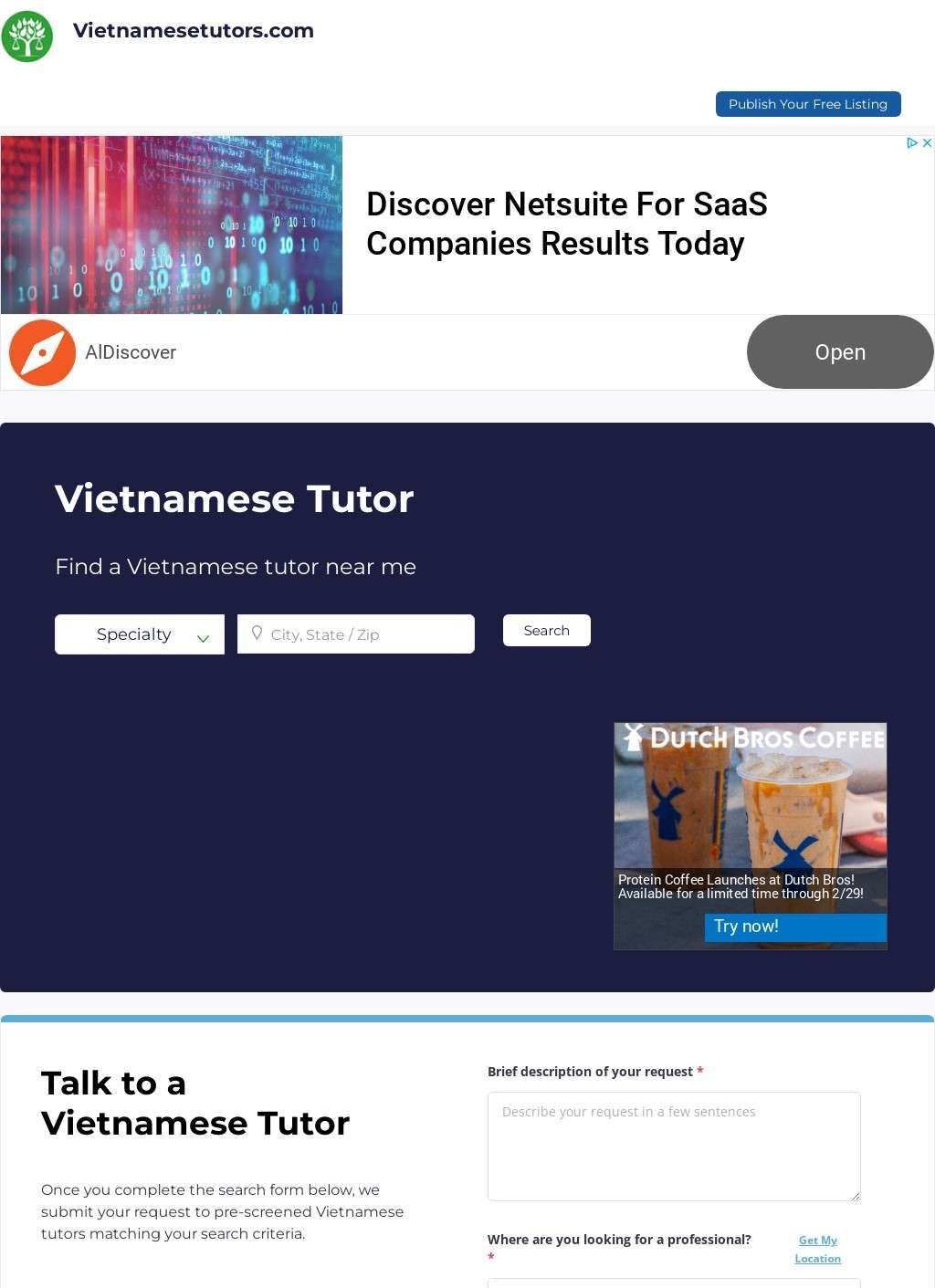
Vietnamese Tutors is a tutor-matching service that pairs students with Vietnamese-language instructors across a handful of US cities and a few spots abroad. New York and the Bay Area are named explicitly, and the platform extends its reach into Canada and Vietnam itself for anyone who needs a teacher closer to the source. The mechanism is simple: a visitor fills in a short location-based form, and Vietnamese Tutors takes that request and pairs it with pre-vetted instructors. Replies are promised within 24 hours to two business days, a concrete enough commitment that you can hold the service to it.
How the matching process works
What sits behind that form is broader than the name alone implies. The headline focus is Vietnamese language instruction, but Vietnamese Tutors also lists academic tutoring, STEM subjects, and test preparation, with both in-person and online formats available. A parent looking for a tutor to help a child through a maths slump falls inside the same net as someone trying to hold a conversation with relatives in Hanoi. That spread changes how to read the brand, because Vietnamese Tutors operates less as a niche language school and more as a general tutoring switchboard that happens to lead with Vietnamese.
Academic subjects and language instruction
Once a person registers, the experience opens into a dashboard. From there a user can manage inquiries, track referrals, and message tutors directly without routing through a third channel. Direct messaging is the part that tends to disappoint on competing platforms, since the gap between requesting help and actually talking to a teacher is where matching services lose people. Vietnamese Tutors keeps that conversation inside the account, and the referral tracking hints that word-of-mouth is part of how the system is meant to grow.
Dashboard features for managing tutors
The structure underneath is where things get more interesting, and a little more complicated. Vietnamese Tutors does not run on its own infrastructure. It is built on the Heritage Web platform, and the help documentation makes no attempt to hide that, since it lives at help.heritageweb.com. That points to a fleet of vertical sites sharing one engine, each aimed at a different subject or language, with Vietnamese Tutors carrying the Vietnamese banner. For a user that arrangement is mostly invisible and mostly harmless. The matching process works the same regardless of which parent company runs the pipes. Still, it is the sort of thing a careful person likes to know before handing over a request.
Built on Heritage Web infrastructure
One detail in the fine print deserves a real read and not a quick skim. The legal disclaimer states outright that the company may receive money or free products in exchange for reviews or endorsements of the services it lists. That is an honest admission, and honesty about a conflict is better than silence on the subject. It also means any praise a visitor sees on the Vietnamese Tutors site should be weighed with that arrangement in mind. A recommendation someone was paid to publish is not worthless, but it is not neutral either, and the disclaimer is candid enough to draw that line for you.
Paid endorsements in listings
Reaching a person is where Vietnamese Tutors comes up short. A contact page exists at the expected address, but following it lands you in Heritage Web FAQ content, not a way to reach someone tied to this service specifically. No phone number appears anywhere on the public pages, neither the home page nor the contact page. No street address is listed. No direct email is published, though the absence of a direct email is no real mark against the service, since plenty of legitimate operations route everything through a form to keep the spam out. The deeper problem is that even the form-and-FAQ path feels generic, routed back to the parent platform. Someone who wants a quick human answer before submitting a request will not find a clear door.
Contact options and outside reviews
Outside opinion is the other quiet area. A search for what independent reviewers say about Vietnamese Tutors turns up nothing on the usual platforms. No Google reviews, no Trustpilot or Yelp profile, no BBB file, nothing on the boards where users normally vent or praise. What surfaces instead are the bigger names in the same space, Wyzant, Preply, Superprof, and the site's own internal pages. So there is no independent verdict to draw on, good or bad. Newer or smaller verticals often go unrated for a long time, but the absence does leave a would-be user without the reassurance that a stack of real testimonials would provide.
Vietnamese Tutors has a clear and followable workflow. State where you are and what you need, get matched with a screened tutor, carry the conversation through a dashboard. The subject range is genuinely wide, covering far more than language alone, which may come as a surprise to anyone who arrives expecting a specialist language site and nothing more. The candor about paid endorsements counts as a point in the platform's favour, since plenty of operations bury that kind of disclosure or omit it entirely. Against that sit two real soft spots: a contact route that dead-ends in generic help content, and a complete absence of outside reviews to corroborate the experience.
The Heritage Web backing implies that the infrastructure behind Vietnamese Tutors is established rather than improvised, which is some comfort when the brand itself has no public track record to point to. Submitting a request commits a visitor to nothing, and the 24-hour to two-day response window means the quality of the match becomes clear fast. Vietnamese Tutors explains its process plainly, names the cities it serves, and lays its commercial incentives on the table. What it cannot offer is independent confirmation that the tutors it sends back are any good. The paid-endorsement admission is worth re-reading before forming a view on the internal testimonials, and the lack of any external ratings means there is no shortcut past that uncertainty. That question only gets answered once someone sends the form and sees who shows up.