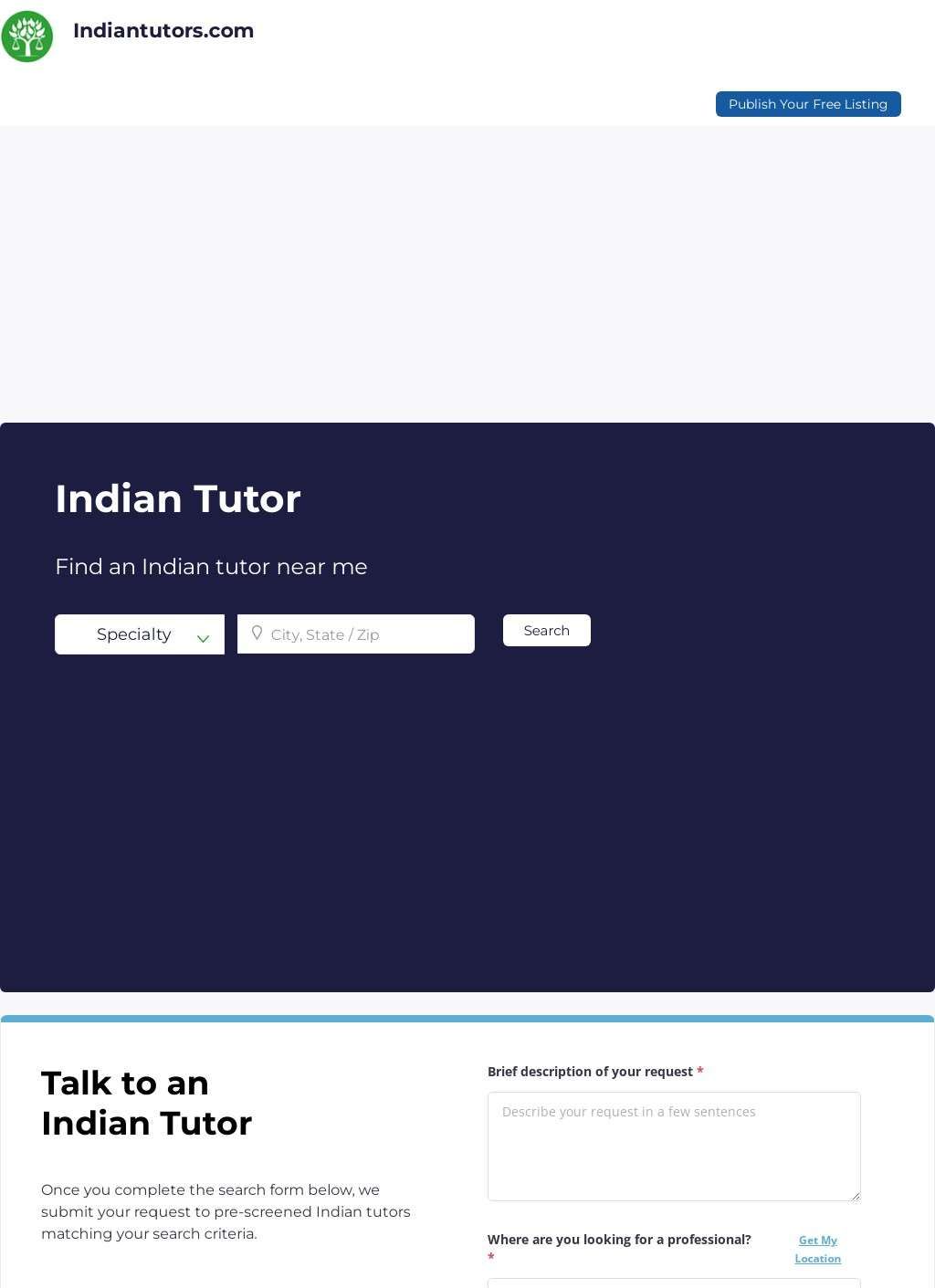
Does a family in Chicago or Toronto have a faster way to find a tutor who speaks the language at home and knows the math curriculum at school? That is the premise Indian Tutors sets out to address. The site is a matching service that links students with pre-screened Indian tutors, and the way it works is straightforward: a parent or student fills out a search form describing what they need, and the platform passes that request along to tutors who fit the profile. It does not employ the tutors directly. It sits in the middle, routing leads to people who can teach.
A referral service, not a classroom
What you are looking at is a referral layer, and it helps to understand that before judging anything else. Indian Tutors is not a classroom and not a payroll. It is the introduction, and after the introduction the relationship moves off-platform between the family and the tutor they pick. Whether that suits you depends entirely on how much hand-holding you want. People who like to vet a tutor themselves and arrange things privately will find that Indian Tutors fits that preference well. People who expect a managed service with billing, scheduling and dispute handling baked in should know that is not what this is.
Subjects and formats covered
Indian Tutors covers more ground than the name might suggest. Categories listed include academic tutoring, language tutoring, STEM tutoring, and test preparation, with both in-person and online formats. So a student could be looking for help with calculus, or wanting to prep for a standardized exam, or trying to keep up a heritage language, and each of those falls inside what the site says it handles. The split between in-person and online is a sensible one to make explicit, because the two experiences are genuinely different and a family usually knows which they want before they start searching.
Geographic reach across three countries
Geography is where the framing gets a little interesting. Despite the name, the service is not aimed only at India. Coverage spans more than twenty U.S. cities, with New York, Los Angeles and Chicago named among them, plus Canada and India itself. The target audience leans heavily toward the Indian diaspora in North America, families who want a tutor with shared cultural and linguistic footing, and that is a specific niche with real demand. The flip side is that a directory promising twenty-plus cities lives or dies on how many actual tutors are signed up in each one. The site cannot demonstrate that depth from the landing page alone, and a sparse roster in a given city would undercut the whole pitch. There is no way to confirm the bench strength without submitting a request and seeing who comes back.
Why language tutoring stands out
For language tutoring in particular, the cultural angle is the strongest part of the proposition. A tutor who shares a student's first language can teach a second subject more comfortably, and Indian Tutors is clearly built around that overlap. It gives Indian Tutors a sharper reason to exist than the test-prep or STEM categories do, since those compete against much larger, better-known platforms.
The mechanics deserve a clear-eyed look because they shape everything. The search form is the front door. A student enters criteria, the platform matches against tutors who qualify, and the request goes out to those tutors. This is lead generation, plainly stated, and the honesty of that framing is to the site's credit. Some directories blur the line and imply they directly supply or guarantee the tutor. Indian Tutors says it is a directory and not the employer, which sets accurate expectations even if it means the family carries more of the vetting load.
Platform infrastructure and extras
A few details point to the infrastructure behind Indian Tutors. The help center is hosted at help.heritageweb.com, which indicates the platform runs on HeritageWeb rather than a fully bespoke build. That is neither good nor bad on its own; plenty of solid niche directories run on shared platforms. It does mean the operation is lean, which fits the lead-routing model. Rounding out the extras are a newsletter and an affiliate program. The affiliate program is worth a small note: it means part of the site's growth strategy is paying others to refer traffic, which is common for lead-gen businesses but also a reminder that the incentive here is volume of inquiries, so a prospective user should weigh the matches they receive on their own merits.
One practical consequence of the routing model: the quality you experience comes down to the individual tutor who responds, not the platform. Indian Tutors can screen, but it cannot teach the lesson. A family should treat the first match as a starting point, ask for credentials and a trial session, and compare a couple of responses. The platform makes the introduction; everything after that rests on the tutor.
How to reach the company
On reaching the company, the picture is functional but not generous. A general contact page is linked from the footer, and through it you get a contact form and a support email, with a stated reply window of twenty-four hours. Committing to a response time is a reasonable move, since it puts someone on the hook for inbound questions. The gaps are visible too. There is no phone number and no physical address presented up front, and you have to click through to a secondary page to find any contact route at all. For a service asking families to entrust a child's education to a stranger it introduces, fuller contact details would build trust faster. A form and an email cover the basics, but only the basics.
Is there an independent track record?
The public record for Indian Tutors is nearly empty. A search for indiantutors.com specifically turned up no notable third-party reviews. The results that did surface, a Trustpilot page for tutorsindia.com with a handful of reviews, plus universitytutor.com and wyzant.com, are different companies entirely and say nothing about this one. An independent track record is simply absent. That does not mean the service is bad; low-profile directories often have no review footprint. It does mean a prospective user cannot lean on outside validation and has to judge through their own first contact.
So where does that leave a verdict? Indian Tutors has a clear and defensible reason to exist: the cultural and linguistic match it offers families in the Indian diaspora. It is also honest about being a referral service rather than a teacher, and that honesty counts for something. Against that sits a genuine absence of proof, no visible reviews, no phone or address up front, and no way to confirm how deep the tutor roster runs in the cities it lists. The concept is sound, and one inquiry is enough to test it, especially for language or culturally-matched tutoring. Families who want a managed, billed, scheduled service should look elsewhere; families happy to vet a tutor themselves have a reasonable starting point here, with the caveat that the proof has to be built one response at a time.