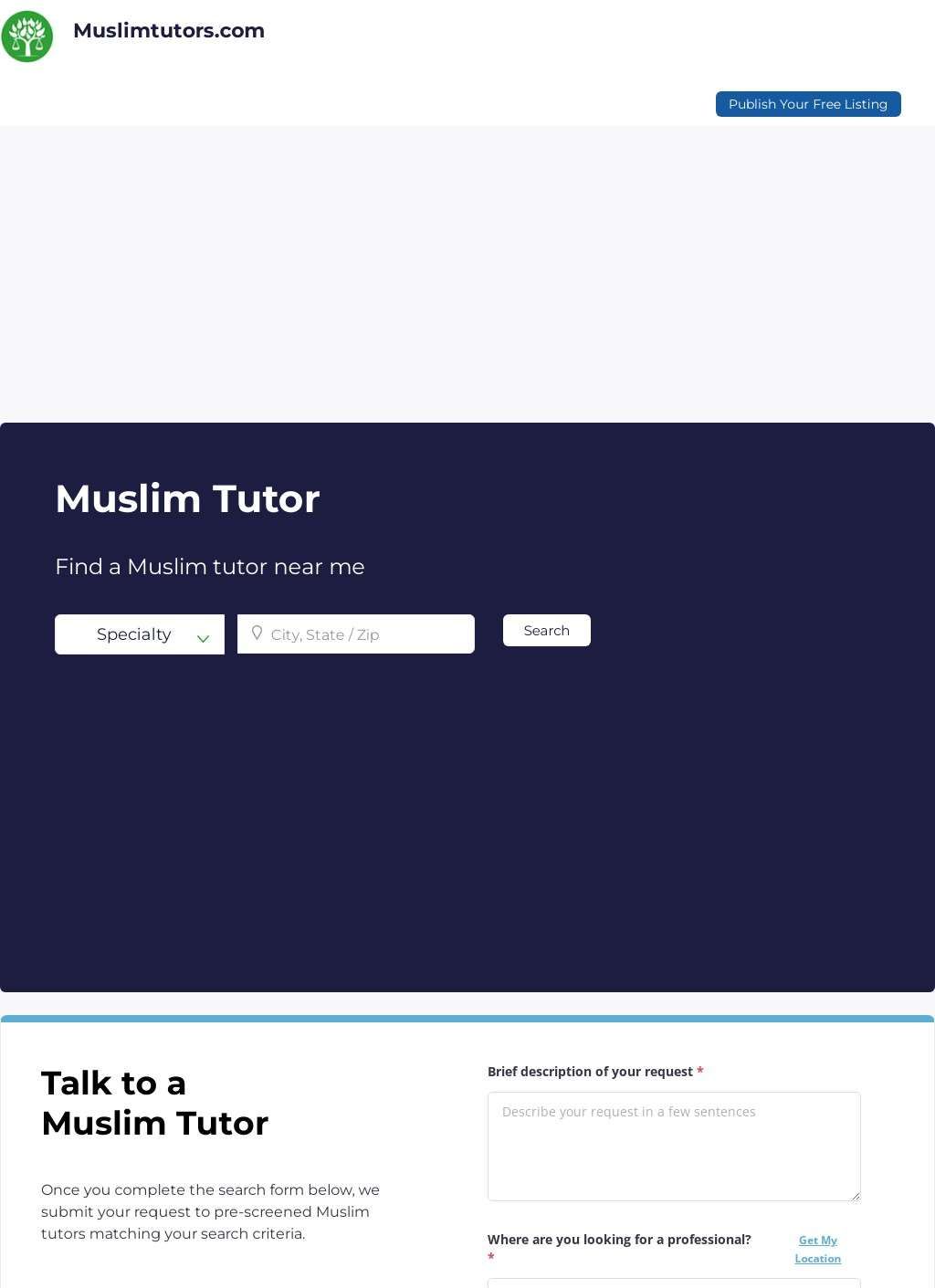
Muslim Tutors runs on a narrow premise, deliberately so: it pairs students with tutors who are Muslim, and it does this across the United States and Canada through a request-and-match system, not a public bookings calendar. A student fills in what they need, the request goes out to tutors who fit, and the site promises a reply within two business days. That two-day window is a concrete promise, because most matching platforms leave you guessing about timing entirely. Muslim Tutors states a number, and that number does more to set expectations than pages of soft reassurance ever would.
How the matching system works
What sits underneath is a directory of pre-screened tutors sorted two ways, by subject and by city. The subject side runs across academic help, language tutoring, STEM, test preparation, and a split between in-person and online sessions. The city side covers the obvious large metros: New York, Los Angeles, Chicago, Houston, Atlanta, and continues into other American cities plus Canadian coverage. A parent in Houston looking for in-person math, or a student anywhere wanting online language work, can filter down a couple of clicks and land on tutors who actually serve that area. The listings carry a verified label, which on a faith-specific matching site is the piece that counts most, since the entire reason someone arrives at Muslim Tutors is trust in who is being matched.
Subject and location filtering
The "verified" claim is the hinge the whole site swings on, and the page does not spell out in any depth what the screening actually involves. That is worth knowing before you read too much into the badge. Verification could mean an identity and credential check, or it could mean something lighter; the site does not resolve it. A student treating the label as a guarantee of teaching quality is reading more into it than is stated. As a sign that a human looked at the tutor before they went live, it is a meaningful step, one a faith-specific service has more reason to take seriously than a generic marketplace does. Muslim Tutors is selling curation, so the screening behind that badge is the product, even if the page keeps the mechanics to itself.
What the verified badge means
The request-forwarding model is the right call for a faith-matching service, because the value is in the curation, not in self-serve speed. You are not scrolling a thousand profiles and gambling. You describe the need and let the platform route it to people who fit both the subject and the location. The flip side is that you are handing over the first move and waiting on that two-day reply, so the experience depends entirely on the platform keeping its word. For someone who wants to book a session tonight, this is slower than a marketplace where you click and pay. For someone who wants the matching done thoughtfully, the trade reads as fair.
Request flow and response time
Browsing by city is the feature worth leaning on most. Tutoring is local even when it is online, and a directory that lets you start from your own metro and narrow by specialty cuts out a lot of noise. The subject categories are broad enough to cover the usual demand, school subjects, languages, the sciences, and the standardized tests that drive a lot of tutoring spending, without splintering into so many tags that the site feels padded.
Browsing by city as primary feature
Contact runs through a /contact page with a form, the standard setup for a matching platform that would sooner route inquiries than publish a switchboard. There is no phone number or street address on the homepage, which fits a service that operates online and connects people regionally. The form covers the need, and a missing phone line is not a real gap for a platform whose whole model runs through submitted requests.
Contact and support channels
One detail under the hood is worth flagging plainly. The help and support links do not stay on the site; they redirect to help.heritageweb.com, and the backend runs through heritageweb.com. That tells you Muslim Tutors is part of a larger directory network's infrastructure rather than a fully standalone build. This is common and not a problem in itself, but it does mean the support experience is shared with a wider platform, so the help you receive may feel more generic than the focused, faith-specific framing of the front end warrants. Anyone expecting close, hands-on support should set expectations accordingly.
Platform infrastructure and newsletter
A monthly newsletter signup is also offered, a low-stakes way to stay in touch if you are not ready to submit a request yet. It suits a service people may return to across a school year instead of using once. A student who needs algebra help in the fall and language practice in the spring is exactly the repeat user Muslim Tutors seems built around, and keeping a thread open by email costs nothing. The newsletter is a quiet acknowledgment that Muslim Tutors views tutoring as an ongoing relationship, not a one-off transaction.
Backend shared with heritage web network
A search for Muslim Tutors turned up no notable third-party reviews. What did surface were ratings and write-ups for other platforms in the same space, larger general tutoring marketplaces and a couple of competing faith-specific sites, none of which tells you anything about this one. There is no independent rating to lean on either way, and that is worth naming honestly rather than dressing up. A prospective user is judging this on the site itself and on whatever the matched tutor turns out to be, not on a wall of stars.
No independent reviews available
Muslim Tutors is doing one specific job for one specific audience, and the structure of the site reflects that focus clearly. The subject-and-city filtering is genuinely useful, the two-business-day response promise gives the request flow a spine, and the faith-matching angle is the clear reason it exists at all. The softer spots are the unexplained depth of "verified," the support handed off to a shared network backend, and the absence of any third-party track record. None of those sink it; they are the things to walk in knowing. Whether Muslim Tutors keeps the promises its front page makes is something only the actual request flow can confirm, and the two-day turnaround is where that test starts.