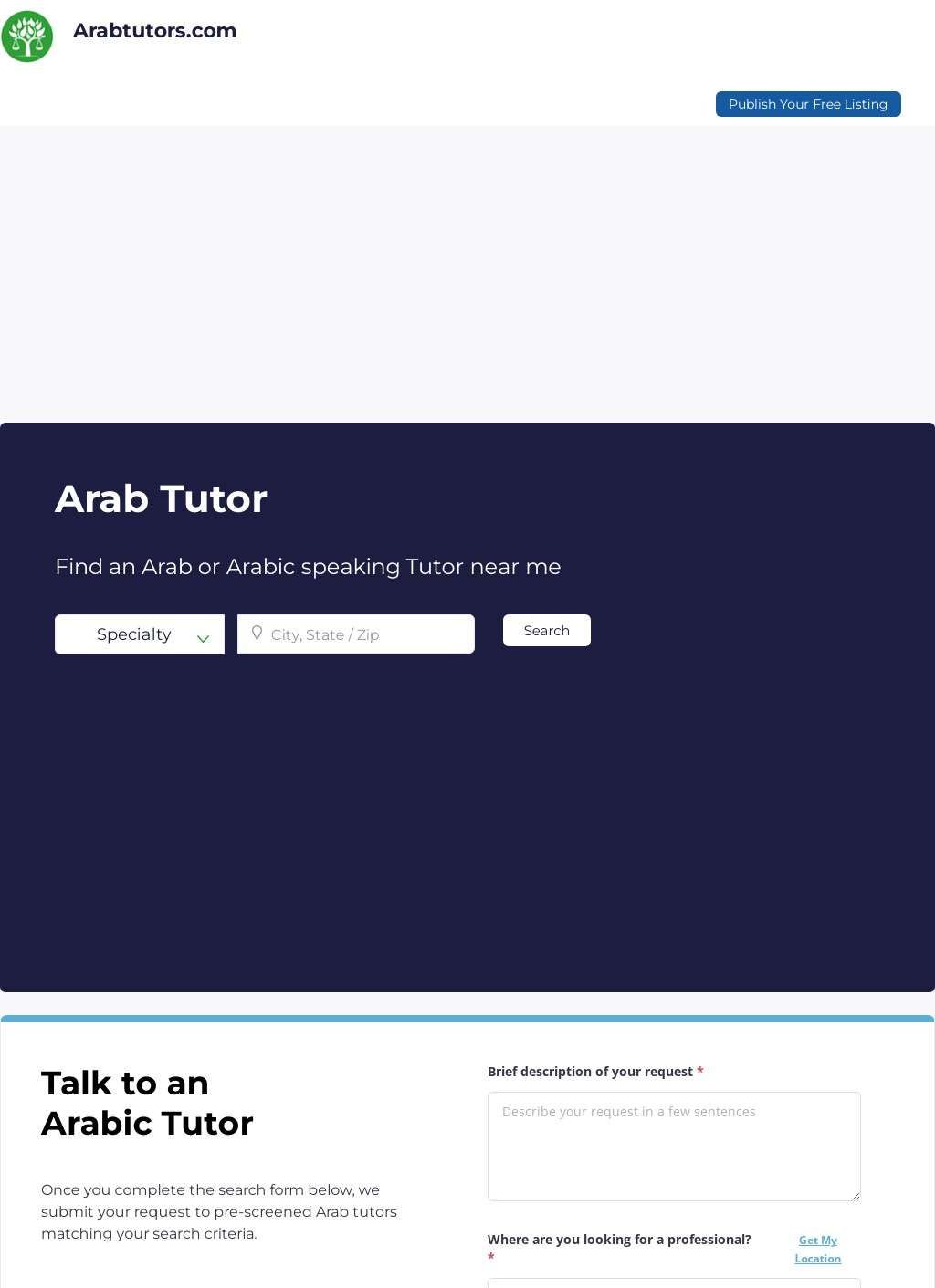
Before a tutor ever appears on Arab Tutors, the site says it checks judiciary records in that tutor's state of licensure for grievances and formal disciplinary actions. That is a heavier vetting claim than the major tutor-matching platforms bother to make, and it sets the tone for what the site is trying to be: a curated middle layer between students and Arab or Arabic-speaking tutors, not an open free-for-all where anyone can post a profile and start collecting students.
How the platform vets tutors
The core function is matchmaking. Arab Tutors connects students with tutors who are Arab or speak Arabic, primarily in the United States but also with listings reaching into Canada, France, and Germany. The subject range is broad. You will find academic tutoring, Arabic language instruction, STEM help, and test preparation, delivered either online or in person depending on the tutor and the student's location. The geographic spread is organized down to the state level, with Florida among the states given its own sub-pages, so a parent in a particular area can narrow the field instead of scrolling through tutors three time zones away.
Judiciary records check for disciplinary actions
There is a second side to the operation that is worth being clear-eyed about. Arab Tutors is also a paid listing platform for the tutors themselves. A tutor can publish a free listing or pay for a more prominent one, on a monthly or annual plan, with a 20 percent discount for paying yearly. The site states that every listing, free or paid, is reviewed by its team before it goes live. So the money flows in two directions that a student should keep in mind: tutors pay to be seen, and the site filters who gets shown. Whether that filtering stays meaningful once revenue is on the table is the honest tension at the center of any platform like this one.
Matching students with Arab tutors
To its credit, the site does not hide the commercial layer. A legal disclaimer states plainly that Arab Tutors may receive monetary compensation or free products in exchange for reviews or endorsements of companies, products, or services listed. Putting that in writing rather than leaving a visitor to discover it later tells you how to read any glowing language on the site. Treat endorsements as potentially paid, and treat the independent vetting claim, the judiciary-records check, as the part that deserves the most scrutiny.
Subject areas and geographic coverage
That vetting claim is the most useful thing Arab Tutors offers if it proves out in practice. Checking a tutor's licensure state for disciplinary actions is a step a careful parent might not know how to take themselves, and a platform that does it across many tutors is offering genuine labor rather than a bare search box. The catch is that a student has no easy way to confirm the check happened for any specific tutor. You are trusting the process described on the About page. For a service handling something as sensitive as putting an adult in front of a child or a young student, that trust is load-bearing, and it is fair to want more visible proof than a paragraph of policy.
Paid listings and the commercial model
The Arabic-language angle gives the site a real reason to exist apart from the big general platforms. A family wanting a tutor who speaks the language at home, or a student learning Quranic or Modern Standard Arabic from a native speaker, has a narrower need than "find me a math tutor," and a specialized listing serves that better than a generalist marketplace where Arabic speakers are scattered among thousands of unrelated profiles.
Contact options and response times
On reaching the company, the picture is sparse. Contact runs through a form linked from the footer, which asks for a name, phone number, email, location, and a description of the tutoring need. The site says it responds within two business days. There is no phone number published anywhere, no street address, and no public email address shown across the pages a visitor lands on. The absence of a published email is no real strike, since a form does the same job and spares the inbox from spam. The missing phone number and address are more noticeable.
No published phone number or address
For a platform that positions itself on careful vetting and trust, having no direct line and no physical presence to point to leaves a visitor leaning entirely on a web form and a two-day promise. A response window of two business days is reasonable for a small operation, though it does mean a parent in a hurry to arrange tutoring before an exam should not expect an instant reply.
Comparing Arab Tutors to larger platforms
On outside opinion, there is little to report, and I would rather say that straight than dress it up. A search for arabtutors.com did not surface independent reviews of the platform itself. What came back instead were the large competitors, Wyzant, Preply, Superprof, Varsity Tutors, which tells you the niche is crowded but says nothing about how Arab Tutors performs once you actually use it. There are no third-party ratings to lean on here, positive or negative. A prospective user is going in without the cushion of other people's experiences, so the early conversations with a chosen tutor, and the questions you ask about credentials, count for more than they would on a site with a long public track record.
Independent reviews and user feedback
Putting it together, Arab Tutors reads as an earnest, specialized directory with a clear purpose and an unusually specific vetting promise, weighed against limited contact transparency and no independent reputation to verify any of it. The structure is sensible, the geographic and subject coverage extends across four countries and down to the state level, and the honesty of the disclaimer counts in its favor. The gaps are the kind a careful student works around by doing some of their own verification when they reach out to a tutor.
Against a giant like Preply, the trade is fairly stark. Preply offers a huge pool, visible reviews on individual tutors, trial lessons, and a refund structure backed by a large company, but its Arabic-speaking tutors sit inside a sea of every other subject and language. Arab Tutors gives up the volume and the public feedback in exchange for focus: every listing is meant to be relevant to someone seeking an Arab or Arabic-speaking tutor, and someone has supposedly checked each one for disciplinary red flags. If that focus and that vetting are what you value most, this site makes a credible case for itself. If you want the reassurance of seeing dozens of past students vouch for a tutor before you book, Preply still holds the stronger hand, and Arab Tutors has real ground to make up.