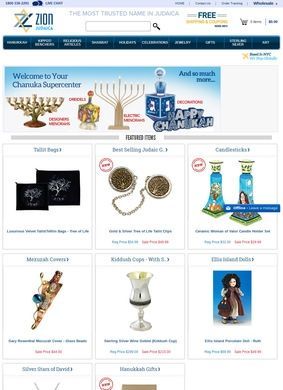
Buy from Zion Judaica through Amazon and the seller rating sits at 4.9 out of 5 across 520 pieces of feedback. Pull up Sitejabber and the same operation averages 1.6 stars. Same store, opposite verdicts, and which one a shopper trusts depends mostly on where they happen to be standing when they read it. That gap is the single most important thing to understand before ordering a menorah or a Kiddush cup here, and it is the reason this listing rewards a slow, careful look instead of a quick glance at one headline number.
Set the ratings aside for a moment, though, because the merchandise itself is simple to describe and genuinely deep. Zion Judaica is a Jewish religious-goods store, and it carries close to the full ceremonial range a well-stocked synagogue gift shop would keep on hand. The audience is plain from the catalog: Jewish individuals and families shopping for religious observance, for life-cycle celebrations, and for gifts tied to both.
A full-line Judaica shop
The Zion Judaica catalog is broad enough to cover a household's religious life, from the everyday Sabbath table to the once-a-year holiday. That breadth is the real selling point. A shopper furnishing a home for observance can find garments, ceremonial objects, holiday goods, and gifts through Zion Judaica in a single order, instead of assembling one purchase across several narrow specialists who each stock only a slice of what a family needs.
The catalog also tracks the shape of an actual Jewish year instead of a generic gift-shop shelf. A family setting up a first apartment can order the everyday ritual objects at the same time as the holiday pieces they will only need once the calendar turns, and the personalization and shipping options apply across all of it instead of being bolted onto one product line. That consistency is easy to overlook next to the review numbers, but it is what makes Zion Judaica function as one stop instead of three.
Kippot, garments, and the ceremonial core
Head coverings come in a real spread of materials: suede, satin, silk, leather, and knitted kippot. That range of materials is more than a vanity choice, because it lets a family order matched sets in a particular fabric for a bar mitzvah or a wedding, where every kippah in the room is meant to look the same. Around the head coverings sit the religious garments, tallit prayer shawls, tefilin bags, and tzitzit, together with the ceremonial objects that anchor a Jewish home.
Kiddush cups, challah covers, candlesticks, and havdallah sets fill out that devotional core, the pieces an observant household reaches for week in and week out. This is the part of the store built for use, not display, and it is where the catalog feels most complete, since these are the objects a family expects to replace or upgrade over the years as the old ones wear or a household grows.
Holiday goods, jewelry, and gifts
The seasonal shelves follow the calendar. Hanukkah menorahs, Passover seder plates and accessories, and High Holiday shofars each get their own section, which quietly turns the store into a return destination as the year cycles through its festivals. A household that buys a menorah in winter is the same one shopping for a seder plate in spring, and the site is arranged to catch that repeat business. Beyond ritual, Zion Judaica carries Jewish-themed jewelry, pendants, bracelets, rings, and necklaces, and it keeps dedicated sterling silver collections for buyers who want the heavier, keepsake versions of these objects.
A wider gifts section rounds things out with books, art, home decor, toys, and tableware, which pushes the shop past pure ritual supply and into everyday and life-cycle gifting, the bar mitzvah present or the housewarming gift as much as the ritual item.
Shipping, personalization, and the practical tools
On the service side, Zion Judaica ships worldwide, which counts for a great deal in a category where the nearest physical Judaica shop can be a long drive away, or nonexistent, for buyers outside a large Jewish community. Custom personalization is offered, kippot being the obvious case, the sort of thing families want printed for a simcha with a name and a date on the inside.
Order tracking and a wishlist feature fill in the rest of the toolkit. These are ordinary online-store conveniences, and their presence is expected rather than remarkable, but the personalization is the piece a customer planning an event will weigh most heavily. A printed name on a hundred kippot is not something anyone can quietly fix after the fact, so it puts real pressure on the store getting the order right the first time.
The review split that should give a buyer pause
Here is where the picture turns genuinely mixed, and it deserves a slow read rather than a snap judgment. The direct customer-review sites treat Zion Judaica roughly. Sitejabber shows seven reviews averaging 1.6 stars, with specific complaints that include a delayed Kiddush cup order, and a TenereTeam aggregation page echoes the same theme, citing poor customer service, unresponsive emails, and long hold times. BrokeScholar shows a gentler 3.0 out of 5, though that rests on only two reviews. None of these carry huge sample sizes, but they point in a consistent direction.
The marketplace numbers tell the opposite story. A Cherry Picks analysis of the Amazon seller puts the average at 4.9 out of 5 from 520 feedbacks, a far larger pool than any of the complaint sites, and a Wayfair product listing shows 4.9 out of 5, though from only seven reviews. A ReviewMeta brand analysis references 2,361 reviews across twenty products in the Home and Kitchen and Candles categories, but that figure is a fake-review-risk assessment, not a plain star rating, so it should not be mistaken for a score of any kind.
A BBB profile exists for Zion Judaica Ltd, listing two locations; it is not BBB-accredited and shows no numeric rating in the snippet that surfaced, so it neither helps nor hurts the case, it just confirms the business exists and is registered.
So which Zion Judaica is the real one? The most plausible reading is that the marketplace ratings reward the product, the menorah shows up and it is nice, while the direct-site complaints cluster around what happens when an order goes sideways: a shipment that runs late, an email that never gets a reply. A buyer who orders a stock item and receives it on schedule may never brush up against the problem those low scores describe.
A buyer who hits a snag, going by the complaints, struggles to get a person on the phone. The volume of high marketplace feedback suggests most transactions land fine; the shape of the negative reviews suggests the exceptions are handled badly, and it is the exceptions, not the averages, that leave people writing one-star warnings for the next buyer to find.
Contact details, at least, are easy to find and concrete. Zion Judaica publishes two phone numbers, a Staten Island storefront address, posted store hours with a short Friday window that closes well before Shabbat, and a contact page. For a small religious retailer, that openness is a genuine mark in its favor, and it puts to rest any suspicion that the business is hard to pin down or hiding behind a web form.
The harder question is not whether a customer can reach Zion Judaica; it is what follows once they do, and no published phone number answers that on its own.
That doubt is the part no outsider can settle from the listing alone. The range is wide, the cost of entry is what any Judaica shop charges, and the product plainly satisfies the marketplace crowd. What no rating resolves is whether Zion Judaica gets a personalized order out the door on time, or whether a problem with that order is answered quickly or left ringing on hold while a deadline closes in.
A purchase pinned to a fixed point in the Jewish calendar, a wedding, a bar mitzvah, the first night of Hanukkah, leaves no room for that answer to show up late, and that is what makes the question worth sitting with instead of brushing aside.