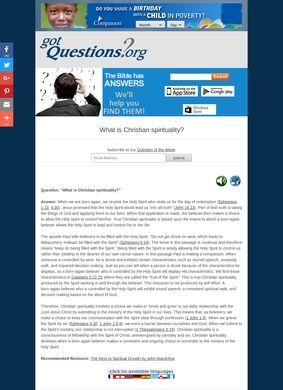
One article. One question. GotQuestions.org puts the Christianity Spirituality piece to work immediately, defining Christian spirituality as a life directed by the Holy Spirit and then spending its length on why that definition stands. Christianity Spirituality, as the entry is titled in this directory listing, is housed on a site known for answering exactly this kind of doctrinal question across thousands of topics. The argument draws on Ephesians, John, and Galatians, walking through the idea of being filled with the Spirit and then laying out Galatians 5:22-23 explicitly so the reader can check the claim against the source. A closing section covers confession and obedience as the practical side of keeping that fellowship intact, and a "For Further Study" list points toward books for anyone who wants more than an article can carry.
How the article defines Christian spirituality
What makes it useful is that it stays inside its brief. Christianity Spirituality picks a defined theological question and holds to it, showing the scripture behind each point rather than asserting conclusions. Someone new to the topic walks away with a definition, a biblical grounding, and a concrete sense of what daily practice looks like. Someone already familiar gets a clean summary they can check against the verses. Christianity Spirituality does not try to settle every adjacent debate about sanctification or the charismatic gifts, and that restraint keeps it readable instead of sprawling.
Organized by topic and by scripture
This article is one of thousands. GotQuestions.org organizes material by topic and by book of the Bible, so the Christianity Spirituality piece sits inside a network of related answers: spiritual disciplines, freedom in Christ, the difference between religion and spirituality. The cross-links at the foot of the page lead to genuinely complementary articles rather than tangentially related filler, so a question about spirituality tends to open naturally onto the next thing a curious reader would ask. That branching structure is the main reason a single visit to Christianity Spirituality rarely stays a single visit.
Features that reduce reading friction
The reading experience has been thought through more carefully than the average reference site. Readers can switch between light and dark mode, adjust font size, and pick the Bible translation they want the quoted verses to display in. That last feature is consequential for a site built around scripture: someone who reads the ESV and someone who reads the NIV can each see the text in their own version without leaving the page. Social sharing is built in, and a weekly email subscription delivers a curated question to subscribers who want steady material without having to remember to search for it. None of it is flashy, which is the point. These features reduce friction for the person who came to read, and Christianity Spirituality benefits from all of them.
Two audiences without compromise
The article handles two audiences at once without watering itself down for either. Practicing Christians who want a scripturally sourced answer to a doctrinal question get exactly that. Curious readers who are unconvinced get a clear explanation they can weigh on its own terms, with the verses laid out so they can judge whether the interpretation holds. Christianity Spirituality treats both as capable of following an argument, and the writing does not condescend in either direction.
Tone and register throughout the piece
The tone stays even throughout. The article does not push, plead, or dress its subject up. It states what Christian spirituality means within the writers' theological framework, shows where that comes from in the text, and leaves the reader to take it or leave it. For a topic that often attracts either vagueness or hard-sell certainty, that measured register is worth something. The "filled with the Spirit" section reads like an honest attempt to explain instead of persuade, and the practical notes on confession and obedience anchor an abstract idea in something concrete.
What this reference page does not offer
Christianity Spirituality is a reference page, not a community, a course, or a study program. It answers a question and points to further reading, and that is the whole of what it sets out to do. Readers wanting structured teaching, discussion, or a curriculum will need to look beyond a single article, though the surrounding library partly closes that gap. The depth here is encyclopedic: solid, sourced, and finite. Anyone expecting a long-form treatise will find the treatment more compact than that, and that is a fair description, not a criticism.
From a conservative evangelical perspective
The interpretive stance is also fixed. GotQuestions.org writes from a conservative evangelical Protestant position, and the article reflects that lens throughout. This is not hidden, and for the audience the site is built for it is a feature: readers know which theological tradition the answers come from. A Catholic, Orthodox, or mainline Protestant reader will recognize that the framing differs from their own. A reader looking for a survey of how different traditions define spirituality will not find that comparison in Christianity Spirituality. Christianity Spirituality is honest about being one tradition's answer, which is more useful than a false neutrality would be.
A search for GotQuestions.org returns broadly positive commentary across Christian forums and apologetics discussion boards, though no consolidated review count from a single platform stands out. The site has been running long enough to accumulate a visible footprint, and the pattern of citations in those discussions is consistent: readers treat it as a reliable first stop for doctrinal definitions, not as the final word on contested theological questions. That matches what Christianity Spirituality delivers on the page.
Set against what it promises, the page delivers. It said it would answer what Christian spirituality is, and it does, with the scriptural reasoning shown openly. The translation picker, the customization options, and the weekly email turn a static article into something a reader can return to and build on. Christianity Spirituality represents a reference site doing what it has always done across thousands of topics: pick a question, answer it carefully, and point somewhere useful next.