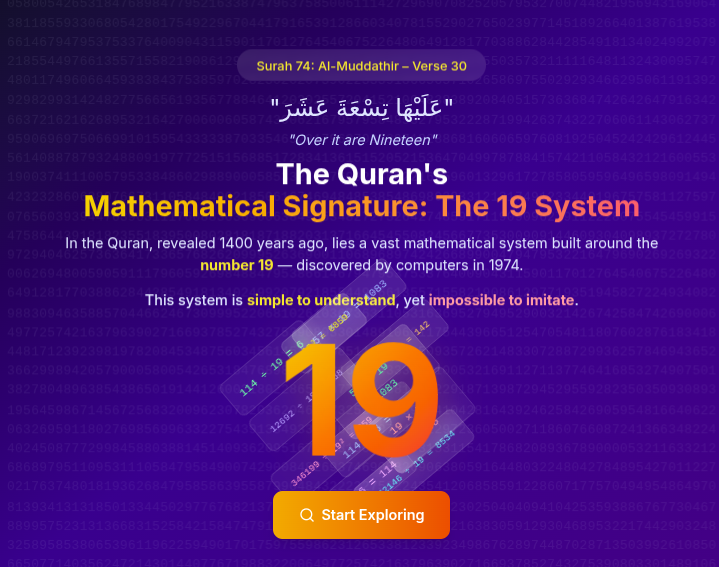
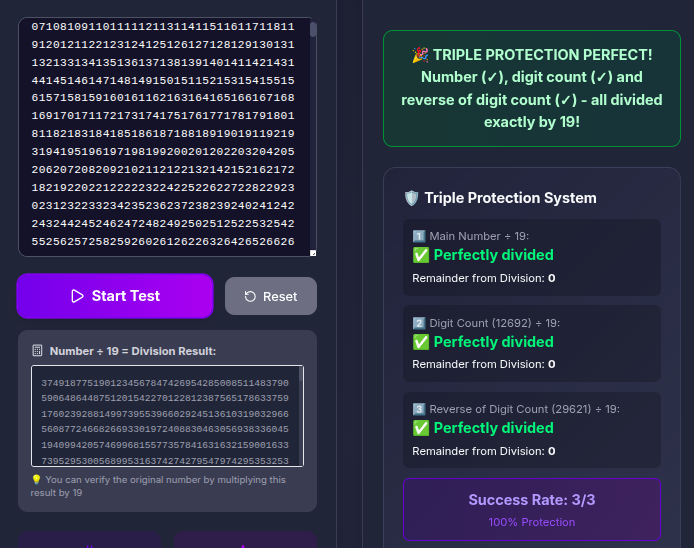
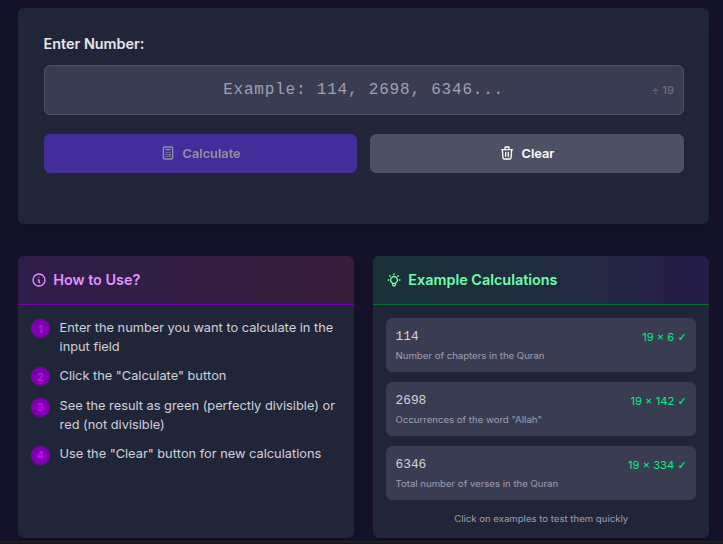
Type a very large number into the "19 Calculator" on 19code.org and it reports back, using BigInt arithmetic, whether that value divides cleanly by nineteen. That one function anchors nearly everything else on the page. The site argues that the number 19 runs like a thread through the Quran, from its 114 suras down to the counting of individual letters, and it treats divisibility by nineteen as the signature of a text it holds to be divinely authored.
The claim built on the number 19
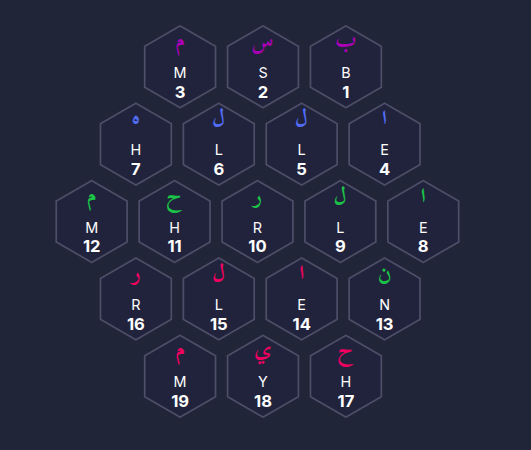
The core material on 19code.org is a set of essays and structured walkthroughs rather than a manifesto. A "Why 19?" section lays out the premise. From there the reader moves into an analysis of the Basmalah, the opening formula the site counts as nineteen letters, and then into what it calls the Quranic Initials System, the detached letters that head certain chapters. There is a breakdown of sura and verse structure spanning all 114 chapters and 6346 verses, plus a separate treatment of the numbers that appear inside the text itself.
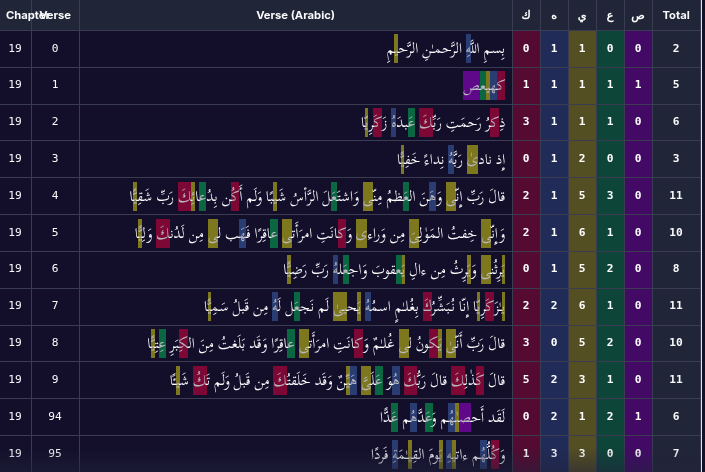
The method is arithmetic, not devotional. Counts are concatenated, summed, and tested for divisibility by nineteen, and each clean result is presented as one more data point in the same column. The writing stays fairly readable for a topic this technical, and 19code.org resists the temptation to drown the reader in exclamation marks, which gives it a calmer tone than a lot of the material staking out the same ground.
Whether any of that proves what it sets out to prove is the question the whole project rests on, and to its credit 19code.org does not hide the stakes. It asks visitors to arrive at their own verdict through testing. The trouble is baked into the premise: an argument for divine authorship built on numerical patterns only stands if the underlying counts are both accurate and genuinely non-arbitrary, and a skeptical reader will notice how much freedom there is in deciding what to count and how to combine it.
Tools that ask you to check the math
What separates 19code.org from a plain apologetics essay is the row of interactive utilities running down the offering. These are not decorative screenshots of results. They are meant to be operated, and the whole rhetorical posture of the site depends on that.
The design choice is a smart one for a contested topic. Handing someone the machinery to reproduce a claim is more persuasive than asserting the claim, and 19code.org clearly understands this. A visitor who wants to poke holes can do so directly on the page instead of taking a screenshot on faith, and that willingness to be tested is unusual enough to note.
There is a resource library and an FAQ sitting alongside the calculators as well, so a newcomer who lands on 19code.org without any background can work from the introductory framing toward the harder claims at a reasonable pace. The learning curve is managed better than the subject matter would suggest.
The letter counting tool and the 19 calculator
The Letter Counting Tool lets a visitor tally letters across a passage without doing it by hand, which is where most people testing this kind of assertion would give up or make an error.
Paired with it, the 19 Calculator handles the divisibility check on numbers far too long for a pocket calculator, since concatenating verse and letter counts quickly produces figures with dozens of digits. The associated GitHub repository, 19code-org, holds the JavaScript behind that calculator, so the arithmetic is at least inspectable by anyone who reads code. That openness is the strongest structural thing about 19code.org: the sums are not hidden inside a black box.
QIVS, the Fatiha test and the preservation checks
Beyond the two counters, the site bundles several named diagnostics. QIVS, the Quran Integrity Verification System, and a Quran Preservation Test both frame the number pattern as a way to detect whether the text has been altered. A Fatiha Test isolates the opening chapter for the same treatment. There is also an Inheritance Calculator, which steps slightly outside the numerology into the practical arithmetic of Quranic inheritance shares, a genuinely useful utility that could stand on its own regardless of what a reader thinks of the number theory around it.
Grouped together, these give 19code.org more depth than the single-idea sites that usually circle this subject. The naming does a lot of persuasive work, though. Calling something a "verification system" implies a settled standard of verification, and none of these tools can establish that the pattern they measure is meaningful or a product of how the counting was set up. A calculator confirms that a number is divisible by nineteen.
It says nothing about whether that divisibility was the point of the text or an artifact of the reader's arithmetic choices, and 19code.org tends to blur that distinction at exactly the moments it matters most.
Who stands behind the claims
19code.org describes itself as non-commercial and open source, and nothing on the page contradicts that. There is no shop, no donation wall, no course to buy. Alongside the GitHub repository, the effort has a footprint on LinkedIn and an Academia.edu profile tied to a researcher working on mathematical patterns in religious texts, which is more of a paper trail than a lot of the sites in this corner of religious argument bother to leave.
The transparency stops at the front door, however. Contact on 19code.org amounts to a single generic "Contact" link tucked in the footer, with no phone number, no address, and no named person surfaced on the homepage. For a project whose entire pitch is independent verification, the absence of an easy way to reach whoever maintains it sits awkwardly. No substantial third-party reviews or ratings turned up for 19code.org either. Searches mostly collide with the unrelated coding-education site Code.org, which shares nothing with this project beyond a similar-looking name.
The Rashad Khalifa lineage
The one biography 19code.org does feature is of Dr. Rashad Khalifa, and that is the detail a careful reader should weigh most heavily. The entire "code 19" thesis traces back to Khalifa, an Egyptian-American biochemist whose numerical readings of the Quran led him to conclusions that mainstream Islamic scholarship overwhelmingly rejected, and whose later claims about himself made him a deeply divisive figure. 19code.org presents his work as a foundation to build on.
That inheritance is the fault line under all the tidy arithmetic. A well-built set of calculators and an open codebase can show that certain numbers happen to be divisible by nineteen, but they cannot settle whether that fact supports the theological conclusion 19code.org draws from it, or whether the reader is looking at a genuine pattern or at a framework flexible enough to find one anywhere.
The site keeps insisting the numbers speak for themselves, and yet the moment you follow the sourcing back to a single contested figure with no outside scholarly endorsement in sight, the confident math starts to feel like the easy part of a case whose hardest claim goes untested.