Seventy-six beds, filled nightly. That is the count the Men's Mission keeps for men who are homeless or close to it, and it is the most concrete thing on the Mission Services of London site, more telling than any statement of purpose. A bed for the night is the whole point of an emergency shelter, and putting the exact number in front of a visitor says the organization is comfortable being measured against it.
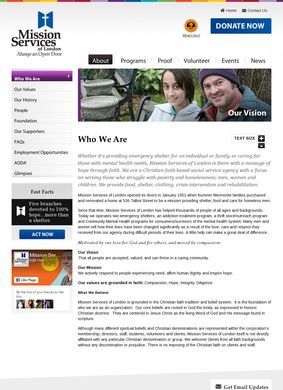
Mission Services of London is a Christian charitable organization in London, Ontario, working with people facing homelessness, mental health challenges, and addiction. Its stated mission is to "actively respond to people experiencing need, affirm human dignity and inspire hope," and the faith grounding is not tucked away in a footer. It runs through how the programs are framed and named.
Who Mission Services of London serves is spelled out plainly: men at risk of or living without shelter, families whose housing has become unstable, and individuals struggling with mental health or addiction. Three physical facilities carry most of that work, and each one is built for a different kind of crisis.
The three facilities: Men's Mission, Rotholme and Quintin Warner House
The Men's Mission is the emergency shelter for single men, those 76 beds a night. Rotholme Family Shelter handles the harder-to-place cases, families who need emergency housing, and the site cites its PHAF program diverting 44 families from the shelter system altogether. Quintin Warner House is the third piece, an addiction treatment facility for men, which pushes Mission Services of London past pure shelter work and into recovery.
Those three names do a lot of explaining on their own. A single man in crisis, a family about to lose their housing, and a man trying to get clean are three genuinely different problems, and Mission Services of London runs a distinct building for each instead of pooling everyone under one roof. That specialization is a real strength, and it is the sort of structure that takes years and steady funding to build.
Around the shelters, Mission Services of London runs a set of support programs, and this is where the organization stretches past beds and meals. Shelter Diversion, Mental Health Supports, Addiction Treatment Services, Outreach, and Spiritual Care are all listed as distinct services. Outreach means meeting people who are not walking through the front door on their own. Mental Health Supports and Addiction Treatment Services acknowledge that homelessness is rarely a simple matter of a missing roof, and Spiritual Care is the piece that flows most directly from the Christian mission at the center of the whole operation.
Whether that faith element is welcome or off-putting will depend on the person walking in, and the site does not pretend the two can be fully separated.
Then there is the Mission Store, a donation-based thrift shop with an Emergency Voucher Program attached, so someone who has just lost everything can be handed clothing and household basics without a bill. It doubles as a revenue source for Mission Services of London and a service for the people it exists to help, which is a tidy piece of design. A charity that can turn donated goods into both cash flow and direct relief has solved a problem many smaller nonprofits never work out.
Shelter diversion in the numbers
The 44-family figure from the PHAF diversion program is the sort of claim worth pausing on. Diversion means keeping a family out of the shelter system entirely, through help with rent, mediation, or a route back to a support network, and it is both cheaper and kinder than a shelter stay.
If Mission Services of London genuinely moved 44 families off that path, that is meaningful work that never shows up as a filled bed, and it says the organization is trying to prevent homelessness instead of only housing families after the fact. Prevention is harder to photograph than a full shelter, and it tends to get less credit from the public even when it saves both money and misery.
The number is stated on the site, and it is exactly the kind of outcome a careful donor should ask the charity to stand behind with detail: how it counts a diversion, how long those families stayed housed afterward, and what happened to the ones the program could not reach. Those follow-up questions are where a diversion claim either holds up or thins out.
Ways to give and how it is judged
The giving options are more developed than a single donate button. Mission Services of London lists direct donations, monthly giving, item donations, gift planning, and securities donations, which is the range you find at organizations used to handling estate gifts and larger commitments, well beyond loose cash in a Christmas kettle. Its Charitable Registration Number, 11930 2578 RR0001, is published on the site, so the tax-receipt side is legitimate and checkable against the Canada Revenue Agency register. That registration number is a small detail that quietly does a lot of trust-building work for any Canadian charity.
Reaching Mission Services of London is easy. A street address on York Street, a phone number, and an email are all shown directly, which is what a local donor or a family in need requires before they will pick up the phone or walk through the door. That level of openness would be unremarkable for an ordinary business directory listing, but for a charity that depends on both community donations and self-referrals from people in trouble, it is close to essential, and it is here without any hunting.
A person in crisis rarely has the patience to dig through a website, and putting the phone number and address up front removes one small barrier at the worst possible moment in someone's week.
Ratings from staff and watchdogs
The outside picture is sparser than the program list. Charity Intelligence Canada, the watchdog many Canadian donors trust for exactly this purpose, has a published rating and report on the programs and spending at Mission Services of London, though the specific grade did not surface in what I could pull up, which is frustrating because that grade is precisely what a giver comparing charities wants to read.
Glassdoor puts employee sentiment at 3.7 out of five across 18 reviews, with 60 percent of staff saying they would recommend working there, and sub-scores of 3.4 for work-life balance, 3.8 for culture and values, and 3.4 for career opportunities. Indeed hosts more employee reviews without an aggregate score, and Rehab.ca lists Quintin Warner House with a review page but no number attached to it.
No Google, Trustpilot, Yelp, or Better Business Bureau donor rating turned up at all. For a charity, that gap is less damning than it would be for a restaurant, since donors tend to judge on financial transparency more than star counts, but it does mean the public feedback comes almost entirely from current and former staff. Their 3.7 out of five and 60-percent recommend rate are respectable without being glowing, and a 3.4 on career opportunities hints at the kind of stretched, underpaid conditions that shelter and addiction work so often run on.
That is context, not a verdict, and staff frustration with pay and advancement is common across the whole nonprofit sector, not unique to this charity.
So the offering is clear and the structure is sound: three specialized facilities, a working thrift store with an emergency voucher, a diversion program with a real number behind it, published charitable registration, and contact details anyone can find in seconds. What stays unresolved is whether the money is spent as well as the mission reads.
The one source built to answer that, Charity Intelligence Canada, holds a grade that a prospective donor cannot read off this page, and until someone pulls that report and looks at the spending ratios behind the 76 beds and the 44 diverted families, the honest position on Mission Services of London is that the work looks genuine and the accountability sits one click short of proven.