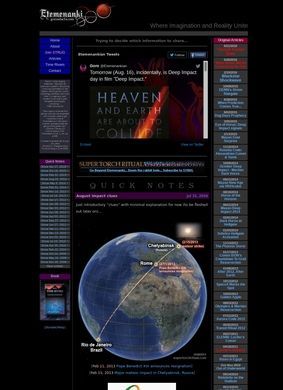
Running since the late 1990s, Etemenanki is the personal esoteric research project of Goro Adachi, and it has outlasted most of the web that surrounded it when it started. That alone makes it an odd thing to evaluate. It is not a company selling a product, not quite a blog in the usual sense, but a one-man archive of long-form speculation that kept publishing while the internet around it churned through fashions and platforms. A stranger on Reddit casually mentioning he has read Etemenanki "off and on since the 90s" tells you more about its staying power than any pitch could.
Multicontextuality as method
What Adachi does is connect things. The organizing idea is something he calls multicontextuality, a method of reading seemingly unrelated events across history, culture, myth, and astronomy as if they were threads of the same pattern. In practice that means original articles pulling Nostradamus interpretation alongside comet research, then drifting toward ancient monuments on Mars, then circling back to secret societies and celestial symbolism. Whether you find this illuminating or maddening will depend entirely on your tolerance for that kind of leap. The writing is dense, the topics are sprawling, and there is no attempt to soften any of it for a casual reader.
Time Rivers and river geography
The most ambitious single piece of work on Etemenanki is a sub-project called Time Rivers. It is presented as a book-length argument, and its central claim is that river geography maps onto prophetic timelines. I will be honest that this is where my own credulity simply ran out, but the scale of the thing is undeniable. Adachi did not knock out a quick post on the idea; he built an entire structured case around it, with internal cross-referencing that looks like years of work instead of an afternoon's whim.
That shapes how you read the rest of the site. Time Rivers is not a teaser or a sales hook; it sits there, fully laid out, free to read, which is unusual in a space where the pattern is usually to dangle a little and charge for the rest. Putting a flagship theory out in full, defensible or not, gives the project a certain integrity even when the content itself invites heavy skepticism.
Free access to archived essays
The public article archives on Etemenanki follow the same logic. Years of essays remain openly accessible, no wall in front of them, no demand to register first. For anyone genuinely curious about how this strand of esoteric thinking developed over two decades, the archive is a real resource, if a demanding one. It also turns up in a directory of conscious and alternative websites, which gives some sense of the niche it occupies.
Shift to paid membership in 2017
In August 2017 the model shifted. The ongoing, in-depth work moved to a paid-membership community called Super Torch Ritual, hosted at a separate domain. Etemenanki was effectively frozen as the public face: the older material stays up and free, but the living current of new analysis now happens behind a membership paywall. That split is worth understanding before you visit, because someone arriving today is largely browsing an archive and not following an active feed.
As a window onto a long body of past work, Etemenanki is complete and freely available. As a way to keep up with what Adachi is thinking now, it is more of a doorway pointing elsewhere, and the elsewhere costs money. Neither of those is a flaw exactly, but the distinction is easy to miss if you assume the site is still the main event.
Credibility and outside recognition
The credibility Adachi draws on rests on two names. The site cites endorsements from Dolores Cannon, known for her Nostradamus research, and from Richard C. Hoagland, described on the page as a NASA consultant. Both names carry real currency inside this community and almost none outside it, and Hoagland is a polarizing figure whose own claims about Mars are contested. Citing them is a fair indication of where Adachi sits intellectually, but a reader treating those endorsements as independent verification should be cautious about what they establish.
Reddit mentions and niche following
Trying to gauge outside opinion on Etemenanki is where the picture gets sparse. There are no star ratings or review counts to be found on Google, Trustpilot, Yelp, or the usual platforms, which is unsurprising for a personal research site that was never a consumer business in the first place. The footprint that does exist is informal: a Reddit thread in r/MrRobotLounge where the site comes up in passing, and a listing on Secret Energy as a recommended conscious website. Secret Energy is itself inside the same alternative-spirituality orbit, so the recommendation shows the site has a niche following rather than broad recognition.
The Reddit mention is, oddly, the most persuasive thing in the picture, precisely because it is unsolicited and unenthusiastic. A reader admitting he has dipped in and out for twenty-odd years is not a testimonial; it is just a habit, and habits are harder to manufacture than praise. Two scattered references across the entire web is not much to go on for anyone wanting reassurance from a crowd.
Social media and contact options
Social presence is listed through a Twitter account under the Etemenankian handle and a Facebook page, though neither changes the basic reality that Etemenanki is a single author's body of work and not an organization with a community behind it. The social links function more as additional reading than as proof of an active audience. A contact form is available through the site and is the only avenue listed; no phone number, no direct email, no physical address appears on the landing pages. That is consistent with a private researcher who would prefer to be read than reached.
So what do you have here. If you already follow alternative history, prophecy, and symbolic pattern-hunting, Etemenanki is a serious, sincere, and genuinely long-running example of the form, with a free archive deep enough to keep you reading for a long time. If you come from outside that world, the experience will be very different: the leaps between Mars monuments and river-coded timelines arrive with full conviction and almost no concession to a skeptical reader, and you may bounce off it within minutes.
Pattern-matching without falsifiability
The doubt that remains is the one at the center of the whole thing. Multicontextuality is presented as a method, but a method that can connect almost anything to almost anything else is also a method that resists ever being wrong, and nothing on the public pages of Etemenanki tells you how Adachi would know when one of his connections is simply false and not yet understood. Two decades of careful, freely shared work on Etemenanki deserve respect for their persistence. Whether that work amounts to insight or to an elaborate, self-sealing system is a question the site itself never quite lets you settle.