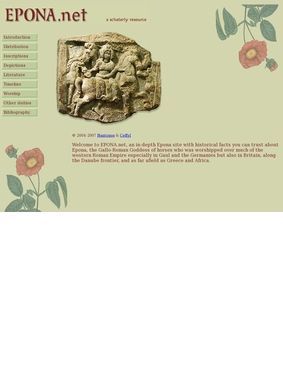
British and Celtic - Epona is a single-subject scholarly reference site, hosted at epona.net, that gathers what is known about Epona, the Gallo-Roman goddess associated with horses and worshipped across large parts of the Roman Empire. The content is split into nine labelled sections, and each one takes on a distinct slice of the evidence: an Introduction, a Distribution section mapping where her cult spread, Inscriptions covering the epigraphic record, Depictions for the surviving iconography and art, Literature for ancient textual mentions, a Timeline, a section on Worship and cult practice, one on other related deities, and a closing Bibliography of scholarly sources.
Nine sections organizing the evidence
That structure is the real strength here. Instead of one long essay, British and Celtic - Epona breaks the goddess down the way an academic monograph would, so someone chasing a specific thread (say, the geographic reach of the cult, or the way she was carved and painted) can go straight to it. The Inscriptions and Depictions sections in particular point to the kind of primary material a student would otherwise have to dig out of specialist publications, and the Bibliography gives them somewhere to go next. It reads as the work of people who cared about getting the sourcing right, not about drawing traffic.
Primary sources in inscriptions and depictions
Two authors stand behind it, writing under the names Nantonos and Ceffyl. Their names link out to their own personal sites at nantonos.net and ceffyl.net, which is roughly the extent of any personal footprint on British and Celtic - Epona. The body of the work carries dates in the 2004 to 2007 range, so this is a settled, static project: a finished reference that has sat mostly unchanged for years, without the running updates or user contributions of a wiki. For a topic as narrow and as unlikely to shift as the archaeology of a Roman-era goddess, that dormancy matters less than it would elsewhere. The inscriptions found a century ago are still the inscriptions.
Authors and project history
Researchers, students, and the more serious sort of enthusiast in Celtic and Roman religious history are the obvious audience, and British and Celtic - Epona pitches itself squarely at them. There are no products, no tools, no membership, nothing to buy or sign up for. It is reference material, plainly presented, and it treats Epona as a scholarly subject worth documenting carefully across her worship, her images, and the texts that name her. A casual reader who wandered in looking for a quick mythology summary would find far more depth than they bargained for, which speaks well of the site's seriousness even if it makes British and Celtic - Epona a heavier read than a general encyclopedia entry.
Who this site serves
The flip side of a small two-person project is that there is very little to verify it against from the outside. Searches turn up plenty of writing about Epona herself, from Wikipedia and Britannica through Druidry.org, Mythlok, and assorted craft listings, but none of that is a review or rating of this particular site. So British and Celtic - Epona stands or falls on the internal quality of its own scholarship, and a non-specialist has no easy way to confirm how its claims are regarded by academics working on Gallo-Roman religion. The presence of a full Bibliography helps, since it lets a reader trace assertions back to named sources, but tracing them is on the reader.
Verifying scholarship without external review
Contact is the other soft spot, and it is a real one. There is no phone number, no postal address, and no contact page anywhere in the navigation of British and Celtic - Epona. The only route to the authors runs through the outbound links to their personal domains, and whether those still respond is anyone's guess. For a static reference site that asks nothing of the visitor, the absence of a contact route is not damaging in the way it would be for a business taking money. It does mean that if a section contains an error, or a link to those personal sites has rotted, there is no obvious way to flag it, and the material simply stays as it was left.
Can you contact the authors?
The design is a product of its era, and British and Celtic - Epona makes no apology for it. Anyone expecting a modern responsive layout will find something closer to an early-2000s academic homepage: functional, text-forward, built to be read. That plainness is not a mark against a reference of this kind. It loads, it is legible, and the organisation does the heavy lifting that visual polish would not have added to anyway. What British and Celtic - Epona offers is substance in a dated frame, and the substance is the reason to be there.
Where does that leave the site? British and Celtic - Epona is a genuinely useful, tightly organised gathering of evidence on a figure who rarely gets this much dedicated attention, and the nine-section layout makes it easy to use as a working reference. What lingers is harder to settle: a static, unmaintained project by two pseudonymous authors, with no way to reach them and no outside assessment of its scholarship, asks the reader to take its accuracy largely on trust. For the goddess Epona that trust may be well placed, but nothing on the site itself lets you confirm it, and that is the doubt British and Celtic - Epona never quite answers.