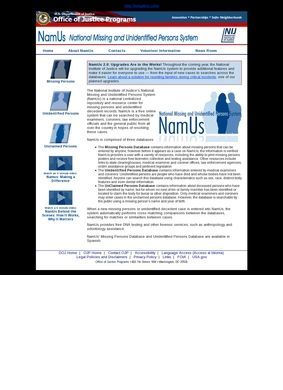
What happens to a missing-person report once the trail goes cold, and to a set of unidentified remains sitting in a coroner's office two states away, when nobody thinks to compare the two? NamUs was built to close that distance. It is a free, secure, national repository and resource center for missing, unidentified, and unclaimed person cases, run under the U.S. Department of Justice through the National Institute of Justice, and its whole reason for being is to let a long-cold report and an unnamed body find each other in the same system.
The core of NamUs is a single online database that a user searches and cross-references across three case types, each with its own dashboard: missing persons, unidentified persons, and unclaimed persons. Keeping the three in one application is the point. A family enters a missing loved one on one side; a medical examiner enters unidentified remains on the other; the system is designed so those records can be matched instead of aging separately in filing cabinets that never talk to each other.
A single database for three kinds of case
Missing, unidentified, and unclaimed dashboards
The three dashboards are what most people will actually touch. A missing-persons record and an unidentified-remains record are the two halves NamUs is trying to reconcile, and the unclaimed-persons dashboard adds a third, quieter category: people who have been identified but whose next of kin has not come forward. Searching is open to the public in the sense that families can enter and look through case information themselves, and relatives often hold details no agency ever wrote down.
One thing the site is honest about is what the records contain. The database holds visual images and text-based case material, and it carries a content warning that some of it may be graphic. That is the right call. Unidentified-remains cases are, by nature, hard to look at, and NamUs does not dress that up.
Free forensic services
Behind the search box sits a set of services that would cost a small agency a fortune to buy on its own, offered here at no charge. NamUs provides DNA analysis, fingerprint examination, forensic odontology, and forensic anthropology, plus family DNA reference-sample collection kits so a relative's genetic material can be logged against unidentified remains. There is free investigative case consultation from experienced staff as well.
For a rural sheriff's office or an overloaded medical examiner, that combination is the difference between a case that moves and one that does not. Forensic odontology and anthropology are specialist fields; most local agencies have no one on payroll who does them. Handing that work to NamUs, for free, is a practical answer to a real resourcing problem.
The reason for routing all of it through NamUs is consistency. When one national program runs the DNA analysis, the fingerprint examination, and the dental and skeletal comparisons, the findings land in the same system as the case records themselves, so a match is something the database can surface rather than something a lucky investigator has to happen to notice. That closed loop, forensic work feeding straight back into a searchable file, is the quiet engineering behind NamUs and the part that separates it from a simple online notice board.
Who uses it, and what surrounds the database
Law enforcement, medical examiners, and families
Three groups use NamUs, and the site is plainly designed around all three. Law enforcement agencies use it for case resolution and secure information sharing. Medical examiners and coroners use it to put names to unidentified decedents. Families of missing persons use it to enter and search case information without waiting for someone else to do it for them, which shifts a little of the power back toward the people with the most at stake.
The scale numbers the site cites explain why a central system is needed at all. Roughly 90,000 people may be missing in the United States at any given moment, more than 500,000 are reported missing in a year, and more than 11,000 sets of unidentified remains sit in medical examiner and coroner offices. Against figures like those, a scattered set of local databases was never going to be enough, and NamUs is the attempt to give the whole country one place to look.
Those figures also explain the design choices. A system meant to sift tens of thousands of open records cannot lean on memory or luck, so NamUs works through structured fields and cross-matching, and it opens the search to families precisely because the households living with a disappearance are often the ones holding the one detail that finally separates one record from another. A distinctive scar, an old dental quirk, a piece of jewellery never taken off: those are the things a relative remembers and a case file may not carry.
Training and outreach round out the human side. NamUs runs free training programs and nationwide outreach events, including a "Missing Person Day," where families can come in, give DNA samples, and add cases in person. That in-person element is easy to overlook and genuinely useful, since the households who most need this are not always the ones comfortable navigating a database on their own.
The library, events, and cold case resources
Around the database, the site carries the sections you would expect of a serious government resource. There is a "Data Imports" tool, a "Library & Multimedia" area with Reports & Statistics, a News Center, and an Events section split into upcoming, past, and tribal events, the last of which acknowledges that missing-persons cases on tribal land have their own jurisdictional tangle.
A "Cold Case Advisory Team" resource walks through the lifecycle of a case, which is a genuinely helpful orientation for a family or an investigator who has never worked one to conclusion. NamUs also publishes an annual report, its second, and runs a login and registration system alongside an FAQs page for the people entering and managing records. None of this is flashy. It reads like infrastructure, which is what it is meant to be.
For anyone coming to this cold, the Library and Multimedia area is where NamUs explains itself. The Reports and Statistics material gives a sense of scale and results, the News Center tracks recent activity, and the FAQs page answers the practical questions a first-time user actually has, like how to open a case or what happens after a record goes in.
The Data Imports tool sits alongside them for agencies moving records in at volume. Little of it is the sort of thing you read for pleasure, but each piece supports the one action the whole site exists for, getting a case entered and then found.
The honest verdict is that NamUs is exactly as good as the data people feed it, and that is both its strength and its ceiling. When agencies and families enter records diligently, a nationwide cross-reference of missing and unidentified cases is a powerful thing, and offering the forensic work for free removes the excuse that a small office could not afford to participate. That is genuine public value, plainly delivered.
Where it stays earthbound is that a matching system only works when both halves of a match get entered, and NamUs cannot force a busy jurisdiction to log its cases. The tool is sound; the outcome depends on participation it does not control. Treated as the central place to check a cold missing-persons case against unidentified remains, and as a free forensic partner for stretched agencies, NamUs is worth consulting and worth contributing to. Expecting it to resolve a case on its own misreads what it is: a well-built clearinghouse waiting on the people who use it.