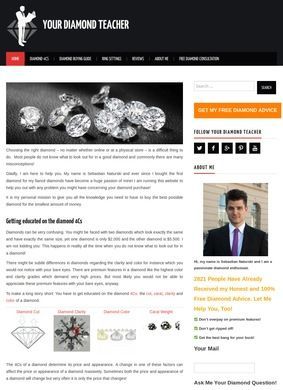
Your Diamond Teacher is an independent diamond-education and buying-advice blog at yourdiamondteacher.com, run by Sebastian Naturski, a GIA Diamond Essentials-certified diamond enthusiast based in Berlin who says he started the site nearly a decade ago. It exists for one kind of reader: someone about to spend real money on an engagement ring or a loose stone and wanting to understand what they are paying for before a salesperson explains it to them.
The scope is wider than a single explainer page. Your Diamond Teacher maps out the 4Cs one C at a time, then branches into diamond shapes, lab-grown stones, ring settings and metals, and a set of head-to-head comparisons of the big online retailers. It reads like a decade of accumulated notes rather than a quick affiliate landing page, and the depth in places is closer to a hobbyist forum than a beginner guide.
The 4Cs, taught one C at a time
The 4Cs are where Your Diamond Teacher spends most of its energy, and it treats cut as the one that matters most, which is the position any serious diamond buyer eventually lands on. Instead of a paragraph each on cut, color, clarity, and carat, every C gets pulled apart into its working parts.
That structure is the site's main strength. A shopper can read only the section that is confusing them and skip the rest, and each one goes deep enough to actually change a buying decision.
Cut, proportions, and hearts and arrows
Cut gets the most technical treatment. Your Diamond Teacher walks through ideal proportions, symmetry, polish, contrast, the hearts-and-arrows pattern, and evaluation with an ASET or Idealscope, which is the sort of tooling most casual buyers have never heard of. I was mildly surprised to find Idealscope and ASET analysis explained on a free blog, since that level of scrutiny usually lives on enthusiast forums where people argue about light return for fun.
For a reader who wants to judge a stone's sparkle by more than a grading label, this is the part that pays for the visit.
Color, clarity, and carat weight
Color is framed around trade-offs a buyer can act on: color against clarity, where the best value sits, how fluorescence plays in, and a separate thread on fancy colored diamonds. Clarity is taught through real examples of inclusion types, feather, cloud, and the rest, mapped across the grade ladder from IF down through VVS1 and VVS2, VS1 and VS2, and SI1 and SI2. Carat weight rounds it out with notes on average sizes and dedicated guides to two, three, four, and five-carat stones.
The through-line is spending where the eye notices and saving where it does not, which is exactly the advice a jeweler has little incentive to volunteer.
Shapes, rings, and lab-grown diamonds
Beyond the 4Cs, Your Diamond Teacher covers ten diamond shapes: round, oval, cushion, princess, emerald, radiant, pear, marquise, asscher, and heart. Each shape carries its own considerations for how it handles light, hides or shows inclusions, and wears on a hand, so someone drawn to an emerald cut is not being handed round-brilliant advice that does not apply to it.
The shape coverage is more than a gallery. Because Your Diamond Teacher explains how each outline handles light and how openly it reveals flaws, a buyer set on a fancy shape learns why it behaves the way it does before falling for a single flattering photo. Someone leaning toward an emerald cut, for example, comes away understanding that a step-cut shows clarity and body color more plainly than a brilliant round, which changes which grades are worth paying for and which are not.
The rings material is the practical companion to all the stone theory. There is content on settings and on metals, including a straight comparison of 14K against 18K in white, yellow, and rose gold, the decision most couples reach right after they have picked the diamond. Alongside that sits a full lab-grown section that treats grown stones as a serious option, covering buying considerations, color, clarity, and where to buy, which is more even-handed than the dismissive tone lab-grown still gets in a lot of the trade.
The author, the retailer reviews, and what to trust
The reviews section is where Your Diamond Teacher gets the most concrete, and the most useful to read closely. It compares named online sellers, Blue Nile, James Allen, Whiteflash, and Brilliant Earth, and runs direct match-ups such as James Allen against Blue Nile and Whiteflash against Brian Gavin. That is genuinely useful when you are deciding where to buy, with one standing caveat: comparison content on diamond blogs is frequently tied to affiliate arrangements, so a smart reader treats the rankings as an informed opinion to cross-check, not gospel.
The head-to-head format is where this approach pays off most clearly. Pitting James Allen against Blue Nile, or Whiteflash against Brian Gavin, forces out the specific distinctions a shopper needs when the choice is down to two sellers, the kind a single-retailer page never volunteers. Read across the comparisons Your Diamond Teacher lays out and you come away with a rough working map of where each store is strong and where it is not.
Which raises the question of the author. Your Diamond Teacher is one person's project, and that person presents himself as an enthusiast with a GIA Diamond Essentials certificate, not as a graduate gemologist. Diamond Essentials is a real credential and a nearly ten-year body of writing is nothing to wave off, yet a reader should be clear that the authority here is one committed hobbyist's experience, not an institution or a panel of graders.
On reaching him, the site is light. No phone number, email, or address is posted. There is a Consult page that seems to be the way to engage Naturski directly and an About page laying out his background, but no formal contact tab and no posted details beyond those routes. For an advice blog run by one person that is workable, since the Consult offer is really the point of contact.
That Consult page is worth flagging on its own, because it quietly turns a blog into a small service. A reader who has worked through the guides but still cannot decide between two similar stones can, in effect, pay for the author's eye on the specific diamonds in front of them. For a nervous first-time buyer that direct line may be worth more than another article, and it is the closest thing Your Diamond Teacher offers to hand-holding through an actual purchase.
Outside verification is the weaker spot. No independent reviews of Your Diamond Teacher surfaced on Trustpilot, the BBB, Yelp, or Google; searches mostly returned the site's own pages and its listing in this directory, neither of which is a third party vouching for it. So the trust you extend rests on the quality of the writing in front of you, which is high, and on the author's own account of himself, which cannot be checked from the outside.
Set against the obvious alternative, that trade becomes clearer. A reader could skip all this and just read the buying guides published by a big retailer like James Allen or Blue Nile, which are free, polished, and thorough. The catch is that those guides are written by the seller, and every soft nudge in them points back to that seller's inventory.
Your Diamond Teacher gives up the institutional polish and gains independence: one opinionated voice with no storefront to fill, teaching you enough to walk into any of those retailers and argue back. On the strength of the writing itself, that independence is worth more than the unverified author costs.
Business address
Your Diamond Teacher
1304 Dean Street,
New York,
New York
11216
United States