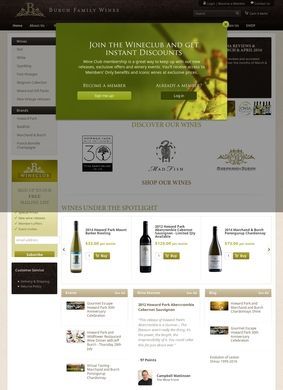
You want a bottle of Western Australian wine that will hold up at a dinner, but you do not have a sommelier on speed dial and the supermarket shelf gives you nothing to go on. That is the gap Burch Family Wines steps into, and the Burch Family Wines site is built around filling it properly. The company is a family producer working out of Margaret River and the Great Southern, growing fruit on named vineyards and selling the finished wine directly, either shipped across Australia or picked up at the cellar door. There is enough specificity here that a buyer can actually make a decision instead of guessing.
Three labels across the price spectrum
The structure of the operation is the first thing worth understanding, because it is not one label but three, and they sit at different points on the price and ambition scale. Howard Park is the flagship, running since 1986, with fruit coming off Leston and Allingham in Margaret River and Mount Barrow and Abercrombie in the Great Southern.
MadFish as the everyday tier
Knowing which vineyard feeds which wine is the sort of information that separates a producer who farms its own land from a brand that buys grapes and bottles them under a pretty name. MadFish, launched in 1992, is the more accessible range, fifteen wines built around cool-climate styles and clean fruit, and it reads as the everyday tier that most people would actually open on a Tuesday. At the top of the Burch Family Wines portfolio sits Marchand and Burch, which deserves more than a passing mention.
Marchand and Burch with French expertise
Marchand and Burch, started in 2007, is a collaboration with Pascal Marchand, a Burgundian winemaker, and through it Burch Family Wines also distributes Franck Bonville Champagne. A French-Australian partnership of this kind is either marketing dressing or a genuine winemaking exchange, and the fact that it has run for years and carries a real grower-Champagne import alongside it points strongly to the latter. For a customer, it means access to a Burgundy-informed style without leaving an Australian producer's catalogue.
Langton's classification for Abercrombie Cabernet
Claims about quality are cheap until someone independent backs them, and here the outside verdicts are unusually concrete. Howard Park's Abercrombie Cabernet Sauvignon is rated "Excellent" in Langton's Classification of Australian Wine, which is the benchmark collectors and the secondary market in Australia actually pay attention to. That is not a self-awarded ribbon. Langton's tiers are built on auction demand and critical consensus over time, so a placement there is more meaningful than a gold sticker from a regional show.
Halliday ratings sustained over twenty-five years
The Halliday rating reinforces it. Howard Park has held a 5 Red Star rating for over twenty-five years, which is the top band in the Halliday Wine Companion and, more tellingly, has been held continuously rather than won once and lost. Consistency across a quarter-century is harder to argue with than a single standout vintage. Wine Companion currently lists seven wines from the Burch Family Wines group with individual scores between 92 and 96, a range that sits firmly in the serious-but-not-unicorn territory where the wines are good enough to seek out but still produced in real quantities.
Where can you find independent reviews?
Beyond the formal classifications, coverage exists on The Real Review and user tasting notes turn up on Delectable for several of the wines, so there is a trail of independent opinion available before any purchase. What is missing is the consumer-style aggregate: no Google, Trustpilot, or Yelp star counts surfaced for the business itself. For a wine producer that distinction is less damaging than it would be for, say, a restaurant. The relevant audience here judges through critics and classifications, and on that scoring the evidence is solid. A shopper who simply wants to know whether other ordinary buyers enjoyed a bottle is left with a narrower set of sources, because the conversation about Burch Family Wines mostly happens in the trade and enthusiast press rather than on general review platforms.
Online shopping with Wine Club membership
The commerce side is straightforward. The online shop ships nationally, browsing is organised by brand, and there is an account portal for managing orders. A Wine Club adds member pricing, first access to limited and pre-release bottles, and members-only events, which is the standard mechanism for a direct-to-consumer winery and a reasonable proposition if someone is already buying a case or two a year. None of this is novel, and it does not need to be. It works.
Contact options organized by function
On reaching the business, the contact page is notably detailed. It splits out separate phone numbers and email addresses for the cellar door, the Wine Club, the Subiaco head office, and an international sales manager for export, with hours attached to each: the cellar door open daily ten to five, the Wine Club and office on weekday business hours. Segmenting contact by function is a small sign that someone thought about who is actually calling and why. The one thing absent is a street address on the contact page itself, which is a minor irritation for anyone planning a cellar door visit who would rather not hunt for the location separately. The hours and phone lines do most of the work, so it is a quibble more than a real obstacle.
Strengths and minor gaps in the website
Where does that leave a prospective buyer? Burch Family Wines is a credible, long-running producer with genuine critical standing, and the three-tier structure means it can serve both a casual buyer reaching for a MadFish white and a collector chasing the Abercrombie Cabernet. The Langton's and Halliday credentials are the kind that survive scrutiny, and the Marchand and Burch line gives the Burch Family Wines catalogue a distinctive corner that most Australian producers cannot offer. The reservations are modest: no consumer review aggregate to consult, and a contact page that tells you when to visit but not quite where.
Those are points to note, not deal-breakers. The proof is in classifications that do not hand out their ratings lightly, and Burch Family Wines has held those ratings long enough that the consistency itself is part of the argument. The website around it is functional and honest about who to call. A buyer going in with eyes open will not be misled by anything Burch Family Wines puts forward.