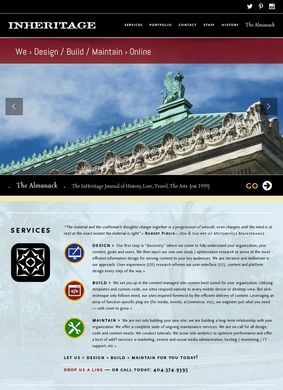
Someone running a county historical society or a small artisan shop hits a wall most web studios shrug at: they need a site that holds quality content for years, gets found, and stays maintainable long after launch day. That is the exact corner InHeritage carved out over its run, building custom sites for historical organizations, nonprofits, artisans, and small businesses with an eye on the long haul rather than the quick handoff. The catch a visitor needs to understand straight away: the studio closed. It operated from 1999 until August 14, 2023, twenty four years, and the site now functions as an archive of that work, not a place taking on new clients.
That framing changes what the page is good for. Nobody arriving today is going to hire InHeritage. So the value sits entirely in what the archive preserves and whether it is worth reading, and on that front the answer is more interesting than a parked domain usually is. The studio's stated focus was custom development built to present unique content well, paired with optimization, content management solutions, and ongoing site operations. Reading between the project notes, InHeritage was a shop that cared about the unglamorous part of the web, the part where a site has to keep working a decade later.
Portfolio across two decades of web technology
The Portfolio section documents work across five business phases spanning the full 1999 to 2023 stretch, which is a genuinely useful way to organize two decades of changing web technology. You can see how the practice evolved, and for a certain kind of reader, a history buff, a small studio owner, a student of how the early commercial web matured, that progression is the draw. The clientele skewed toward heritage and cultural work, which fits a developer who clearly had a personal stake in the subject matter.
Alongside it sits a History section laying out the company's own evolution as a timeline. I find the choice to treat the firm's own arc as a documented record, rather than a single dusty about-page, a telling sign of how this person thought. It is consistent with the heritage-organization clients InHeritage served: people who care about keeping a record tend to care about keeping their own.
Archival materials and related ventures
The site does not stop at past project work. There is an Almanack, a journal covering history, lore, heritage travel, and the arts, which reads as the proprietor's continuing personal interest, not a marketing vehicle. And there is The Regionals, described as a venture dealing in vintage books, collectibles, and memorabilia, with its own storefront at theregionals.store. A personal site, davebuckhout.com, is also listed, along with an Instagram account under the handle davestratbucks.
The Regionals is the part of this constellation that still has a pulse. While InHeritage itself stopped trading, that storefront and the linked personal projects show the person behind it kept building in adjacent directions: collectibles, writing, the Almanack. So the archive is not entirely frozen. It points outward to things that may still be active, which raises an obvious practical question for anyone landing here from a search.
Reaching the studio or its successors
Contact is where that question gets awkward. There is no phone number, no email, and no physical address anywhere on the site or its landing page. The single outbound channel is the Instagram link. For a working business that would be a serious mark against it; for an archive of a closed studio it is more forgivable, though anyone hoping to reach the person about a vintage book or a past project is left funneling through a social handle and hoping for a reply. The connected sites, theregionals.store in particular, are the more sensible route if you need an actual transaction.
Third-party reputation signals are essentially absent. A search for reviews or ratings turns up only unrelated namesakes: a video game, some films, and a separate organization with a similar name. No third-party reviews of InHeritage surfaced at all, which is unsurprising for a small custom shop whose clients were institutions, not the kind of consumer base that leaves star ratings. The absence is a data point, not a verdict against the work.
What the archive delivers for different visitors
Judged as a portfolio and a record of twenty four years of niche work, InHeritage comes through well. The phases are documented, the writing in the Almanack gives it a voice, and the History section treats the firm's own story with the same care it gave clients. Judged as a place to hire or even easily contact, it falls short, and the Instagram-only channel makes that gap concrete. What InHeritage offers is closer to a well-kept museum than a storefront, and that is no small thing for a corner of the web that tends to vanish without trace.
Assessing value as record versus active business
The work and the writing remain readable, the linked ventures give it somewhere to go, and the heritage angle runs deeper than decoration given who the studio served. The closure was deliberate and clearly stated, so there is no mystery to untangle. If a thoughtfully preserved record of a closed studio, with its journal and its collectibles offshoot still within reach, fits what you came looking for, the archive repays the visit. If you need a developer, the trail ends in 2023.