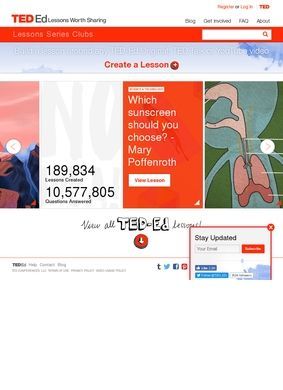
Animated lessons that millions of people recognize from YouTube are only the public face of TED Ed; the platform behind them lets any teacher take an arbitrary YouTube video and turn it into a structured lesson with questions, discussion prompts, and follow-up resources attached. That single tool reframes what the site is. It is a content library, yes, but it is also a quiet publishing workshop for educators who want to build something around a clip they already trust.
Free lessons across multiple subjects
The free lesson catalogue is the part that pulls most first-time visitors in. TED Ed lessons are sorted into more than a dozen subject groupings, covering mathematics, the sciences, psychology, health, the arts, and the humanities, and each one tends to pair a short animated explainer with a set of comprehension and open-ended questions. The animation style is consistent enough that you can spot a TED Ed video within a few seconds, and the curatorial hand is visible: these are commissioned pieces shaped around a teachable idea, not random uploads. For a student working alone, the lessons function as bite-sized explainers. For a classroom, they slot into a period with room left over for the discussion the questions are designed to provoke.
Building custom lessons from any video
Where the platform gets more interesting is the creation side. An educator can build a custom lesson from scratch, gather favourites into a personal collection, and run the result as a presentation. The customization layer is the genuinely useful part, and it separates TED Ed from a plain video archive. You attach your own questions and notes to a video, whether that is a TED Ed original or some other YouTube source, and you end up with a lesson tailored to a particular group of students instead of a one-size clip. Teachers who have spent years writing worksheets to bolt onto videos will understand the appeal immediately.
Student and educator talk programs
Two programs sit alongside the lesson tools and give TED Ed a participatory dimension that most education sites never attempt. The Student Talks program walks young people through creating and delivering their own TED-style talks, which is a different muscle from watching a polished one. The Educator Talks program does the parallel job for teachers, helping them shape and present original ideas of their own. Both turn the audience into producers, and the difference shows up in what students actually retain: someone who has stood up and structured an argument for an audience has learned something the most carefully animated lesson cannot hand them directly.
Interactive explorations with partner institutions
The interactive explorations deserve a mention because they are built with outside institutions, which gives them a depth that a single in-house team would struggle to match. These collaborative pieces go beyond a video and a quiz, pulling in partner expertise to build something closer to a guided investigation of a topic. They appear less frequently than the standard TED Ed lessons, but they tend to be the more ambitious entries in the catalogue, showing that the platform is willing to spend real effort on a smaller number of richer experiences.
Themed collections and subject browsing
Beyond the structured lessons, TED Ed maintains a blog and a steady supply of themed collections, so the material is organized in more than one way. A teacher hunting for a particular topic can browse by subject; someone building a unit around a broader theme can pick up a ready-made collection rather than assembling clips one by one. The themed collections in particular save the kind of time that adds up over a school year, because the grouping work has already been done by people who understand how the pieces fit together.
Free access with optional account features
It is worth being clear about the cost structure, since it shapes who the platform is really for. All of the core educational content on TED Ed is free to watch and use, and the lessons themselves carry no paywall. Registering an account unlocks the additional features, chiefly the lesson-building and collection tools, but the barrier to simply learning from the material is essentially nonexistent. A parent who wants to point a curious kid at a science explainer never has to sign up for anything. A teacher who wants to construct and reuse custom lessons will want the account, and the trade there is reasonable.
Multilingual content and third-party distribution
Reach is one of the platform's quieter strengths. TED Ed lessons turn up embedded across third-party educational sites, and the same content lives on YouTube, so the material meets people where they already are instead of demanding they come to one destination. There is multilingual support too, which extends the catalogue to a global audience and keeps it from being a strictly English-language resource. That distribution model is part of why so many people have encountered the lessons without ever realizing they came from a single coordinated platform.
If there is a limit to flag, it is that the customization tools reward investment. Casual visitors will get the most out of the ready-made lessons and may never touch the builder, while the deeper value, the part that makes TED Ed more than a video site, only opens up once you commit to learning how to assemble and annotate your own lessons. That is a description of the audience split rather than a flaw: passive viewers and active creators are served by two quite different layers of the same site, and the second layer takes time to learn.
For an educator deciding whether it belongs in their toolkit, the calculation is fairly direct. The free lessons alone justify a bookmark, the subject coverage is broad enough that most curricula will find something usable, and the ability to wrap your own questions around any video addresses a problem teachers have been solving manually for a long time. The Student Talks and Educator Talks programs are the reason to dig deeper, because they turn TED Ed from a place you consume into a place you contribute. It is the kind of resource that looks like a video collection from the outside and reveals itself as a lesson-design system once you start using it properly.
The single feature worth returning to is the one that attaches a quiz and a discussion to any YouTube link, because it quietly solves a small daily problem for working teachers. Everything else in TED Ed, the animated catalogue, the collections, the talks programs, the partner-built explorations, builds outward from that idea of turning passive watching into structured learning. A teacher who spends an afternoon with the builder walks away with lessons they can reuse for years, and a student who finishes a TED Ed lesson has answered questions instead of simply watching a clip.