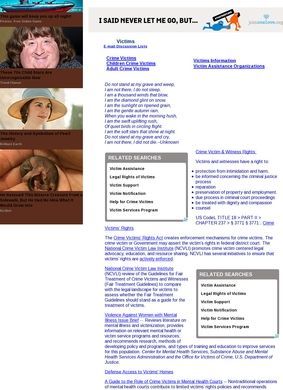
Where does someone turn when the crime they care about is not the killer but the people left behind? That gap is what True Crime - Victims sets out to fill. This is the victims-focused section within the larger karisable.com reference portal, run out of Olympia, Washington, and it gathers reading, rights information, and links to assistance organizations for people harmed by crime and for those trying to help them.
Reading hub for victims of crime
The page does not pretend to be a victim-services agency. It works as a reading and reference hub. There are book recommendations tied to victim-centered true crime, including "102 Minutes: The Untold Story of the Fight to Survive Inside the Twin Towers" by Dwyer and Flynn, which reconstructs the 102-minute window inside the towers on 9/11. Alongside the books sit links to victim assistance groups and a plain-language summary of crime victim rights, with a citation to the federal statute at US Code Title 18, Part II, Chapter 237, section 3771. Pointing a reader to the actual law by chapter and section is more useful than a vague assurance that rights exist, and True Crime - Victims does exactly that.
Content organized by type of harm
The content is broken out by type of harm, which is a sensible approach for a subject this broad. Separate threads cover adult homicide victims, child abuse victims, domestic violence victims, elder abuse victims, and hate crime victims. Someone arriving with a specific situation can go straight to the relevant strand instead of wading through one undifferentiated essay, and a researcher comparing categories can move across them quickly. The framing is refreshingly unglamorous given a genre that tends to fixate on perpetrators. The emphasis in True Crime - Victims stays on the people affected and on what they can do next, whether that means finding an advocacy group or understanding where they stand legally.
Victim-centered approach to true crime
The reading suggestions reinforce that orientation. They lean toward accounts that treat victims as the center of the story rather than as background to a killer's biography. It is a small editorial choice that shapes the whole feel of the resource, and it is consistent throughout.
Broader reference site and community
True Crime - Victims is one section in a much larger reference site. Karisable.com extends into DNA and forensics, homicide, serial killer cases (the Green River Killer material is documented in depth), unsolved cases, missing persons, mental health courts, organized crime, drug wars, white-collar and computer crime, and how the media covers all of it. There is also a moderated true crime discussion list open to victims, survivors, researchers, and the general public, which gives the site a participatory side beyond static pages. That breadth tells you something about the intended audience: victims and the advocates who support them are the obvious entry point, but the wider portal clearly speaks to law enforcement, academic researchers, journalists chasing background, and general readers with a serious interest in the subject.
A search for third-party reviews or ratings for the site turned up nothing, so there is no outside assessment to set alongside this one. The judgment here rests on the published material itself: the categories are coherent, the statutory citation checks out, and the links point somewhere useful. A PO Box in Olympia, Washington appears on the page as a contact point. No rating from any independent platform exists to report. When something like True Crime - Victims appears in a business directory, those details matter for basic verification, and they pass the basic test here.
Verifying links and legal references
One practical caution applies to any long-running, individually maintained resource: some outbound links to assistance organizations may have shifted over the years, and statute references can be superseded, so it is worth confirming current details directly with the agencies or with up-to-date legal text. That does not undercut the value True Crime - Victims provides; it just sets the right expectation for how to use it.
How this resource differs from national services
Set True Crime - Victims against something like the National Center for Victims of Crime and the difference in purpose becomes clear. The national center offers direct programs, a help line, and institutional backing. This site offers curated context, reading, and a survivor-aware discussion community. A person in immediate need should reach for the former. Anyone who wants to understand the landscape of victim issues, locate the relevant law, or find the right book will get genuine mileage out of True Crime - Victims. The victim-first framing, consistent across the whole resource, is what lifts it above a plain curated link page and makes it worth returning to. The published citations and the statutory reference in particular push it past the level of a simple link aggregator.