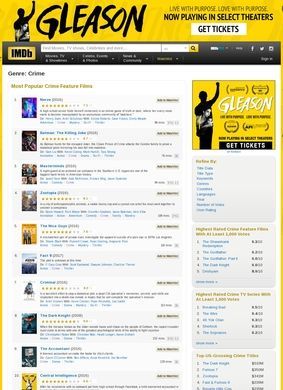
A title page like Crime 101 (2026) tells the whole story of what this listing does. A 7.1 star rating out of ten sits at the top of the record, next to credits for director Bart Layton and a cast led by Chris Hemsworth, Mark Ruffalo, and Barry Keoghan, with the genre tags Crime, Drama, and Thriller running underneath. That single screen, multiplied across tens of thousands of films and television series, is what IMBd: Genre: Crime amounts to: a reference page for one slice of the catalogue, built around a number the audience assigned.
The 7.1 on Crime 101 is not a critic's verdict handed down from a review desk. It is a running tally of what everyone who bothered to vote thought, which is a different kind of authority, broader and blunter, and the whole site runs on it.
The section is a filtered view of the Internet Movie Database, the reference site general viewers, film researchers, and industry people have leaned on for years. Pick the genre and the catalogue narrows to crime films and series, sortable by user rating, so the highest-scoring titles float to the top of a Top 250 list assembled entirely from what viewers voted. That ranked slice is the whole premise of IMBd: Genre: Crime, and it is a premise most people already understand without being told.
How the crime catalogue is laid out
The structure is plain and it works. IMBd: Genre: Crime hands a visitor a browsable, sortable index: choose the genre, sort by rating, and the site returns a ranked wall of titles, each carrying its own score, its cast and crew, and a plot summary. A viewer chasing the best-reviewed heist films and a researcher mapping one director's output both start from the same filtered page, then peel off in different directions once they click into a specific record.
The genre filter is doing quiet heavy lifting, since crime overlaps constantly with drama and thriller, and a title like Crime 101 carries all three tags at once.
Sorting by rating on top of that filter is what turns a messy overlap into a usable ranking someone can actually work down.
That genre page is only the doorway. Click any title and the full record opens, the rating out of ten front and center, the credits laid out in order, the synopsis in place, and a user review section below where anyone with an account can argue for or against the score. Every layer of IMBd: Genre: Crime hangs off that individual title page, which is why the site rewards a viewer who digs into one film as much as one who skims the ranking.
The Top 250 and how titles sort
The Top 250 is the headline of the genre view. Sorted by user rating, it turns a sprawling catalogue into a defensible ranking, and because the sort runs on votes, a film's position reflects a large audience instead of one critic's taste. On IMBd: Genre: Crime, that means a decades-old classic and a release from this year compete on the same scale, judged by the same crowd, with nothing but the aggregate score deciding which sits higher.
A viewer can disagree with the order, but the method behind it is at least transparent. The list rewards films that a broad audience keeps returning to, which tends to favor durable reputation over opening-weekend noise, and that bias toward staying power is part of why the ranking reads as more than a popularity contest.
User reviews and curated lists
Underneath the numbers sit two softer layers. Every title carries a user review section where viewers write out why a film landed or fell flat, which gives the bare score some texture and lets a reader see the argument behind a rating instead of only its result. Those written reviews range from a paragraph of genuine analysis to a single furious line, and the mix is part of the appeal, since the disagreement itself tells a browser how divisive a crime film really is.
User-curated lists such as "Crime rated 7+" let members assemble their own cuts of the genre and publish them for others to browse. Those lists are where IMBd: Genre: Crime stops being a static ranking and starts reflecting how real viewers group, sort, and recommend films to one another.
What a star rating out of ten really carries
The rating is the currency here, and it pays to understand what it is. A score on IMBd: Genre: Crime is a weighted average of user votes, so a title showing a 9.0 out of ten backed by 2.6 million votes makes a very different claim than a 9.0 propped up by a few hundred. Volume is part of the signal. The site surfaces the vote count next to the number, which lets a reader weigh how much confidence to place in the figure instead of taking a bare average at face value.
Editorial coverage of IMBd: Genre: Crime leans on these figures constantly. Third-party articles ranking the best crime movies, the best crime epics, or the best crime TV shows routinely cite the site's user ratings as their backbone, quoting a weighted average and its vote total as evidence that a title belongs on the list.
That secondhand use is a fair measure of how much weight the wider film conversation puts on IMBd: Genre: Crime as a shared reference point, since a writer reaching for an authority reaches for these numbers first. When a listicle wants to prove a title deserves its spot, the fastest shorthand available is a high weighted average attached to a vote count in the millions, and that shorthand keeps circulating precisely because readers already trust where it comes from.
The scale has a known weakness worth naming. A rating out of ten flattens a lot of disagreement into a single figure, and a genre as broad as crime, spanning noir, police procedural, gangster epic, and pulpy thriller, forces very different films onto one yardstick. IMBd: Genre: Crime does not pretend to resolve that tension. It hands over the number, the vote count, and the written reviews, then leaves the judgment where it belongs, with the person doing the reading.
Where it sits against the alternatives
Set beside Rotten Tomatoes, the difference in method is the whole story. Rotten Tomatoes aggregates professional critics into a percentage that measures consensus, a yes-or-no verdict summed across reviews. IMBd: Genre: Crime aggregates the audience into an average that measures intensity of regard on a ten-point scale. A crime film can post a middling critics' score and a high audience number at the same time, and the two sites will tell a reader opposite-sounding things about the same movie, each true in its own frame.
Letterboxd is the closer comparison for a certain kind of viewer, with its five-star audience ratings and a stronger social layer of lists and written logs. What Letterboxd cannot match is depth of record. IMBd: Genre: Crime carries full cast, crew, and production credits for titles that a cinephile app treats mainly as objects to rate and shelve. For pinning down who directed a 2026 crime thriller or which supporting actors filled out an ensemble, the database is the sturdier of the two, and it is not close.
A researcher tracing a cinematographer's filmography or a viewer settling an argument about a bit-part actor will exhaust a rating app in seconds and stay on the fuller record for an hour.
So the choice comes down to what a viewer wants from an evening of browsing crime titles. Someone hunting a critics' consensus before buying a ticket is better served by Rotten Tomatoes, where the percentage answers that exact question.
Someone who wants a deep, crowd-ranked catalogue with credits, plot, and thousands of user votes standing behind every score will find IMBd: Genre: Crime the harder resource to walk away from. Metacritic, which blends critic scores into a single weighted number, lands somewhere between the two: more authoritative than a crowd average, lighter on catalogue depth and user voices than the database.
For a quick, sortable ranking backed by sheer volume of votes and matched to a full production record, none of the three quite replaces what the crime genre view already puts on one page.