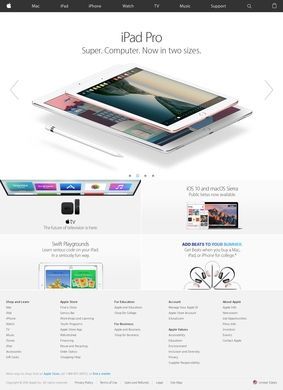
Apple is the American technology company behind the iPhone, the Mac, and a sprawling line of consumer hardware, software, and subscription services. The site under review is its main commercial home, where every product line is laid out alongside the operating systems and digital services that tie them together. It functions as catalogue, store, and support desk at once, and the breadth on display is the first thing worth taking in.
Hardware catalogue from phones to computers
The hardware does most of the talking. The current iPhone range covers the iPhone 17 and the thinner iPhone Air, sitting at the front of a catalogue that also runs through the Mac family: MacBook Air and MacBook Pro for portables, then the Mac mini, Mac Studio, and Mac Pro for people who want a machine on the desk. iPad gets its own spread across the standard model, Air, Pro, and mini, so the tablet line alone spans casual use up to work that would once have needed a laptop.
Wearables and entertainment accessories
Apple Watch and AirPods round out the wearable side, and then there is Apple Vision Pro, the spatial computing headset that reaches well past anything else in the catalogue. Accessories such as cases, adapters, and MagSafe peripherals fill in the gaps, and a separate TV and Home section handles entertainment and smart-home gear.
Software that connects every device
What stops this from being a plain electronics shop is the software underneath it. iOS, iPadOS, macOS, watchOS, and visionOS each run their matching devices, and the App Store sits across all of them as the distribution layer. That shared foundation is the reason a phone, a watch, and a laptop tend to behave as one set of tools instead of three separate purchases, and the site leans on that integration when it describes almost any product.
Subscriptions bundled under apple one
The services list answers that fairly directly. Apple TV+ handles streaming video, Music covers audio, and Arcade bundles games into a subscription. Fitness+ streams workouts, News+ packages magazines and newspapers, and Books and Podcasts cover reading and listening. For anyone who uses more than one or two of these, the Apple One tier folds several subscriptions into a single bill, which tells you the company would rather sell a habit than a single download.
Payment tools built into the wallet
The money side has grown into its own category too. Apple Card is a credit card offering up to 3% Daily Cash back, Apple Pay handles contactless payment, and Cash moves money between people directly. These are not bolt-ons. They are built to sit inside the same wallet and watch most customers already carry, which is exactly how the site frames them. The effect is a product that keeps widening: buy one device, and the path toward services, payments, and the next device is already paved.
Privacy is positioned throughout as a feature of the products themselves, applied to both the hardware and the software, and it shows up as a selling point next to the technical specifications. Whether a given buyer weighs that claim heavily will vary, but it is presented as something the company designs around rather than something it merely promises.
Inside the retail and support network
The retail and support layer is more substantial than most online catalogues bother with. Physical Apple Store locations come with a Genius Bar for technical help, the Today program runs free educational sessions, and Camp is aimed at younger users. Trade-in programs let an old device offset a new one, device financing spreads the cost, and AppleCare adds extended protection plans on top. For a buyer who wants a real human to set up a phone or fix a cracked screen, that combination of in-person service and warranty cover is a meaningful part of what is being sold, and it is harder to replicate than a spec sheet.
One genuinely useful thing the site does is sort itself by who is buying. There are clearly marked routes for general consumers, college students, and business customers, then separate paths for K-12 schools and higher education, healthcare professionals, government and military personnel, and state and local government staff. Education and business pricing, in particular, changes the calculation for institutions buying in volume, and surfacing those tracks up front is more practical than burying them. A student and a hospital procurement officer arrive needing very different things, and the site does not pretend they are the same shopper.
The trade-off behind staying loyal
If there is a tension in all of this, it is the one Apple has always carried: the same integration that makes the products work smoothly together also makes them difficult to leave. Files, photos, purchased media, and the subscriptions all assume you are staying inside the system. That is a deliberate design choice, not a flaw exactly, but it is the cost of the convenience the rest of the catalogue advertises. The headset and the financial products only deepen that pull, since each one adds another thread connecting a customer to the rest.
For the practical visitor, the value of the site depends less on any single product and more on how much of the catalogue you intend to use. Someone buying one phone and never thinking about it again will find a clean store and a support network. Someone weighing a Mac, a watch, a couple of subscriptions, and Apple Pay will find a system that rewards commitment and quietly raises the price of changing their mind later. Both are valid ways to use what is here, and the site serves them equally well; it just does not hide which one it prefers. So the question worth sitting with before clicking buy is a simple one: are you shopping for a device, or are you signing up for the whole arrangement?