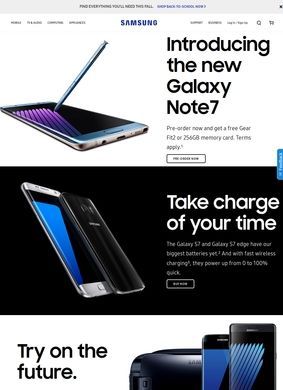
A washing machine dies on a Sunday, or a phone screen finally gives out, and the replacement hunt starts on the manufacturer's own website. For anyone already inside the ecosystem, that means Samsung, and the version reviewed here is the Romanian storefront, which shapes some of what appears: a 'Credit Online' financing tab, category labels in Romanian, delivery and support tuned to the local market.
The job of the site is plain. It sells things, and it keeps selling to you long after the box is open. That after-sale grip is the most interesting thing about how Samsung runs the store.
As a place to shop, it is comprehensive to the point of sprawl. Samsung makes an enormous range of hardware, and the storefront tries to hold all of it in one set of menus, from a pocket phone to a refrigerator that costs more than some cars. The site is pitched at two audiences at once, everyday consumers and business customers, and it mostly lets both browse the same shelves. Whether that dual focus helps a shopper or just widens an already overwhelming catalogue depends on how much someone already knows about what they want.
The site itself is competent. It loads, it searches, it takes a card, and it presents each product cleanly enough. The reservation has nothing to do with the plumbing and everything to do with what a manufacturer's own shop is for, and that question colours every section below.
A storefront for the whole catalogue
The top-level categories on the Samsung store map straight onto the product lines. Telefoane covers the Galaxy phones, TV and AV holds televisions, audio gear and projectors, Electrocasnice gathers the large home appliances such as refrigerators, washing machines, dishwashers and vacuum cleaners, Monitoare and Memorii handles monitors and storage, Wearables collects the watches, earbuds and smart rings, and Accesorii mops up whatever is left. It is a lot of ground.
The site's main task is keeping all of it navigable, and for the most part the category structure does that, even if the sheer number of options inside each aisle can stall a decision rather than speed it.
Search helps, but the menus still ask a visitor to already know which of six categories their problem lives in.
From Galaxy phones to Bespoke AI appliances
The phones are the headline, as they always are for Samsung. The featured lineup runs to the Galaxy S26 Ultra, the Galaxy Z Fold7 and the Galaxy Tab S11 series, the flagship and near-flagship devices Samsung wants front and center. These are the products the whole storefront is arranged to sell first, and the folding phone and the big-screen tablet in that group signal a company still pushing the expensive, experimental end of mobile hardware. A shopper who came for a phone will find the newest and priciest options waved in front of them before anything more modest.
Beyond mobile, the range broadens fast. OLED televisions anchor the TV and AV section, and the home-appliance aisle leans on the 'Bespoke AI' branding, one of Samsung's louder marketing pushes, which folds artificial-intelligence talk into fridges and washers. Whether a washing machine needs AI is a fair thing to wonder, and the store does little to answer it beyond the label.
The wearables tell a similar story of a company chasing new form factors, with a smart ring sitting alongside the more familiar watches and earbuds. Monitors and storage round out the productivity side for anyone building a desk setup around the same brand. What the site does well is depth.
Pick any category and the range underneath runs deep, from premium down to mid-tier, so a shopper on a tight budget and one chasing the newest folding phone both find something. The product pages are dense with specifications, which suits a spec-driven buyer and buries a casual one under numbers.
Care+, trade-in and Credit Online
Buying is only half of what the site is built for. Samsung Care+ sells extended warranty and accidental-damage cover for the products most likely to get dropped or spilled on. The trade-in program knocks the value of an old device off a new one, and Credit Online spreads the cost into instalments for people who would rather not pay for a folding phone in one hit.
Trade-in in particular is a neat piece of retention engineering, since the old phone's value only counts toward another purchase from the same shop. Online shopping comes with delivery, so the whole purchase can happen without leaving the sofa.
These are the mechanics Samsung uses to turn a product catalogue into a checkout, and they are the parts a first-party store does better than a third-party retailer, because the warranty, the trade-in credit and the financing all come from the same source that built the device. For a business customer kitting out an office, having purchase, cover and payment terms in one account is a real time saving. The flip side is that every one of these conveniences also deepens the commitment to a single brand, which is exactly what the store is designed to do.
Support that lasts past the sale
The support layer is where a manufacturer store justifies itself. Samsung provides technical support backed by product manuals, an authorized service-center locator for repairs that need hands on the hardware, and remote technical assistance for the problems that can be sorted over a connection.
The manuals in particular matter for appliances that outlive their sales pages by a decade, when the only way to fix a ten-year-old dishwasher is to look up the part yourself. Between the three, most faults have a route to a fix without a trip to a random repair shop, which is worth something when the device in question is an expensive television.
For a household running several devices from one maker, having the manuals, the warranty status and the repair options in one Samsung account is genuinely convenient. It also quietly locks you in. Every one of these services works best when the next thing you buy carries the same logo, and that is the whole point of building the ecosystem this tightly. Convenience and lock-in are the same coin here, and how a shopper feels about the store depends largely on which side of that coin they are looking at.
So the verdict lands qualified. As a buying-and-owning hub for someone already committed to the brand, the Samsung site does its job well: a broad catalogue, a working checkout, and warranty, trade-in, financing and support in one place. As a place to decide whether a Samsung product is the right choice at all, it is close to useless, because everything on it is the company selling to you, and 'Bespoke AI' reads more as a marketing hook than as a reason to buy.
The Romanian storefront is worth remembering too, since the exact services and offers differ from what a shopper in another country sees, so nobody should assume the experience is uniform. Treat the store as a well-stocked shop run by the manufacturer, useful once the decision to buy Samsung has already been made, and it delivers. That is a narrow but honest use case, and it is the one the store is genuinely good at. Ask it to be impartial, and it was never built for that.