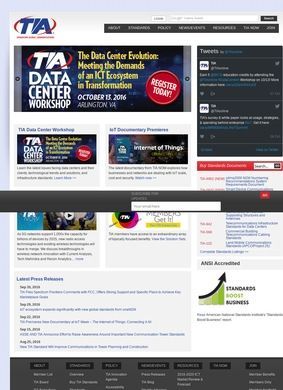
TIA-942, the Data Center Infrastructure Standard, is the document most people in the field will recognize first, and it sets the tone for everything else here. It defines how a data center should be laid out, cabled, powered, and rated for reliability, and it has become a common reference point when operators and auditors talk about facility resilience. TIA, the Telecommunications Industry Association, sits at the point where physical infrastructure, network engineering, and industry policy meet.
What TIA presents is a working body of standards and programs, not a marketing shell. The catalog runs deeper than the one flagship document. SCS 9001 is a cyber and supply chain security standard aimed at the parts of the network that regulators have grown nervous about. TL 9000 is a quality management certification built specifically for telecom hardware and software suppliers, layered on top of the general ISO quality thinking but tuned to this sector.
DCE 9000 rounds out the certification side. Taken together these give suppliers and operators a documented way to answer an auditor's questions about their own processes.
What the standards and programs cover
The work TIA does splits into a few recognizable tracks, and the site organizes them clearly enough that a supplier or a network operator can figure out which door to walk through. Some of it is committee-driven standards development. Some of it is certification. Some is technology collaboration among competitors who need to agree on how things interoperate before anyone can sell them.
Standards committees and interoperability
Behind the published standards are the committees that write and revise them. These groups tackle infrastructure reliability and interoperability, the unglamorous engineering agreements that let equipment from different vendors actually work on the same network. This is the slow, consensus-bound part of the job, and it is where a trade body like TIA earns its usefulness. A single company cannot declare an interoperability standard and expect the market to follow. A neutral convener can.
The committee structure is what separates an organization like this from a vendor pushing its own spec. Membership brings a seat at the table where those decisions get argued out, which is the real draw for the companies that pay to belong.
Technology programs and the consortium work
Alongside the formal standards sit a set of technology programs, and this is where the range gets interesting. There are data center initiatives that extend the TIA-942 lineage. There is OneM2M, the machine-to-machine and Internet of Things standardization effort. There is FOTC, and there is the Single Pair Ethernet Consortium, a collaboration around a wiring approach built for industrial and automotive networks, where cost and cable weight are real constraints. These are the kinds of efforts that need many companies pulling in the same direction, since a single vendor cannot force adoption of a wiring standard on its own.
The QuEST Forum feeds the quality management and supply chain security side, which connects back to TL 9000 and SCS 9001. There is also a MEID database, the registry of mobile equipment identifiers that carriers and manufacturers rely on to keep device identities distinct. That last one is a quiet piece of plumbing, the sort of shared resource nobody notices until it is missing. A registry only works if one trusted party maintains it and everyone agrees to use it, which is precisely the kind of coordination a trade association is built to handle.
I find the breadth here genuinely useful, though it does mean the site asks a newcomer to already know which acronym belongs to their problem. The programs are named more than they are explained on the surface, and a first-time visitor may need to click a few layers deep before the purpose of each one comes into focus.
Policy work, events, and the MEID registry
TIA also does government advocacy and policy work, weighing in on connectivity and infrastructure resilience. For a trade association this is standard practice, but it is worth noting because it changes what membership buys. A company joining is buying influence over both technical standards and the regulatory environment those standards operate in.
On the outward-facing side there are events. The Broadband Nation Expo is the marquee gathering, and it is backed by a run of webinars for people who cannot or will not travel. These serve the education and networking function that keeps TIA visible between standards cycles, and they give the smaller programs a venue to reach an audience that might otherwise never encounter them.
The regulators, suppliers, and operators the group serves are working on networks, data centers, and supply chains, and the offerings map onto that audience with reasonable precision. There is little here aimed at a general public. This is infrastructure for the people who build infrastructure.
One thing the range makes plain is how much of modern telecom rests on agreements nobody outside the industry ever reads. Cabling grades, quality audits, device identifiers, security baselines for the supply chain. The value of TIA is in assembling those pieces under one roof so that a company does not have to chase them across a dozen separate bodies.
That consolidation cuts both ways. The scope is wide enough that the site can feel like a directory of programs more than a guided path, and someone arriving with a single narrow question has to do a little orienting before the relevant standard surfaces. It rewards visitors who already speak the language.
For its intended readers, the material is on point. A data center designer checking rating tiers, a supplier preparing for a TL 9000 audit, an engineer tracking Single Pair Ethernet progress, a policy staffer following infrastructure debates: each of them will find something concrete and current. The material is the actual work product of TIA, which is what you want from a standards body, not a marketing summary of one.A search for independent reviews of TIA itself turns up nothing meaningful, which is unsurprising for a trade association that operates through committee membership rather than consumer transactions. There is no storefront to rate.
The verdict is a qualified yes, weighted toward the specialist. If you work in telecom or digital infrastructure, the standards, certifications, and program pages are a primary reference worth bookmarking, and the depth of the catalog justifies the visit on its own. If you are outside that world and hoping for a plain-language explainer of how networks work, this is the wrong door, and the acronym density will make that obvious fast. What TIA does, it does for the people who need it, and it does not pretend to do anything else.