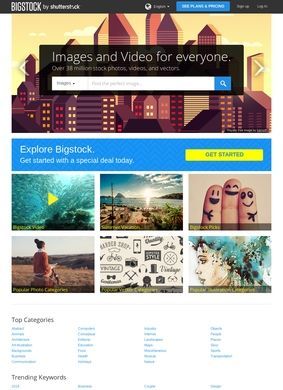
Picture the situation: a designer is two hours from a deadline, needs a clean photo of a person working at a laptop, and cannot afford a $300 single-image license from one of the premium agencies. That is the corner Bigstock aims to fill. Bigstock is a royalty-free stock media marketplace, owned by Shutterstock, that sells photos, vector illustrations, and video footage for both commercial and personal use under a standard royalty-free license. The pitch is straightforward: a large library at prices that undercut the high end, with a few different ways to pay depending on how often you need to buy.
Flexible pricing for different budgets
That pricing structure is where the site puts most of its thinking, and it is worth walking through because the right choice changes the per-image cost dramatically. Subscriptions come in tiers of 25, 50, 100, and 200 images per month, running from roughly $69 to $200 monthly, which suits anyone pulling images regularly.
Subscription tiers and monthly plans
Occasional buyers can use credit packs instead, starting near $49 for 25 credits, where the credits sit in your account until you spend them. There is also a Pay-As-You-Go option in the $2.99 to $4 range per image for people who genuinely just need one thing. Across all of that, the effective price per image lands anywhere from about 16 cents on a heavy subscription to around $21 on the most casual purchase. A seven-day free trial covers the subscription plans, so you can test the search and library on Bigstock before money changes hands.
Credit packs and pay-as-you-go options
The spread between those numbers is the whole story of who Bigstock is for. At 16 cents an image you are committed to a high-volume subscription and using most of your monthly allotment, which suits an agency or a busy marketing team. At $21 you are buying one image with no commitment, which is the price of convenience for someone who will not be back next month. Most buyers land somewhere in the middle, and the credit packs are the honest compromise: no recurring charge, no expiry pressure of a monthly reset, just a balance you draw down as work comes in. That flexibility is a real strength, and the kind of thing a freelancer with uneven workload tends to appreciate more than a flat subscription.
Photos, vectors, video in one place
Bigstock covers the usual three pillars of a modern stock shop: still photography, vector art, and video clips. For designers, marketers, small businesses, and content creators, that mix is sensible. A small agency putting together a brochure and a landing page can pull both the hero photo and a set of icons from one account, which keeps licensing tidy. The single standard royalty-free license removes the question of which tier of rights you bought. You license it, you use it within the standard terms, done. Video sitting alongside photos and vectors is also more useful than it first appears, since a content creator building social clips no longer has to maintain a separate footage account elsewhere. On a crowded business directory page for a stock photo service, those are the filters that actually separate the options worth considering.
Standard royalty-free license for all content
What I keep coming back to is that the value proposition on Bigstock rests almost entirely on price and breadth, not on exclusivity. This is not the place you go for a rare, hand-shot editorial image that nobody else has. It is the place you go when you need something competent and affordable, fast, and you are fine with the possibility that another company used the same shot. For a lot of working budgets, that trade is exactly the right one. A contributor upload portal feeds the supply side, which is how a library this size stays stocked, and the supply keeps refreshing rather than sitting as a static archive.
Owned by Shutterstock, cheaper sibling brand
The Shutterstock ownership sits underneath all of this in a way that cuts two directions. Bigstock began as an independent agency and was later acquired, so it now operates as the cheaper sibling within a much larger company. That gives it scale and a content pipeline most standalone sites could not match. It also raises a fair question about how much independent attention the brand gets when the parent has a flagship product to push, and whether a customer at the budget tier is a priority when something goes sideways.
Mixed reputation across review platforms
Here the picture gets harder to wave away, and it is the reason anyone should read the terms before clicking the trial. The outside reputation around Bigstock is genuinely mixed, and on some platforms it is poor. Sitejabber carries 64 reviews averaging 1.6 stars. A smaller pool on SmartCustomer sits at 1.7 stars across three reviews. Trustpilot has 17 reviews and reads as middle of the road. G2 is the bright spot, with reviewers there generally happy on price and ease of use, which tracks with what the product is built to do. The Better Business Bureau lists a B-minus, tied to complaints that were not resolved to the customer's satisfaction.
Those scores deserve a little weighting. Review-aggregation sites skew toward people with a grievance, so a 1.6 on Sitejabber is not a verdict that the images are bad, and the G2 sentiment confirms the product side works for plenty of users. The issue is consistency: when several independent platforms surface the same two complaints, the average stops being noise. The G2 praise and the low aggregate scores are not contradictory because they are measuring different stages, one the buying and using, the other what happens when a customer tries to leave or needs help.
Billing and customer service complaints
The complaints cluster around two specific things: being billed after a cancellation, and slow or unhelpful customer service when something goes wrong. Those are the two failure modes that turn a cheap subscription into an expensive headache, because a $69 monthly plan that keeps charging after you tried to stop it is no longer cheap. The pattern is consistent enough across separate sites to read as a real operational weakness, not a handful of disgruntled outliers. Support on Bigstock runs through a portal of FAQ articles and contact forms, with no phone number visible on the main page. For a self-serve product that model is usually fine, but paired with recurring billing-and-cancellation complaints, that contact route is only as good as the response times behind it, and the reviews suggest those have not always been good enough.
When to use Bigstock
As a product, Bigstock does the job it sets out to do: a deep library, flexible pricing, a free trial to de-risk the start, and per-image costs that beat the premium agencies for everyday commercial work. If your use is steady and you stay inside the subscription you picked, the math is attractive and the G2 sentiment lines up with that experience. The catch is the part you cannot see from the price grid. Set a calendar reminder a day or two before any trial converts, and keep a record of any cancellation request, because the most common complaints turn on exactly that moment. The billing pattern across review platforms is consistent enough that it is the one thing this entry cannot dismiss.