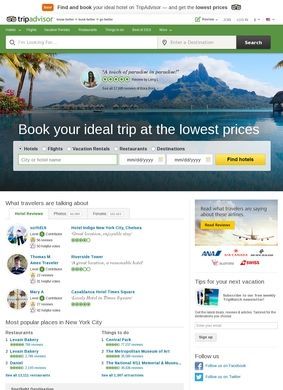
Trip Advisor is a travel guidance and review site, based in the United States, that has grown into one of the largest repositories of traveler opinion anywhere online. The number it puts forward is over a billion reviews and contributions, and that scale is the whole point of the place.
Hotels, restaurants, things to do
When someone is deciding between two hotels in Lisbon or trying to figure out whether a restaurant near their conference venue is any good, the draw is volume: enough voices that the outliers wash out and a rough consensus emerges. Trip Advisor organizes all of that around four main pillars, namely hotels, restaurants, things to do, and cruises, and most of what a visitor does on the site funnels into one of those four. None of it is hidden behind a paywall to read, which is worth noting when the whole reason to consult a place like this is to gather opinions before you spend money.
Booking experiences and activities
The things-to-do category is the one that has clearly absorbed the most product effort at Trip Advisor. The site lists more than 400,000 bookable experiences, meaning tours, day trips, classes, tickets and activities you can reserve and pay for without leaving the page. This is the part of the operation that has moved well past being a pure review board. You can search a city, filter by what you feel like doing, and book a guided walk or a cooking session the same way you would book a hotel night. The accommodation side works similarly: search, compare, read what previous guests wrote, and book. Pulling those bookings inside Trip Advisor itself, instead of pointing visitors off to a third party, makes the platform feel less like a reference and more like a place where a trip gets assembled.
Reviews and traveler ratings
What keeps people coming back, though, is still the reviews. Anyone can read them, and registered travelers can submit their own. Trip Advisor layers editorial structure on top of that raw material through curated lists, the best known being the Travelers' Choice Awards, which rank hotels, restaurants and destinations by a mix of rating and review activity. There are also destination hubs for the obvious heavyweights, with Rome, Paris and New York front and center, plus interest-based entry points for travelers who prefer to start from a mood rather than a map. The outdoors, food, culture and water-activity categories let you browse by the kind of trip you want instead of a place you have already chosen.
On the homepage Trip Advisor now runs an AI-driven trip-planning quiz, which asks about your preferences and returns suggestions tailored, in theory, to what you said. These features often produce the same handful of crowd-pleaser answers regardless of what you type, and a few minutes with it tends to confirm that it does little a couple of targeted searches would not. It is harmless and occasionally a useful nudge for someone who genuinely does not know where to start, but it is not the reason to use Trip Advisor. The deeper value is still the searchable, filterable mass of listings underneath it.
Trip Advisor also runs a rewards program that hands out discounts on activity bookings, a sensible way to push people toward booking experiences through the platform instead of going direct to an operator. For someone who books a lot of tours and tickets across a year, that adds up to a real saving. The Trip Advisor mobile apps, on iOS and Android, carry the same functionality in a form that makes more sense once you are on the road, since the moment you most want a restaurant recommendation is usually when you are standing on a street corner with a dead afternoon to fill.
Worth saying plainly: the reviews are user-generated, and that is both the strength and the recurring complaint. A consensus drawn from hundreds of strangers smooths out one person's bad mood or unusually high standards, but it also means the occasional review is planted, mistaken, or written by someone with very different expectations than yours. Reading three or four entries at different star levels tells you far more than skimming the average score, and Trip Advisor does at least make that easy by letting you sort and filter. Treating the rating as a starting point rather than a verdict is the way to get real use out of it.
The business-facing side of Trip Advisor is substantial enough to mention, because it explains how the whole thing pays for itself. The company sells sponsored placements and advertising programs to operators, offers a content API for partners who want to pull listings into their own products, and runs affiliate partnerships. Owners can claim, list and manage their properties through a dedicated business directory portal, responding to reviews and keeping their information current. That dual nature, a consumer review site that is also a marketing channel for the businesses being reviewed, is the structural tension at the heart of every large platform of this type, and Trip Advisor is no exception. It does not invalidate the reviews, but it is the reason the curated lists and sponsored slots sit so close together.
There is also a media and press room at a separate subdomain, serving journalists and partners with announcements and company information. Most travelers will never touch it, but it keeps corporate communication out of the consumer-facing experience, which is the right call.
In practice, what Trip Advisor does best is breadth. Very few competing services try to cover hotels, dining, attractions, tours and cruises under one login, and fewer still bring this much accumulated opinion to each of those categories. The combination is what makes Trip Advisor sticky: once your saved places and past reviews live there, the cost of starting over somewhere else is enough to keep you returning. The coverage runs genuinely global, so Trip Advisor is roughly as useful for a small town as it is for a capital city, even if the depth of reviews naturally falls off in less-visited places.
The honest caveat is that breadth can come at the cost of depth. A dedicated restaurant guide may carry sharper commentary on dining in a given city, and a specialist hotel-booking service may surface better rates. Trip Advisor is the generalist here, and generalists win on convenience and lose, sometimes, on the last ten percent of detail. For most trip planning that trade is well worth making.
Comparing Trip Advisor with Google Maps
Set against something like Google Maps, which has quietly become a serious rival for restaurant and attraction reviews thanks to sheer ubiquity and tighter integration with directions and hours, Trip Advisor holds a clear edge on one front: the bookable experiences and the long-form, travel-specific reviews that Google's quick star-and-snippet format does not really replicate. Google wins on immediacy. Trip Advisor wins when the question is bigger, when you are weighing an entire itinerary, hunting for a tour to fill a free day, or trying to read enough firsthand accounts to trust a hotel you have never seen. For that planning-heavy stretch of a trip, it remains the more complete tool of the two.