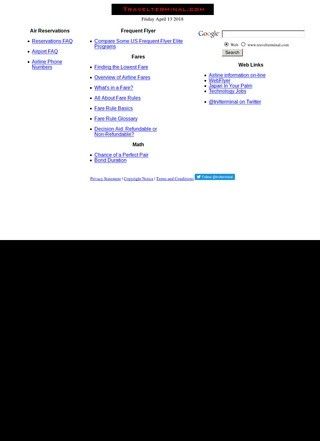
What happens to a refundable fare when you cancel, and why does the same seat cost three different prices on three different days? Travel Terminal sets out to answer questions like these, and it does so without the booking-engine clutter that surrounds most travel sites. There is nothing to buy here. It is a US-based reference site built around air travel mechanics: how reservations work, how airports operate, how fares are constructed, and how loyalty programs reward the people who fly often. A traveler who wants to understand the machinery behind a ticket, not a deal on one, is the reader it has in mind.
Airfare pricing structures explained
The strongest material sits in the airfare section. Travel Terminal walks through pricing structures, the logic behind low fares and when they appear, fare restrictions, refundability rules, and a glossary that unpacks the terminology airlines use without ever explaining. That glossary is more useful than it first looks, because fare jargon is where a lot of passengers quietly lose money. The site treats this as something worth learning rather than something to gloss over, and the result reads like notes from someone who has spent real time decoding ticket rules. I found the framing genuinely practical, the sort of thing a nervous first-time flyer or a price-sensitive regular could read in one sitting and come away better armed.
Fare restrictions, refunds, airline terminology
Alongside the fare material, Travel Terminal covers frequent flyer loyalty programs in some depth, including comparisons of elite status across different carriers. That comparison angle matters, because elite tiers are where airlines bury the differences that actually affect a regular traveler: upgrade priority, baggage allowances, boarding order, and how quickly miles expire. Laying several carriers side by side is more helpful than reading one airline's own glowing description of its own scheme.
Frequent flyer programs compared
There is also a set of FAQs on airline reservations and airport operations, plus a compiled list of airline customer service phone numbers. That phone-number directory is a small thing that solves a real annoyance, since finding the right line to call an airline is often harder than it should be. The site rounds this out with links to external airline databases and to FlyerTalk, the long-running frequent flyer community forum, which is a sensible place to send anyone who wants to go deeper than a reference page can take them. Pointing readers outward to a well-known community is a mark of a site that knows its own limits.
Elite status differences across carriers
Then the scope wanders. Travel Terminal also hosts a couple of mathematical tools that have nothing to do with flying: a probability calculator and a bond calculator. These are harmless, and someone clearly found them handy enough to keep, but they sit oddly next to airline content and do nothing for the site's focus. A visitor arriving for fare advice will wonder why a bond calculator is sharing the roof. It reads like leftover material from a more general utility site that never got pruned.
Practical tools for air travel
The credibility picture is harder to read. Travel Terminal carries no visible contact route at all. There is no phone number for the site itself, no email, no postal address, and no contact form anywhere on the homepage or the pages retrieved. The only links of that administrative kind point to privacy, copyright, and terms policies. For a site whose entire value is information rather than transactions, the absence is not fatal, since nobody is handing over a credit card. But it does leave a question hanging about who maintains the content and how current it stays. A reader cannot ask the site a question or flag an error, and that puts more weight on taking the material at face value.
FAQs, phone numbers, external links
The reputation side is similarly quiet. A search for the site surfaces no third-party reviews or ratings tied to www.travelterminal.com specifically. What does come up is a tangle of unrelated names: a Turkish travel agency on Facebook, an Indian railway booking portal, and a separate fareterminal.com that has its own Trustpilot presence. None of those is this site, and it would be easy for a casual searcher to conflate them. So Travel Terminal arrives with no outside score to lean on, good or bad. It has a Twitter account under the handle trvlterminal, which at least signals that someone has been at the wheel, but a social handle is not the same as an audience vouching for the work.
Unrelated calculators that lack focus
That quietness cuts two ways. On one hand, the lack of reviews means there is no record of anyone being burned, and an informational site that never asks for money rarely generates the complaints that fill review pages. On the other, there is nothing external to confirm the accuracy of what is written, which in a field like fare rules can shift as airlines change policy. The content has to stand on its own internal logic, and to its credit, most of it does.
No contact information available
The airline material in Travel Terminal is specific and clearly organized. It explains things that airlines themselves tend to leave murky, and it does it in plain language. Someone trying to grasp why fares behave the way they do, or trying to decide whether chasing elite status is worth the effort, will get real footing here. The phone directory and the FlyerTalk pointer add practical value beyond the explainers.
Third-party reviews and social presence
The verdict lands somewhere in the middle, and honestly so. Travel Terminal is a useful free reference for the mechanics of air travel, with genuinely instructive fare and loyalty sections, dragged down a little by the off-topic calculators and, more seriously, by the complete absence of any way to reach whoever runs it. As a quick study aid before a trip or before a mileage-program decision, it does the job. As a source you would cite or rely on for a high-stakes call, the missing accountability gives reason to double-check anything important against the airline directly. Read it as a helpful primer, not as gospel.