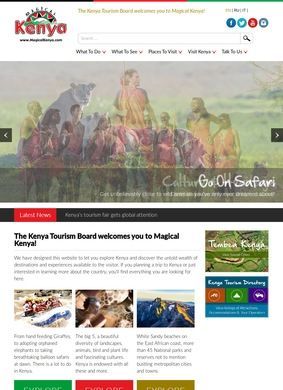
A traveler who has settled on Kenya wants the country described by the people who actually run its tourism, not by a tour operator angling to close a sale. That is the gap Magical Kenya sets out to fill. It presents itself as the official magazine of the Kenya Tourism Board, a digital publication built to walk a prospective visitor through the country's landscapes, its wildlife, its headline destinations, and the kinds of travel experiences that a generic tour listing would skip over.
As a piece of inspiration, that positioning makes sense. A national tourism board has every reason to gather the savannah, the coast, the highlands and the game parks into one editorial place where a traveler can browse before deciding anything. The magazine framing signals that the content is meant to be read and lingered over, closer to a glossy feature spread than a booking engine.
Which is the first thing to be clear about. Magical Kenya is a magazine, not a reservations desk. It points at what a trip could hold; it does not, on its own, put a bed under a visitor or a guide at their side.
What the publication trades in is atmosphere and orientation. The wildlife and the scenery are the whole pitch, and the magazine format suits that pitch, since photography and destination writing sell a safari far better than a fare table ever could. A reader comes away with a sense of where they might go and why, which is exactly the job a tourism board wants its front-of-house title to do. What that reader does not come away with is a confirmed booking, and Magical Kenya never pretends otherwise.
That orientation role has a hard edge to it. A traveler who arrives wanting concrete tools, the park fees, a booking calendar, the fine print on entry requirements, is standing one layer above where those answers actually live, and the publication is content to leave the execution to somebody else.
As a way to fall for the idea of a trip it works. As the single tab that carries a family from curiosity to a confirmed safari, it was never built to, and knowing which of those two things a visitor needs before opening it saves a good deal of frustration later.
One brand spread across several official sites
The name attaches to more than a single web address, and that is worth understanding before a traveler goes looking. Magical Kenya is the consumer-facing publication, but it sits inside a wider set of properties run by the same government agency, each built for a different job. Some of those jobs are for the tourist. Others are for the travel trade that sells Kenya abroad.
For a first-time visitor the distinction is easy to miss, and it can send someone in circles. A person hunting for practical trip planning may land on the magazine, read some genuinely good destination writing, and still be a step short of the tools that actually arrange the trip. The material and the machinery live under one banner but not always on one page, and the Magical Kenya name rides across all of it.
The Kenya Tourism Board behind it
The credibility of the operation rests on who owns it. The Kenya Tourism Board is a Kenyan state corporation, established and regulated under the country's Tourism Act, with a defined mandate to market Kenya's tourism products at home and overseas. This is a public agency doing a public job, and its separate government portal at ktb.go.ke handles the institutional and corporate side of that mandate.
Splitting the two makes sense on paper. A traveler dreaming about a coastal escape and a civil servant reading procurement notices want nothing in common, so the board keeps the inspirational magazine apart from the government portal. The upshot for a visitor is that Magical Kenya stays fixed on the travel story while the dry administrative material lives somewhere else entirely, which is the correct call for a consumer title.
The Magical Kenya specialist program
Behind the consumer magazine runs an accreditation track aimed squarely at the trade. Through a KTB service portal, travel agents and tour sellers can register for the Magical Kenya Specialist Program, a certification designed to train the people who sell Kenya to clients in other countries. The logic is straightforward: an agent who knows the parks, the seasons and the regions will sell the destination more accurately than one working off guesswork.
That program matters to a would-be traveler even though it is not built for them. If the agent booking a safari carries this certification, the advice on the other end of the line should be grounded in real knowledge of the country. It is the sort of quiet infrastructure that shapes the quality of a trip without the tourist ever seeing it directly, and its existence says the board cares whether the people reselling Kenya abroad actually understand the place.
The Magical Kenya travel expo
The brand also anchors a live event. The Magical Kenya Travel Expo, at mkte.co.ke, is an annual trade show held in Nairobi that brings international buyers together with Kenyan tourism suppliers. This is business-to-business ground, where operators, hoteliers and inbound agents meet the wholesalers who will package and resell the country.
For the ordinary holidaymaker the Expo is background rather than a destination, but it explains a lot about how a Kenyan trip reaches a foreign customer in the first place. The supply chain that turns a magazine feature into a booked itinerary runs partly through this room, and Magical Kenya lends its name to that room as much as to the pages a tourist reads. Between the magazine, the specialist certification and the Expo, the board covers inspiration, trade knowledge and dealmaking under one identity, which is a genuinely coherent spread of functions for a single brand to hold together.
The reach of the consumer side is large. The official Magical Kenya accounts on Instagram, Facebook and X carry sizeable followings, with the Facebook page alone counting several hundred thousand followers, so the destination photography and travel stories land in front of a wide audience wherever people already scroll. For a country selling itself on scenery and wildlife, that visual reach is a real asset, and it keeps the brand in front of travelers who have not yet started planning a thing.
The audience question sits underneath all of this. Someone booking through an agent may never open the magazine at all, since their trip is shaped by a certified seller working from the trade side of the operation. Someone planning independently leans on exactly this kind of destination writing and then has to go hunting for the booking tools elsewhere, on sites the magazine gestures toward but does not contain. The same brand serves both travelers, and it hands each of them a very different share of the actual work.
The honest doubt is concrete, not abstract. The flagship magazine, the piece of this whole apparatus a traveler is most likely to reach for first, would not load on repeated attempts, returning an access-forbidden error at the front door and failing again through a fallback route. For an official tourism magazine whose entire purpose is to be read and shared, a site that turns visitors away is a real problem, and it is impossible to tell from outside whether that was a passing outage or a standing barrier.
So the picture that remains is a strong brand, a legitimate government agency, a sensible split between consumer and trade, and a front page that, when someone actually tried to open it, was not there to greet them. Whether Magical Kenya delivers on its promise depends, in the end, on a front door that simply would not open when a traveler went to knock on it.