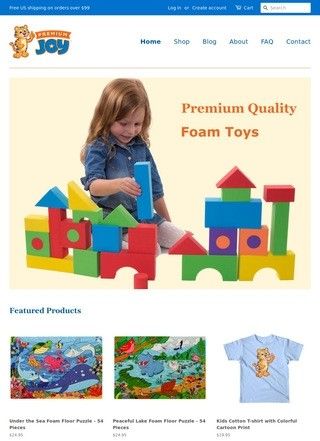
Premium Joy started life selling toys and then walked away from the product business entirely, around 2022, after freight costs made the math stop working. What remains is a parenting blog that grew out of that earlier venture, and the shift is the most telling thing about Premium Joy. The site still carries the language and instincts of a toy reviewer, but the thing it now sells is reading material instead of anything you put in a cart.
Four content categories and their focus
Premium Joy launched in 2017 and organizes its writing into four buckets: parenting tips, kids toys, kids learning, and children puzzles. The parenting tips cover the day-to-day grind that wears parents down, things like sleep routines, discipline, and the ordinary family conflicts that do not show up in baby books. The toy material leans on Premium Joy's old expertise, with reviews and recommendations aimed at toys that supposedly help a child develop through play. Learning content covers activities and strategies, and the puzzles section deals with problem-solving for kids. A shop section is still bolted onto the site, a leftover from the product era, though the brief gives no sign that it is the point anymore.
Toy reviews grounded in product expertise
What gives the toy coverage a bit of weight is the history behind it. As a toy brand, Premium Joy collected a Moms Choice Award and a Creative Child Award. Those credentials belong to the products it used to sell, not to the blog posts, so it would be a stretch to read them as endorsements of the current writing. Still, they tell you the people behind the site were not strangers to the children's product world, and that background plausibly shapes how the toy reviews are framed.
The article topics are more specific than the four tidy categories suggest, and that specificity is where the site reads as genuine. There are pieces on lightweight strollers, sensory toys, and bubble toys, the practical purchase-decision stuff parents search for at odd hours. Then there is a vein of nostalgia, with writing on kids' toys from earlier generations, which fits a blog founded by people who clearly think about toys for a living.
Medical content and health literacy for families
More interesting are the pieces that drift toward the medical and the cautious. The site has covered topical numbing creams for children and broader medical literacy for families, which is a heavier subject than bubble toys and a sign the blog is willing to wade into territory where parents most want a steady second opinion. That mix, light buying guides next to careful health-adjacent writing, is the shape of a publication with an actual editorial brief, not a keyword farm assembled to chase ad clicks.
Editorial approach versus keyword farming
The parenting tips section is where the blog separates itself from a pure shopping resource. Sleep routines, discipline, and family challenges are the topics parents lose sleep over, and they take more effort to write well than a stroller roundup, demanding some lived perspective. The learning and puzzles sections round things out with activities and problem-solving content aimed at the developmental side of childhood, which dovetails with the toy reviews instead of pulling in a different direction. Taken together, the four Premium Joy categories read as a coherent editorial plan and not a scattershot grab at search traffic, even if the depth of any single article is something a visitor has to judge alone.
Developmental framing in toy selection
The framing of the toy content stays consistent with the brand's origins. Premium Joy describes itself as reviewing toys that help children develop through play, naming interactive learning games and developmental puzzles as the sort of thing it looks at. Whether every Premium Joy review lives up to that developmental claim is not something the brief can settle, and a reader should treat "helps children develop" as a marketing posture worth verifying against the actual writeups.
Credibility gaps in health-adjacent writing
One honest limitation: a parenting blog rises or falls on whether you trust the voice giving the advice, and the brief does not surface bylines, author bios, or any named expert standing behind the medical-adjacent posts. For stroller picks that gap barely registers. For an article touching numbing creams on children, a careful parent would want to see who wrote it before acting on anything. The brief notes the site frames itself around medical literacy for families, which is a worthy aim, but worthy aims on health topics carry an obligation to show your credentials, and that is the one place where the site stays quiet. A reader can still take the buying guides at face value while holding the health material to a higher bar.
Contact information and site transparency
Contact sits behind a single page. Premium Joy keeps a Contact link on the site, but no phone number or email shows on the homepage, and the Montana address lives in the site metadata without being put front and center. None of that is unusual for a blog that no longer ships products, and a contact page is a reasonable amount of access for a publication of this type. It is worth noting only because it confirms the operation now behaves like a content site rather than a store expecting you to call about an order.
Absence of third-party reviews or ratings
On outside validation, there is very little to go on. The Facebook page sits at "Not yet rated" with zero reviews, and nothing turns up on Google, Trustpilot, Yelp, or the BBB. No notable third-party coverage surfaced at all. For a toy shop that absence would be a red flag, but for a blog it mostly means the writing has not generated the kind of reviewable transaction that produces star ratings. Readers tend not to leave Trustpilot reviews for free articles. So the silence is less damning than it would be for a merchant, though it does leave a visitor with no external signal of quality beyond what they can judge from the posts themselves.
Comparing Premium Joy to broader parenting sites
That self-judgment is really the only test available here. The pivot from selling toys to writing about parenting was a deliberate response to a cost problem the company has been open about, and the result is a site whose strongest asset is a back catalog of practical, child-focused articles written by people with a toy-industry past. The awards date to the product era and do not transfer to the blog posts, the reputation trail is mostly empty, and the medical-leaning content carries the risk that always comes with un-bylined health advice on the open web.
Set against a destination like Verywell Family, which a parent might just as easily land on for the same sleep and discipline questions, Premium Joy is the smaller, narrower option. Verywell brings a deep library and a visible medical-review process; Premium Joy brings a tighter focus on toys and play, plus the texture of a site built by people who genuinely know that corner. A parent hunting for a developmental toy recommendation or a sensory-play idea will probably get more usable specifics from Premium Joy than from a sprawling general site. A parent weighing anything medical should read the bigger, better-credentialed source first and treat Premium Joy as a supporting voice. On those terms, it is a worthwhile bookmark for the toy-and-play niche it knows best, and a more cautious read everywhere else.