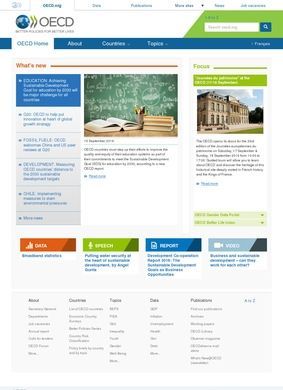
Thirty-eight governments fund a single organisation in Paris whose job is, broadly, to compare how countries run their economies and then tell each other what is working. That is the OECD in a sentence, and it is worth keeping in mind when you land on www.oecd.org, because the breadth on display can otherwise feel scattered. Investment is only one of the topics it covers, sitting alongside trade, taxation, education, health, employment, environment and governance. For someone arriving specifically to read about foreign direct investment or cross-border capital rules, the trick is knowing that the investment material is a slice of a much larger research operation, not a standalone product.
Investment guidelines and policy tools
Under that investment heading, the substance is dense and unusually concrete. The site publishes the OECD Guidelines for Multinational Enterprises, which set out expected conduct for companies operating across borders, and the Policy Framework for Investment, which reads more like a checklist governments use when they want to attract capital without giving away the store. Alongside the policy texts sit the numbers: FDI statistics and the regulatory restrictiveness index, which scores how open or closed a country is to foreign investors across sectors. That index in particular is the sort of thing a researcher or a journalist can actually cite, because it puts a figure on something usually discussed in vague terms.
Tax rules and transfer pricing work
Tax is where the investment work bleeds into the rest of the catalogue, and it is hard to overstate how central this has become. The transfer pricing guidelines, used by tax authorities and multinationals alike to decide how profits get allocated between countries, live here. So do the materials for the Base Erosion and Profit Shifting project, the long-running effort to stop companies booking income wherever the rate is lowest. The OECD also maintains the multilateral instrument that lets countries amend thousands of bilateral tax treaties at once, and it runs the Global Forum on Transparency and Exchange of Information for Tax Purposes. None of this is light reading, but it is the primary source for an entire field of practice.
Statistical databases behind the analysis
The statistical side is the part I find myself returning to, because the analysis is only as good as the figures underneath it. OECD.Stat and the iLibrary together hold national accounts, capital flows and regulatory data for member and partner countries, and the coverage stretches well past the 38 members into a long list of partner economies. For anyone building a model or checking a claim, having harmonised series across dozens of countries in one place removes a lot of the drudgery that usually comes with stitching together national sources that all count things slightly differently.
Free reports versus paid subscriptions
Access is split. A good deal of the reports, working papers and datasets are free to read or download, while books and some deeper datasets sit behind a subscription. That distinction matters depending on who you are. A government department or a university library will likely have the paid access already; an independent analyst or a curious member of the public will hit the wall on certain titles. The free tier is genuinely substantial, though, and the working papers in particular tend to be open, which is where a lot of the newest thinking shows up before it reaches the polished flagship reports.
Finding data by country or topic
Navigation is organised around a handful of entry points: Data, Topics, Countries, Publications and About. The Countries view is the one I would steer a newcomer toward, since it pulls the scattered investment, tax and trade material for a single nation into one place, which beats hunting topic by topic. The Topics route works the other way, gathering everything on, say, investment across every country. Both are reasonable, and the dual structure reflects the two ways people genuinely arrive: either asking about a place or asking about a subject.
Inside the Better Life Index
It is also worth naming the lighter material, because the catalogue runs well past flagship reports and treaty annexes. The Better Life Index is an interactive tool that lets a visitor weight things like income, housing, health and work-life balance to see how countries rank on their own terms. It is a smart piece of public-facing work, the kind of thing that gets used in a classroom, and it sits comfortably next to the heavier statistical machinery without pretending to be a research instrument itself. The OECD clearly understands that the same institution serving finance ministries also has to explain itself to people who will never read a treaty, and the index is the cleanest example of that second job being done well.
Who actually uses this material?
In practice the audience spans governments drawing on the analysis to shape rules, academics mining the datasets, businesses checking how a market is regulated, journalists looking for a defensible figure, and ordinary readers trying to follow a policy debate. The writing assumes a certain seriousness, so a complete beginner may find the flagship reports heavy going. The layering helps: summaries and briefs sit above the full studies, and the Better Life Index provides an entry point for people who would never open a working paper.
Behind the size of the site
The fair criticism is that the sheer scale works against a first-time visitor. A dozen domains compete for space on the homepage, and finding the precise document sometimes takes a few extra clicks. Ministerial meetings and global forums add yet another stream of communiques and event materials. A first visit can feel like walking into a very large reference library with no help desk. The structure rewards repeat visits, and the OECD seems to assume its core audience returns often enough to learn the layout.
Combining measurement with rule-setting
The investment offering is distinctive because it is normative as well as descriptive. Beyond counting foreign direct investment flows, the OECD sets standards for how that investment ought to behave, through the Guidelines for Multinational Enterprises and the anti-bribery convention. That combination of measurement and rule-setting is rare. Plenty of bodies publish statistics, and plenty publish principles, but having both under one roof, cross-referenced against each other, is part of why the OECD material pulls so much weight in policy circles.
A search for user reviews of oecd.org on consumer rating platforms turns up essentially nothing, which is predictable: this is an intergovernmental research organisation, not a service being rated by its customers. The credibility of the OECD rests on its institutional record and the frequency with which its data appears in government budgets, court filings and academic citations, none of which show up in star ratings.
The practical question for a visitor is less about whether the OECD is credible and more about matching the resource to the task. If you need the authoritative text of a tax guideline or a comparable FDI figure across countries, this is the source the rest of the field tends to defer to. If you want a quick consumer-grade summary of a country's economy, you may find the depth more than you bargained for. Either way, the material is here, organised, and largely traceable to its underlying data.