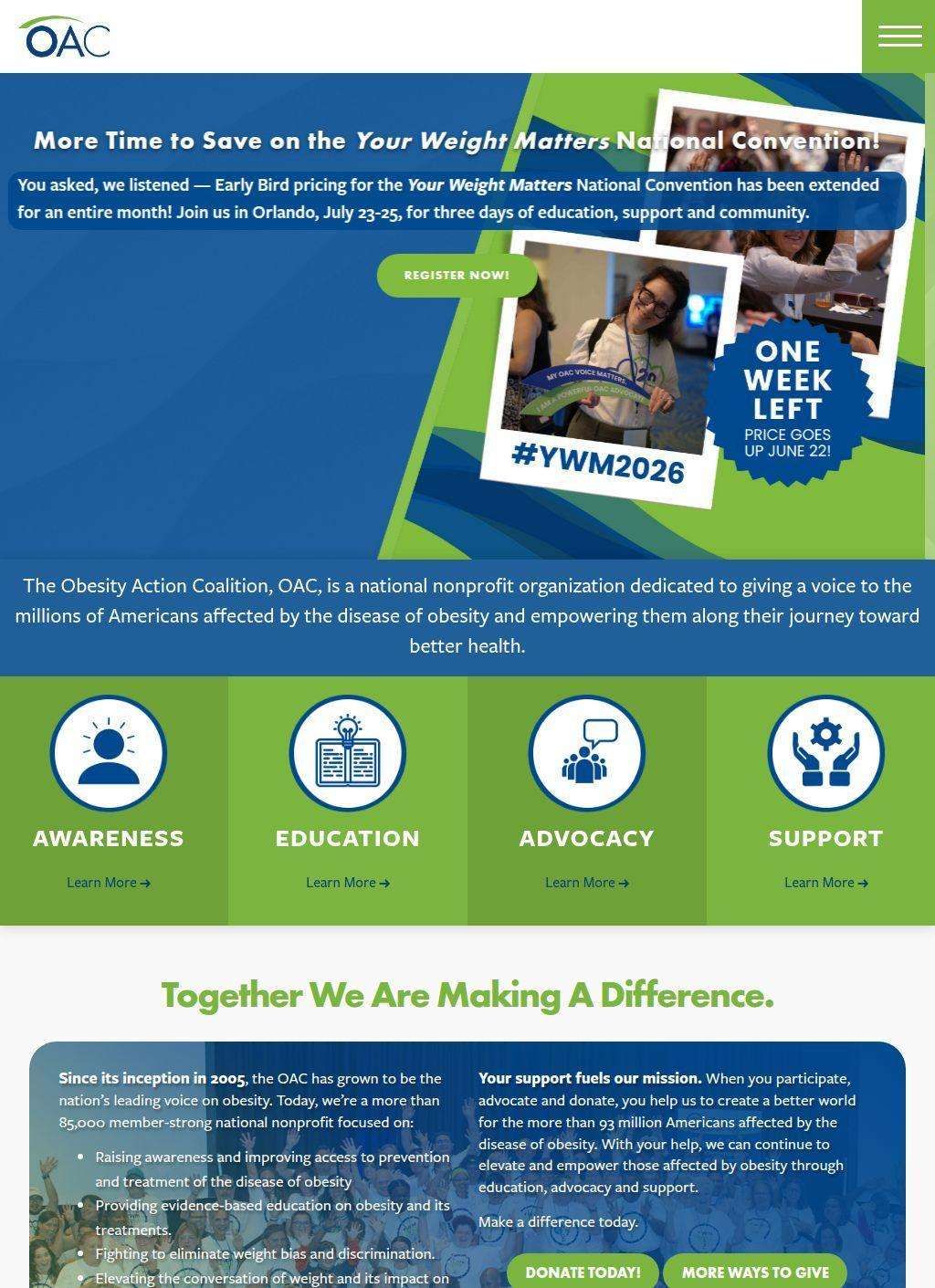
Weight Matters Magazine arrives in both print and digital form, and it is a fair introduction to what the Obesity Action Coalition is built to do: take the science and lived experience of obesity and turn it into something a member can actually read, keep, and pass along. The Tampa-based nonprofit counts more than 85,000 members, and the site is organized around serving them rather than selling to them. That distinction shows up quickly. The first thing a visitor meets is not a pitch but a library.
Education library for patients, families, providers
The starting premise here is that obesity is a disease, and the entire structure of the Obesity Action Coalition flows from that position. Resources are written for people affected by obesity, for their families, and for the healthcare providers who treat them. That three-way audience could easily produce a muddled site, with clinical jargon talking past patients and patient stories offering nothing to clinicians. The Obesity Action Coalition mostly avoids that trap by separating its material into clear lanes and letting each one go deep instead of skimming.
Learning resources across treatment options
The learning library is the core of the offering, and it is broad without feeling padded. It covers what causes obesity, the range of treatment options, nutrition, exercise, and mental health. That is a more honest spread than sites that reduce the whole subject to diet tips. Putting mental health alongside the physical pieces tells you the Obesity Action Coalition understands that weight is about far more than calories and movement.
Childhood obesity materials and Health Talks
There is a dedicated section on childhood and adolescent obesity, which is a harder topic to handle well and tends to get skipped or softened elsewhere. Families looking for material aimed at younger ages have a real place to land here. Alongside the written resources sit OAC Health Talks, a set of educational video and audio pieces for people who would rather watch or listen than read through a long page. That mix of formats quietly widens who the material can reach.
Treatment information without product bias
The treatment-options section reads like it was written to inform a decision, not to steer one toward a particular product. For an area of health where bad information travels fast, that restraint keeps the section usable. I spent the longest stretch inside it, and the depth held.
Policy advocacy and community support
Beyond education, the Obesity Action Coalition does the slower work of policy. The Action Center is the hub for state and federal advocacy, aimed at eliminating weight bias and widening access to obesity care. This is where the organization stops being a reading room and starts trying to change the conditions its members live under. Coverage decisions, treatment access, and the way obesity is talked about in public are all fair game.
Bias-Free Image Gallery for media
The Bias-Free Image Gallery is a concrete extension of that same fight. Media coverage of obesity has long leaned on dehumanizing stock photos, the headless-torso shots and the rest, and the gallery gives writers and editors a better alternative. It is a practical tool, and it puts the Obesity Action Coalition stance into something a journalist can use today.
Peer networks and annual convention
Membership runs through OAC Community+, a platform that connects people into regional peer-support networks. The annual Your Weight Matters National Convention pulls that community together in person once a year. Peer support is one of those things that sounds soft until you need it, and the Obesity Action Coalition has built standing structures for it, so members have a place to land without having to piece together their own networks.
Independent coverage of the Obesity Action Coalition is not hard to find. Google returns a substantial number of reviews across several platforms, the counts running well into the hundreds. The organization has been around long enough that independent commentary is easy to find, and most of it aligns with what the site itself describes: a serious, patient-centered nonprofit with real infrastructure behind it.
Checking independent reviews and merchandise
The merchandise store sits a little apart from everything else. A nonprofit selling branded goods is ordinary enough, and it can double as a fundraising channel, but it is the one corner of the site that points outward toward a transaction instead of inward toward a member. Worth knowing it is there; it does not define the place.
Taken together, the pieces fit a coherent mission. Education feeds awareness, awareness feeds advocacy, and the community layer keeps members engaged between the magazine issues and the yearly convention. The Obesity Action Coalition is not trying to be a clinic or a weight-loss program, and it is upfront about that. It points people toward understanding their options and toward others walking the same road.
What you will not find is a quick fix. There is no calorie tracker promising results by summer, no before-and-after wall, no plan to buy. For someone arriving in search of a diet to start tomorrow, the Obesity Action Coalition may feel like a detour. For someone trying to understand the disease, weigh real treatment paths, or push back against the bias that surrounds it, the depth on offer is the point. A single visit cannot cover the learning library, the childhood section, the Health Talks archive, the magazine, the advocacy tools, and the community platform, and the Obesity Action Coalition does not pretend otherwise. It is structured as a place to return to, with material that rewards a second and third look more than a quick scan.
One stretch sits with me afterward: the framing that runs underneath all of it, treating the people in its orbit as patients with a medical condition rather than as failures of willpower. That framing shapes the tone of the writing, the choice of images in the gallery, and the policy goals in the Action Center. The magazine on the doormat and the convention badge are the visible edges of a single argument the Obesity Action Coalition has been making for years, and the site is where that argument is laid out in full.
Business address
Obesity Action Coalition
4511 North Himes Avenue, Suite 250,
Tampa,
FL
33614
United States
Contact details
Phone: (800) 717-3117