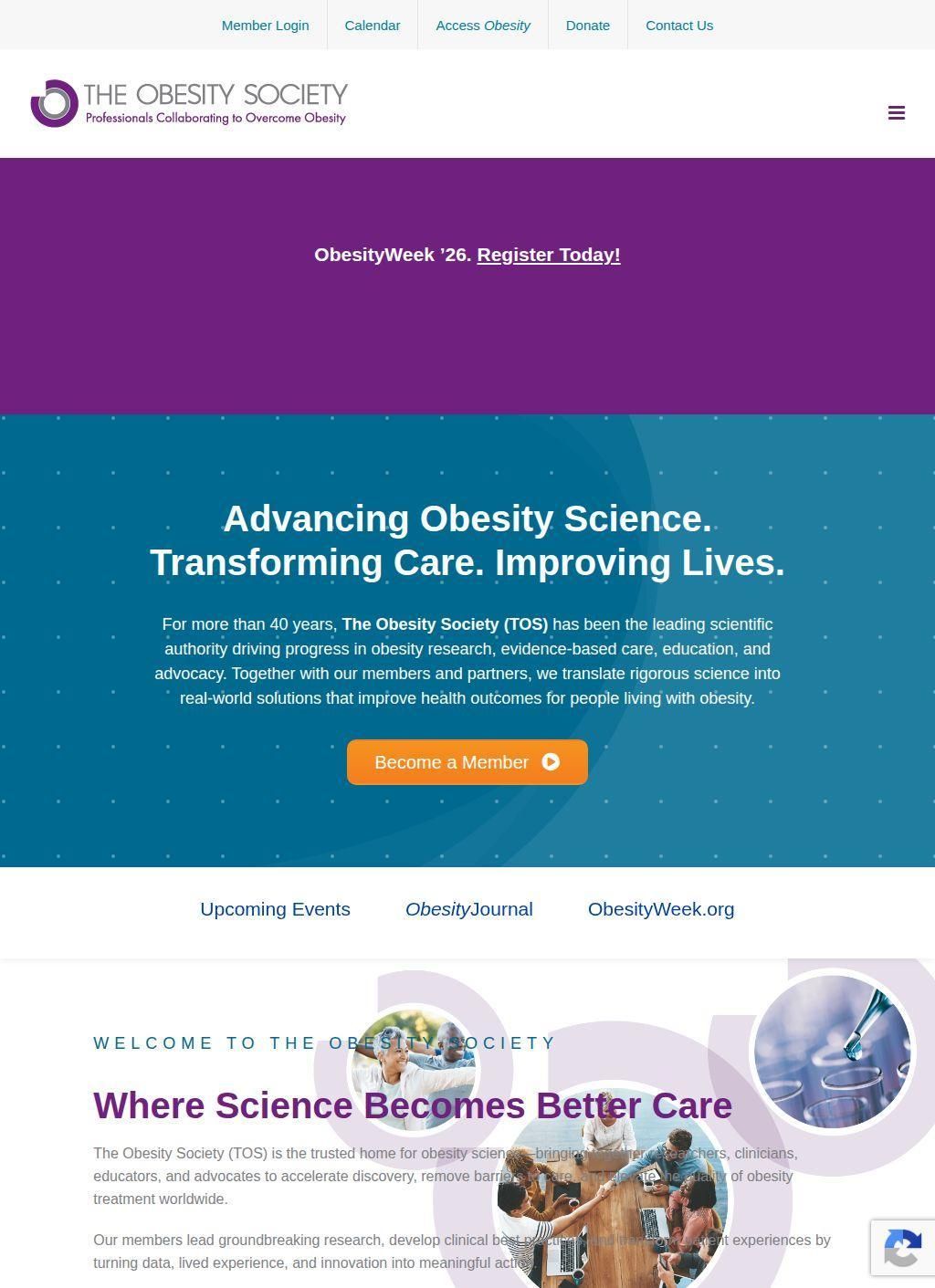
A clinician treating patients with obesity runs into the same wall fairly quickly: the field moves fast, the guidance is contested, and the line between marketing and medicine is not always obvious from a search engine. The Obesity Society occupies a specific and useful position in that landscape. It is a nonprofit professional and scientific membership organization, more than forty years old and headquartered in Rockville, Maryland, built around obesity research, evidence-based clinical care, education, and policy work. Researchers, practicing clinicians, educators, advocacy professionals, and patients all have a reason to land here, though the mix of what each gets from it varies considerably.
Peer-reviewed journals for obesity research
The two peer-reviewed journals are the operational center. Obesity is the flagship title, and Obesity Science and Practice runs alongside it. A reader chasing the actual literature on a treatment or a mechanism has a direct path to vetted work instead of secondhand summaries, and that separates The Obesity Society from the bulk of weight-related material online, where the science tends to arrive pre-digested and often distorted. If you want to read what the researchers themselves are publishing, you can. That access is not incidental to the organization's purpose; it is the purpose.
Education programs for clinical practitioners
Beyond the journals there is a heavy education program aimed at people who treat obesity rather than people casually curious about it. The ABOM Review Course supports clinicians preparing for board certification in obesity medicine. Best Practices Workshops, Grand Rounds, and Coffee with the Expert sessions fill in the gaps between formal credentials and day-to-day decisions, and a library of on-demand webinars means none of it is tied to a single calendar date. The Obesity Society also produces the Dialogues in Obesity Podcast for practitioners who absorb material better by listening than reading.
Member directories and professional development
Membership in The Obesity Society opens a set of practical tools the public pages only hint at. A Member Directory and a separate Provider Directory give the field a searchable map of who works in this area, the latter especially useful for anyone trying to find a clinician who treats obesity as a primary specialty. Fellowship and awards programs, grant opportunities for active researchers, and mentorship and career development resources round out what the organization offers people at different stages of their path. Members can join committees and sections, which is where a professional body either earns its relevance or becomes a credential people list and ignore, and the committee structure here has enough specificity to suggest actual participation rather than nominal affiliation.
Connecting journalists with obesity experts
One offering deserves its own mention because it reaches outside the membership. The Spokesperson Network connects journalists with credentialed obesity experts. That is a quiet but meaningful service: a reporter writing about a new drug or a policy fight can reach an actual specialist instead of relying on whoever answers first. Given how much bad obesity coverage circulates, having a structured pipeline from the press to qualified voices does real public good, and The Obesity Society is one of the few professional organizations in this space with both the credentialed roster and the infrastructure to run it well.
The free Pocket Guide on obesity treatment is worth pulling up even for clinicians who are not members. It distills evidence-based treatment guidance into a reference you can keep at hand during a consultation, and The Obesity Society offers it without a paywall. That choice reflects something about organizational priorities that a price tag would have obscured.
The annual conference, ObesityWeek, is the event the rest of the year seems to orbit. The 2026 edition runs in Washington, DC, from November 14 to 17. This is where research presentations, clinical sessions, and professional networking converge, and for many members it is the single most concrete reason to belong. A field this active needs a place to argue in person, and ObesityWeek is that place. The Obesity Society has run this conference long enough that the program structure reflects what the field wants to discuss, not what a conference committee thought sounded good on paper.
The organization also does policy advocacy on obesity-related issues, which fits the rest of the picture. A group that publishes the science, trains the clinicians, and certifies the expertise is well positioned to weigh in when legislation or insurance coverage is on the table. The advocacy The Obesity Society pursues is grounded in the same research base the rest of the site rests on, which is more than can be said for most obesity policy, which gets driven by anecdote and ideology as often as by evidence.
What makes this resource different from consumer sites?
It is worth being clear about who this resource is not built for. Someone looking for a quick diet plan or a consumer weight-loss program will find very little to use here, and that is by design. The Obesity Society treats obesity as a chronic medical condition and a scientific subject, not a self-help genre. Patient-facing material exists, but it is framed by clinical evidence, so a reader expecting tips and tricks will feel out of place. That narrowness is a strength for the right visitor and a mismatch for the wrong one.
The breadth can also be a little overwhelming on a first visit. Between journals, courses, directories, podcasts, awards, grants, and the conference, the site carries a lot, and a newcomer may need a few minutes to figure out which door applies to them. The Obesity Society is not a landing page dressed up with ambition it cannot back. The depth is substantial, and most of the substance points back to peer-reviewed work or credentialed clinical guidance, which is what you want from a body claiming scientific authority over a contested subject.
Credibility grounded in research and certification
Outside reputation is limited in the conventional sense. A search for public reviews of The Obesity Society does not return the kind of volume you would find for a consumer-facing service, which is expected for a professional membership organization. The audience it is designed for does not tend to leave star ratings. What is checkable, and what holds up, is the publication record, the conference history, the journal impact, and the board certification course that practicing physicians use to prepare for a recognized specialty exam.
Where The Obesity Society proves its worth is the reliability of what it puts in front of you. In a subject area crowded with supplement pitches, fad programs, and confident misinformation, a source anchored to two peer-reviewed journals, board-level clinical education, and a credentialed expert network is a steadying presence. The material is not always easy reading, and it does not try to be. It assumes you came for accuracy over comfort, and for the audience it was built for, that assumption is correct.
Clinicians, researchers, and educators working in or adjacent to obesity medicine will find The Obesity Society worth more than a bookmark. The practical next step is straightforward: review the membership tiers against your needs, then decide whether ObesityWeek in Washington this November is the right moment to see whether the community delivers in person. Journalists on deadline have a faster path through the Spokesperson Network. Patients and caregivers can start with the free Pocket Guide, grounded in the same evidence base the organization builds everything else on.
Business address
The Obesity Society
9211 Corporate Boulevard, Suite 250,
Rockville,
MD
20850
United States
Contact details
Phone: (301) 563-6526