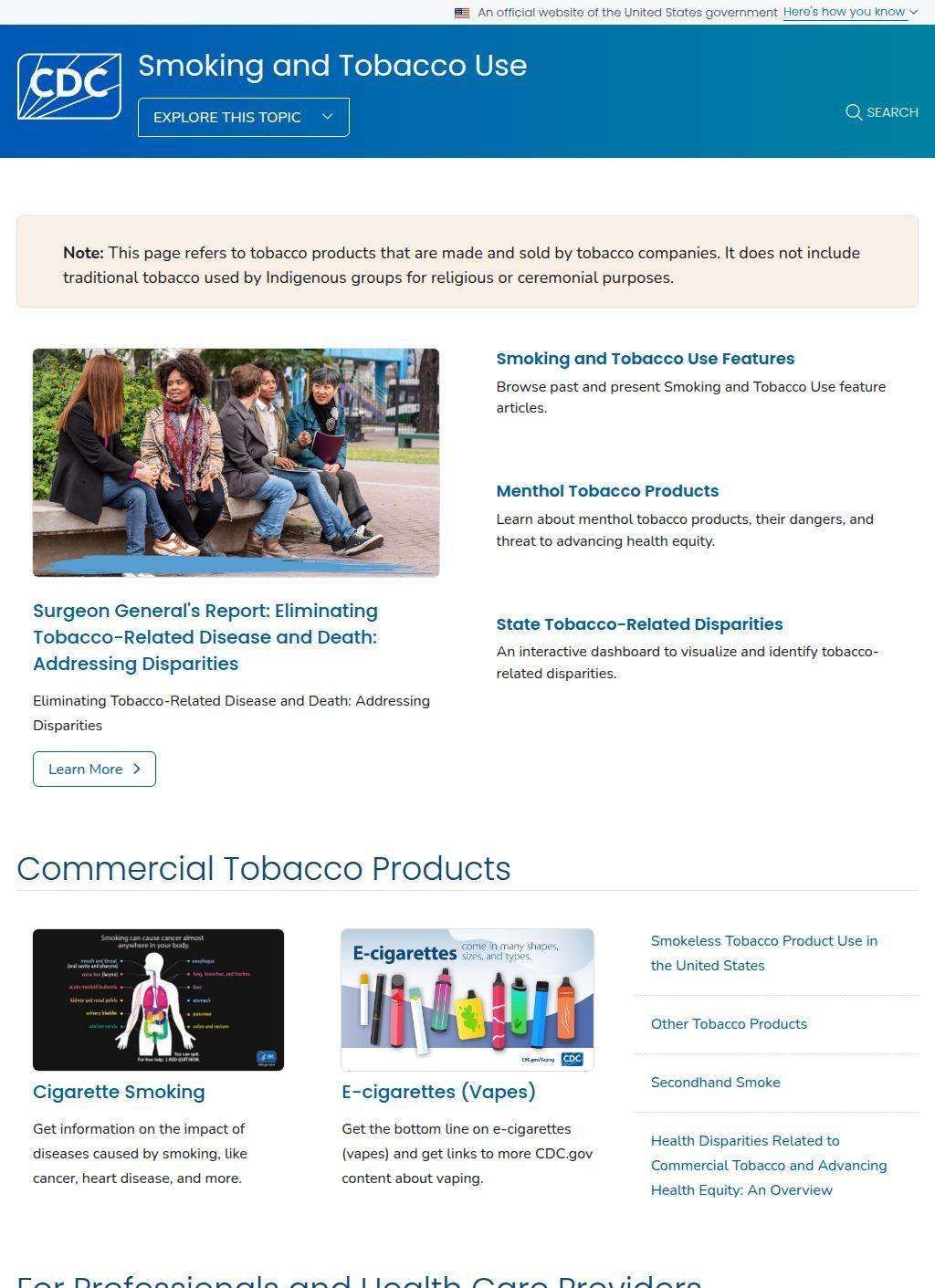
At the center of what CDC Smoking and Tobacco Use puts in front of professional users sits the STATE System: an interactive database tracking tobacco-related legislation, policies, and statistics across U.S. states, with the full name State Tobacco Activities Tracking and Evaluation. It is the kind of tool a state health department or a graduate researcher opens, queries, and cites. Its presence signals that the site is built to be worked with, not browsed once and closed.
Tracking tobacco policy across states
That working orientation runs through the whole portal. CDC Smoking and Tobacco Use sorts itself into three audiences and keeps them genuinely separate: the general public, healthcare providers, and public health professionals. Plenty of government sites announce that kind of structure and then dump the same brochure pages on everyone. Here the split holds, because the material in each lane is different in kind, not identical content with different labels.
Separate pathways for different users
For a member of the public, the depth is in the health-effects pages. Cigarette smoking gets the major conditions: cancer, heart disease, COPD. Beyond that there is information on secondhand smoke and smokefree policies, on e-cigarettes and vapes, on menthol tobacco products, on nicotine pouches, and on smokeless tobacco. CDC Smoking and Tobacco Use also surfaces Morbidity and Mortality Weekly Reports on tobacco topics, which is a step above the simplified fact sheet most general-audience pages stop at. A reader who wants the plain version can stay on the fact sheets; one who wants the underlying epidemiology has a path to it from the same place. That layering is the practical difference between a reference portal and a pamphlet site.
Health effects and product information
The clinical side is narrower but pointed. Providers get guidance on patient care and smoking cessation interventions, plus tools meant to support cessation across different care settings. The Surgeon General's Reports on tobacco's health impacts are reachable here, which is important for anyone who needs to anchor a recommendation in the authoritative document rather than a summary of it. I find the decision to route clinicians to cessation tooling, instead of leaving them with patient-facing leaflets, the most useful single choice on the site.
Cessation guidance for healthcare providers
This is where CDC Smoking and Tobacco Use stops resembling a reference site and starts resembling a working desk. Funding Opportunity Announcements for research programs are posted for people pursuing grants. Scientific Evidence Briefs lay out prevention and control strategies. There are adult and youth tobacco use statistics, Smoking Cessation Fast Facts, economic trend analyses, and data on tobacco industry spending. The State and Community Work initiative collects resources for the people running programs on the ground.
Research data for public health professionals
The interactive pieces are the real differentiators. Alongside the STATE System there is a dashboard that visualizes tobacco-related health disparities. That is a meaningfully different thing from a static table: it lets someone examine how the burden falls across population groups, which a single national number cannot show. Multimedia counter-advertising assets and digital media are available for public health campaigns, so a local program can pull finished creative instead of building it from scratch. Global Tobacco Control resources extend the scope past U.S. borders, and health equity materials address commercial tobacco disparities among underserved populations.
Interactive dashboards and campaign resources
One framing CDC Smoking and Tobacco Use returns to is its statement that commercial tobacco use is the leading cause of preventable disease, disability, and death in the United States. That sentence explains the breadth of everything around it. If you accept the premise, the spread of tools across the site, from cessation guidance to industry-spending data, reads as proportionate to the problem.
What you do not find here is filler. CDC Smoking and Tobacco Use is not selling anything, and it is not trying to keep a visitor on the site for its own sake. A person looking for help quitting lands on cessation material; a clinician lands on intervention tools; an analyst lands on the STATE System or the disparities dashboard. The routing is the product. It is worth being clear about who this is for, because a casual visitor who only wants a one-line answer about vaping might find the volume of material more than they expected. The economic trend analyses and the Funding Opportunity Announcements are not written to be skimmed. That density is a feature for the intended user and an obstacle for the accidental one, and CDC Smoking and Tobacco Use does not pretend otherwise.
Someone familiar with tobacco research policy or public health infrastructure will use CDC Smoking and Tobacco Use very differently from a first-time visitor. In the same way that a business directory is useful only if the entries are current and the categories are honest, CDC Smoking and Tobacco Use is useful because the data it holds is authoritative and updated. Adult and youth use statistics, industry spending figures, and the trackable state-by-state policy picture in the STATE System are the kind of inputs that feed a grant application, a journal article, or a state legislative briefing. They are also the kind of data hardest to assemble independently, which is much of why a portal like this exists.
Scientific Evidence Briefs sit next to the data and connect numbers to the prevention and control strategies they are meant to support, so the analysis and the source material are not in separate places. On the cessation thread specifically, CDC Smoking and Tobacco Use keeps the provider tools and the public health-effects pages connected. Someone counseling a patient can reach the clinical guidance, and that patient can then be pointed toward the same fact sheets and cessation support available to the general public. The continuity from clinical instruction to patient-facing material is sensible and not always present on sites that split their audiences this sharply.
Current market coverage and policy areas
The menthol and nicotine-pouch pages are a small sign that content is being kept current with where the market has moved. Nicotine pouches are a more recent product category, and their inclusion alongside older smokeless tobacco and e-cigarette material means CDC Smoking and Tobacco Use is not frozen at the cigarettes-only stage of the topic. The menthol product information tracks an active and contested policy area; the content treats tobacco as an evolving subject, not a settled one.
Connected information across audience tiers
If there is a limitation, it is the one that comes with breadth. Covering general readers, clinicians, and program staff in one place means no single audience gets a perfectly streamlined experience, and finding the exact page you want can take a few clicks through the audience tiers. That is the trade for putting fact sheets, Surgeon General's Reports, the disparities dashboard, and grant announcements under one roof. For most of the people CDC Smoking and Tobacco Use is built for, that trade is worth making.
What lingers after working through CDC Smoking and Tobacco Use is the range of the data: youth use figures, tobacco industry spending, and the state-level policy tracking in the STATE System, all kept in one place that a researcher or state program can return to as numbers change. The STATE System alone, with its cross-state legislative and statistical coverage, is reason enough to bookmark CDC Smoking and Tobacco Use as a primary source.
Business address
Centers for Disease Control and Prevention
1600 Clifton Road NE,
Atlanta,
Georgia
30329
United States
Contact details
Phone: 800-232-4636