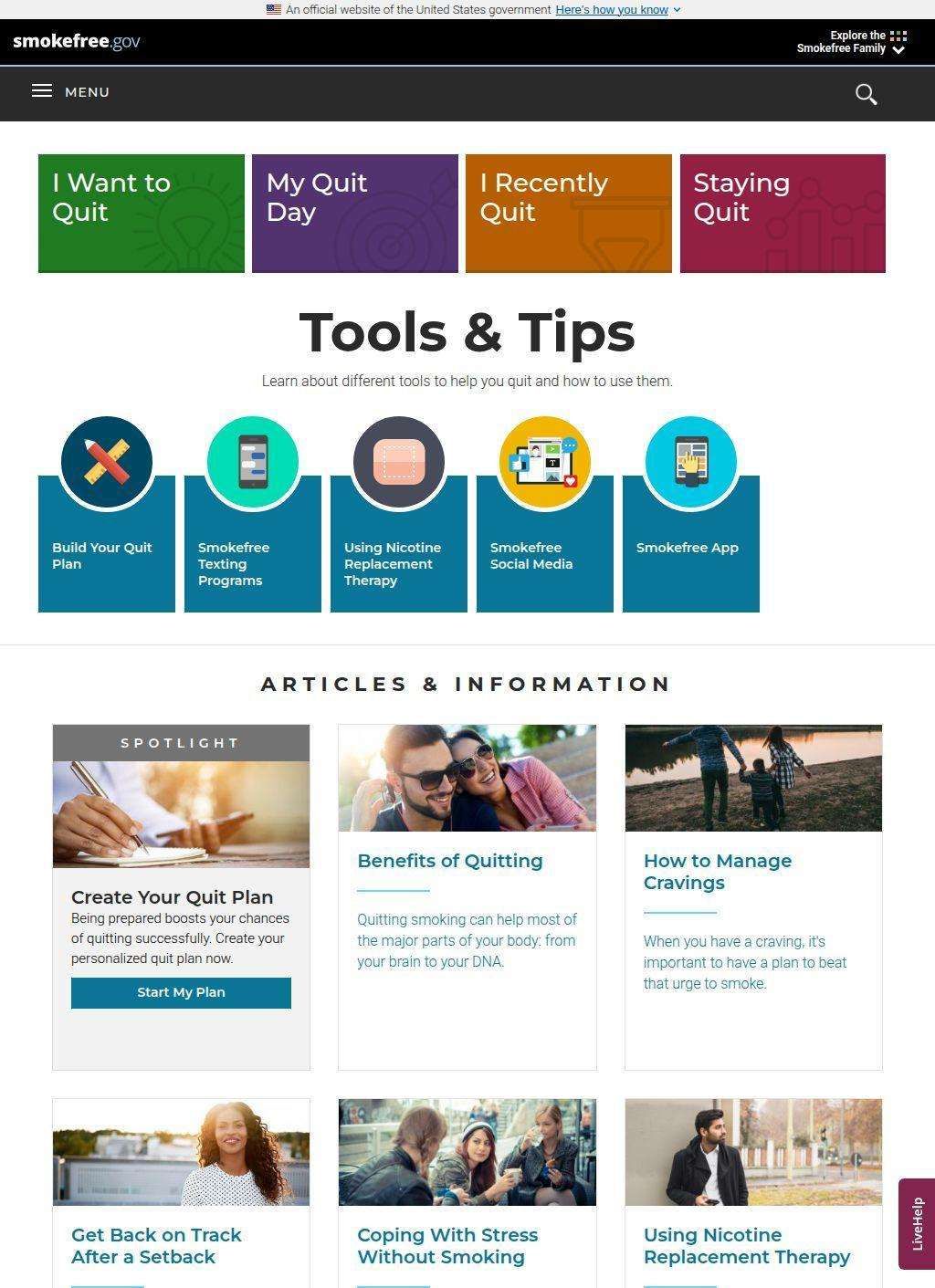
A federal cancer agency runs a free text-message coaching service that pings your phone with support messages while you try to stop smoking. That is what Smokefree.gov does, and it was the detail that surprised me most. Smokefree.gov comes from the National Cancer Institute, sitting inside the National Institutes of Health, and it exists for one purpose: getting people off cigarettes and, increasingly, off vapes.
How the quit-plan builder works
Most quit-smoking advice you stumble across online is generic. It tells you that quitting is hard, that you should pick a date, that you can do it. Smokefree.gov goes a long way past the pep talk. The core of Smokefree.gov is a quit-plan builder that asks where you are in the process and then shapes itself around that answer. Someone who is still thinking about it gets a different plan than someone whose quit day is tomorrow, and someone three weeks clean gets material aimed at staying that way. The four stages it works through, preparing to quit, quit day itself, recently quit, and staying quit, map onto how the experience unfolds for people, which is more care than a lot of cessation material bothers to take.
SmokefreeTXT and quitSTART tools
Two programs do most of the daily work. SmokefreeTXT enrolls you and then sends cessation-support and motivational texts to your phone, so the help arrives where your hand already is when a craving hits. The other is quitSTART, a smartphone app that lets you track cravings, run through distraction exercises when one comes on, and mark milestones as you pass them. Cravings tracking sounds minor until you have tried to white-knuckle through one. Having a record of when they strike, and a set of things to do instead of lighting up, turns a vague battle into something you can watch yourself winning.
Support options beyond the app
Smokefree.gov also offers live chat with quit-smoking experts, available on the site itself. Cravings strike at any hour, and the live text chat with a trained counsellor in the moment is a genuinely useful feature. The site connects users into the national 1-800-QUIT-NOW quitline network for people who would rather talk than type, and it links out to social-media communities where others going through the same process can compare notes. Quitting in isolation is harder than quitting alongside people in the same boat, and having a community channel built in reduces that pressure.
Health benefits timeline and education
The educational material backs all of this up without burying you. It walks through nicotine replacement therapy options, explains how to handle the symptoms that derail people (cravings, mood swings, weight gain), and lays out stress-management tactics that do not assume you have a therapist on call. One detail worth noting on Smokefree.gov: it maps out the health benefits on a timeline, from twenty minutes after your last cigarette out to fifteen years on. Seeing that your body starts repairing itself within the hour is a different kind of motivation than being told smoking is bad for you.
Tailored programs for specific groups
What pushes Smokefree.gov above a one-size resource is that it splits into sub-programs for groups whose situations genuinely differ. Teens get a track centered on vaping addiction, including a self-assessment quiz that helps a young person gauge how hooked they really are. That is sharp targeting. Vaping took hold among teenagers in a way cigarettes had stopped doing, and a quit resource that ignored it would be fighting the last war.
Veterans have their own Smokefree Veterans portal on Smokefree.gov, and pregnant people get pregnancy-specific guidance through the Smokefree Women section. These are not cosmetic relabelings. A pregnant smoker faces a clock and a set of risks that a long-term adult smoker does not, and a veteran may be carrying circumstances that civilian advice glosses over. Building separate paths for them is the difference between advice that nods at your situation and advice that was written for it.
Guidance for supporters and family members
There is even a supporter section, aimed not at the smoker but at the friend or family member trying to help. Anyone who has watched someone they love struggle to quit knows how easy it is to say the wrong thing, and how little guidance exists for the person on the sidelines.
Smokefree.gov giving that person somewhere to turn is a thoughtful piece of the design. Everything described is free. No subscription, no upsell to a premium tier, no payment wall in front of the chat or the app. Given who runs Smokefree.gov, that is the natural outcome, but it is worth saying plainly because so much of the quit-smoking market is built around selling you something, whether a gum, a patch, or a coaching package. The apparatus here exists to get you to stop, and the institution behind it has no product to move.
The breadth is the strongest case for Smokefree.gov and also its only real risk. A first-time visitor lands on a site that does a great deal, and the sheer number of doors (plan builder, text program, app, chat, quitline, plus four population-specific portals) could read as a lot to take in at the moment someone is anxious and looking for a single clear next step. The quit-plan builder is meant to be that front door, and it mostly is, but the volume of what Smokefree.gov offers is something to be aware of going in.
Set against that, the depth is hard to argue with. This is content built by people whose job is cancer research, aimed at the single biggest preventable cause of it, and the tools reflect serious thought about how quitting goes wrong: the 3 a.m. craving, the week-two mood crash, the partner who wants to help but does not know how. Smokefree.gov has an answer for each of those, and the answers are practical rather than inspirational. The information on nicotine replacement is the kind of thing people otherwise pay a pharmacist or a clinic to explain.
A teenager worried about a vape habit, a pregnant person who needs to stop now, a veteran: Smokefree.gov has built a path specifically for each of them, and for the ordinary smoker who has tried before and wants more structure this time. The combination of a plan that adapts to your stage, a phone that keeps nudging you, an app that catches the cravings, and a human you can chat with covers the parts of quitting that usually go unaddressed. The milestone timeline alone, showing the body mending itself across years, gives the whole thing a forward pull that purely clinical resources rarely manage.
Business address
National Cancer Institute
9609 Medical Center Drive,
Rockville,
Maryland
20850
United States
Contact details
Phone: 1-800-422-6237