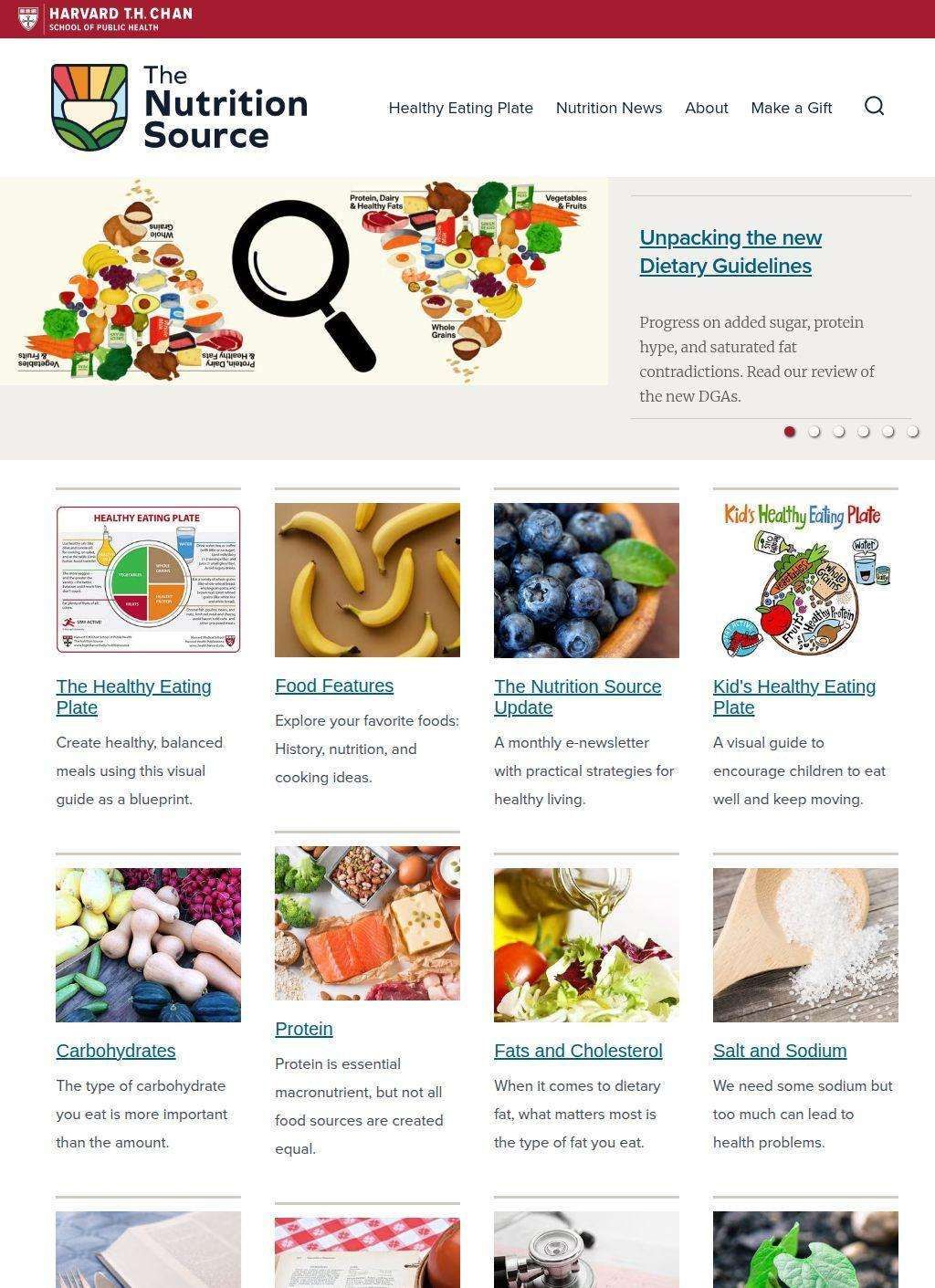
Someone gets a worrying lab result, or reads three contradictory headlines about eggs in one week, and wants a plain answer they can trust about what to put on their plate. That moment is exactly where The Nutrition Source - Harvard T.H. Chan School of Public Health does its best work. Rather than a single slogan diet, the site lays out a framework called the Healthy Eating Plate: a simple picture of how a meal should be divided between vegetables, whole grains, healthy proteins, fruit, and healthy oils, with water as the default drink. It is the kind of thing a parent can stick on the fridge, and the children's version exists for exactly that reason. The plate comes in many translations too, which widens its reach well past English speakers.
The Healthy Eating Plate framework
What keeps the plate from feeling like a poster is everything sitting behind it. Each component links out to its own deep explanation. Whole grains get their own treatment, proteins get theirs, and the writing keeps separating the useful detail from the noise: which fats matter, why carbohydrate quality is not the same as carbohydrate quantity, where vegetables and fruit pull their weight in a diet. The micronutrient pages do the same for vitamins and minerals. None of it asks for a fee, a login, or an email address, and that openness is consistent across the whole site. The Nutrition Source - Harvard T.H. Chan School of Public Health publishes all of this under an institutional mandate to translate research into plain-language guidance, which is a different proposition from a blogger summarising what they read last week.
Detailed explanations for each component
The drinks section goes further than a typical health site manages. Rather than stopping at "drink water," there are separate discussions of sugary drinks, sports drinks, energy drinks, and the low-calorie sweeteners that get marketed as the harmless swap, and the tone stays measured instead of alarmist. For a category where most advice collapses into either fear or hype, The Nutrition Source - Harvard T.H. Chan School of Public Health reads like someone weighed the evidence and reported what it says.
Beverages and drink choices
The macronutrient and micronutrient pages form the spine of the whole resource. They are organised so a reader can land on one nutrient, understand it, and follow the threads outward to related foods or health questions. The Nutrition Source - Harvard T.H. Chan School of Public Health treats these as living explainers, not glossary stubs, and the cross-linking means you rarely hit a dead end. A question about protein leads naturally to a question about specific protein sources, and those have their own pages.
Nutrients organized as living explainers
One detail worth noting: individual foods get their own dedicated entries. Potatoes, for instance, are examined on their own terms instead of being lumped into a vague "starches are bad" verdict. Food additives get a similar standalone look. That granularity is rare on free nutrition sites, where the usual move is to generalise and move on.
Diet and health conditions
Where The Nutrition Source - Harvard T.H. Chan School of Public Health stretches past basic eating advice is its coverage of how diet ties into health conditions. There are pages on salt and sodium reduction, obesity, heart disease, type 2 diabetes, cancer prevention, oral health, and the relationship between nutrition and immunity. Healthy weight is handled as its own topic, with the framing kept clearly educational. The site is explicit that none of this is personal medical advice, and that honesty about its own limits is worth more than a confident overreach would be.
Evaluating popular diets with evidence
The popular-diet reviews are a section many visitors will go straight to. Instead of endorsing or dismissing the latest plan, The Nutrition Source - Harvard T.H. Chan School of Public Health walks through what a given diet actually involves and what the evidence supports or fails to support. For anyone who has stood in a bookstore staring at competing diet books, that neutral read-out is genuinely useful.
Then there are the topics that show how broadly The Nutrition Source - Harvard T.H. Chan School of Public Health thinks about food. Planetary health and sustainability get real attention, connecting what we eat to environmental cost. Precision nutrition appears as its own area. So do mindful eating, stress, sleep, and physical activity, which is an honest acknowledgement that diet does not operate in a vacuum and that the body responds to more than just the contents of a meal.
Broader food and lifestyle topics
The practical side is handled with the same care. The Nutrition Source - Harvard T.H. Chan School of Public Health carries curated recipe collections, so the advice does not float free of the kitchen. There is also a set of food-service resources aimed at schools and workplaces, which tells you the site is thinking about institutional kitchens and cafeterias, alongside the individual cook. A monthly e-newsletter exists for people who want the material to come to them. The food-feature articles dig into the nutritional history of particular foods, the kind of background reading that makes the rest of the science land better. It gives the site a texture beyond the reference pages, and it rewards browsing.
Recipes, newsletters, food history
The audience is wider than a casual visitor might guess. The general public is the obvious group, but The Nutrition Source - Harvard T.H. Chan School of Public Health is also clearly built for parents feeding kids, for healthcare educators who need a reliable place to point patients, for schools shaping what they teach and serve, and for the food-service operators who plan meals at scale. One resource trying to speak to all of those groups could easily feel scattered. This one mostly holds together because the underlying science is the same regardless of who is reading.
If there is a limit, it is the flip side of the strength: this is education, not a diagnosis or a meal plan tailored to one person. The Nutrition Source - Harvard T.H. Chan School of Public Health says so itself. Someone with a specific clinical condition still needs a clinician, and the site does not pretend otherwise. What it offers instead is the literacy to have a better conversation with that clinician, and to read the next round of food headlines with a steadier eye.
Taken together, the depth is unusual for something that costs nothing to use. The plate gives a beginner a place to start, the nutrient pages give a curious reader somewhere to go next, and the disease and lifestyle sections give the whole thing a reason to keep someone coming back. The Nutrition Source - Harvard T.H. Chan School of Public Health spans the gap between a quick visual rule and the dense research literature, and that middle ground is precisely where most people get stuck.
A reader can spend ten minutes or an afternoon here and the structure supports both. The recipe links and the food-service pages keep pulling the science back toward something you can act on. The Nutrition Source - Harvard T.H. Chan School of Public Health does not chase trends, and it does not sell anything. The pages on potatoes and food additives sit a click away from the pages on cancer prevention and sleep, all under the same plate.
Business address
Department of Nutrition, Harvard T.H. Chan School of Public Health
665 Huntington Avenue, Building 2,
Boston,
Massachusetts
02115
United States
Contact details
Phone: 617-432-1333