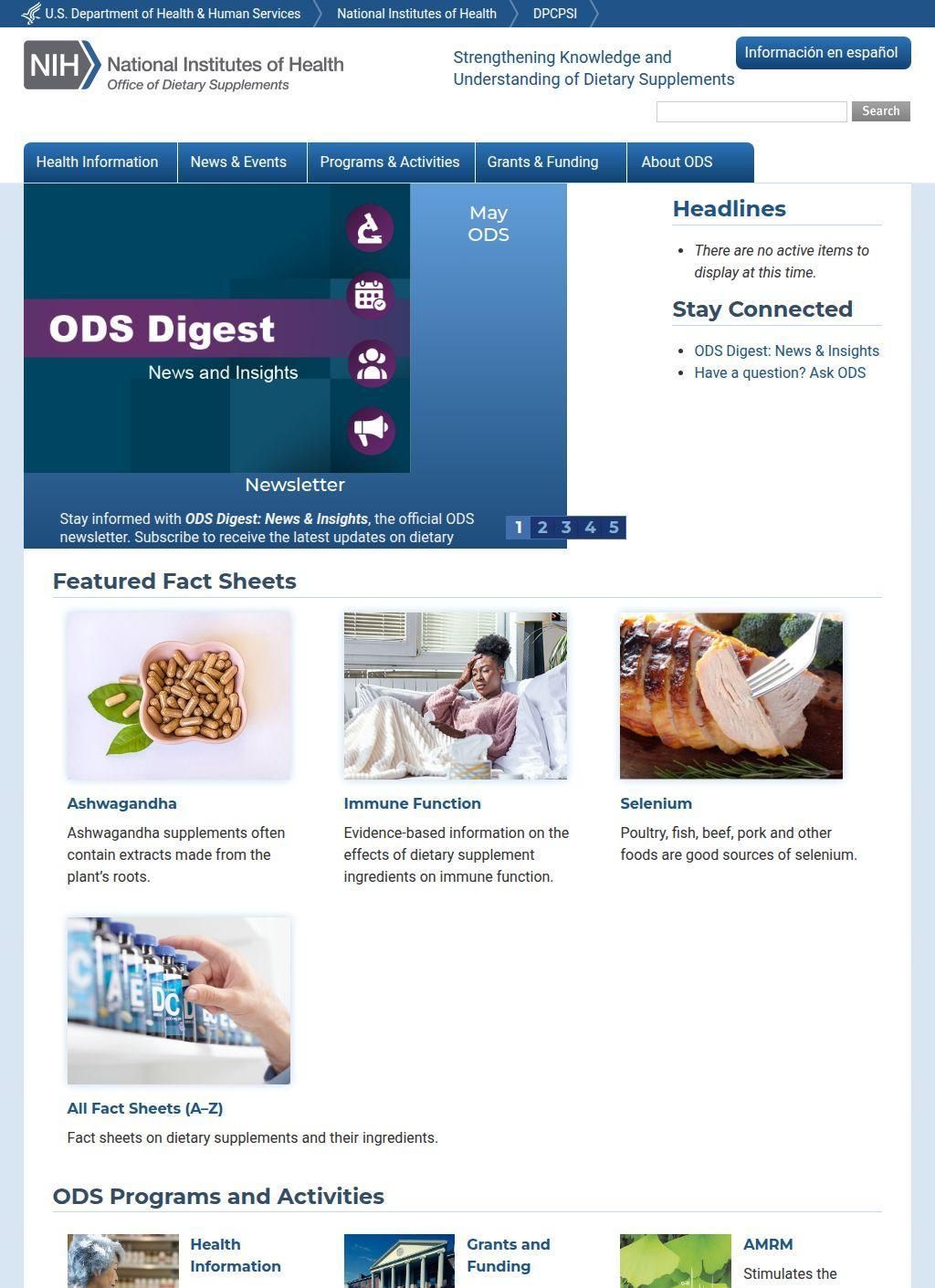
As a federal scientific body inside the U.S. National Institutes of Health, the NIH Office of Dietary Supplements sits under the Department of Health and Human Services with a congressional mandate written into the 1994 Dietary Supplement Health and Education Act to expand what is known about supplements. That origin shapes everything about what the site is and is not: it exists to advance and translate research, not to sell anything, and the content reflects that throughout. A reader arriving with a question about, say, whether selenium or ashwagandha does what a label claims will find the answer framed around evidence rather than persuasion. The NIH Office of Dietary Supplements treats the public, clinicians, and researchers as three separate readers with three different levels of patience, and it organizes accordingly.
Fact sheets for consumers and professionals
The most-used part of the NIH Office of Dietary Supplements site is almost certainly the Supplement Fact Sheets, and they are built with some care. Each ingredient gets two versions, one written in plain language for consumers and a denser one for health professionals, indexed A to Z across vitamins, minerals, botanicals, probiotics, immune-function compounds and more. That dual-track approach is unusual and genuinely useful, because the same page can serve a worried parent and a clinician without dumbing down the second to reach the first. Around the fact sheets sit a Supplement FAQ, a "What You Need To Know About Supplements" series, short videos, a Dictionary of Dietary Supplement Terms, and published Nutrient Recommendations. There is a Spanish-language section too, which widens the reach of material that is otherwise easy to find only if you read English comfortably.
Databases tracking labels and research
Behind the consumer pages, the NIH Office of Dietary Supplements runs the infrastructure that other people rely on. The Dietary Supplement Label Database (DSLD) catalogues what is actually printed on product labels, the CARDS database tracks federally funded supplement research, and there are links out to other government data sources.
A personal supplement tracking tool
For anyone studying patterns in supplement use, or a journalist checking a claim against the actual marketed labels, these are the raw material, not summaries of it. A smaller consumer-facing tool, "My Dietary Supplement and Medicine Record," lets an individual keep a personal log to bring to a doctor's appointment, which is a sensible nudge given how often supplements and prescriptions interact. None of this is locked away. The NIH Office of Dietary Supplements makes the same datasets available to a casual visitor and to a full research team, which is rarer than it should be.
Research programs measuring supplement quality
The research infrastructure goes well beyond what a casual visitor will ever use. The Analytical Methods and Reference Materials program works on validated ways to actually measure what is in a supplement, a quietly important problem given how inconsistent products can be. The Botanical Research Centers network (CARBON), the Population Studies program that tracks supplement use and nutritional status across the country, Resilience and Health Studies, and a line of evidence-based reviews all feed the same goal.
Population studies training future researchers
I find the Population Studies work the most quietly valuable of the group, since it answers the unglamorous question of what Americans are really taking and whether it is doing them any good. For people training to enter the field there is a Dietary Supplement Research Practicum and a Scholars Program, which shows that the NIH Office of Dietary Supplements is building the next generation of investigators alongside running its current portfolio of studies.
Coordinating grant funding requirements
The office also operates as a funder and coordinator. The NIH Office of Dietary Supplements co-funds work with other NIH institutes, publishes a co-funded research portfolio, and issues grant guidance along with product-integrity guidance so that researchers use supplements of known quality in their studies. That last point is easy to overlook but it is the kind of behind-the-scenes rigor that keeps published results trustworthy. Outreach rounds it out: a seminar series with expert talks, the ODS Digest newsletter, news releases, and a Strategic Plan covering 2025 to 2029 that lays out where the work is heading.
Separating readers by expertise level
The audiences are spelled out plainly as consumers, health professionals, and biomedical researchers, and the NIH Office of Dietary Supplements does not pretend a single page can satisfy all three. That honesty about depth is one of its strengths. The clinician-grade fact sheets are not watered down to spare a general reader, and the database tools are not hidden because they look intimidating. Everything is sorted so the right person can go as deep as they need.
Set against something like WebMD or a vitamin retailer's own ingredient guides, the difference comes down to who is talking and why. Commercial health sites and brand pages have an incentive, whether subtle or not, to keep you reading toward a product. The NIH Office of Dietary Supplements has none, and its references trace back to the same studies a researcher would cite. If you want a quick, friendly skim, a consumer health site may feel easier on a first pass. For checking a specific claim, comparing what a label says against measured reality, or grounding a decision in the actual science, the NIH Office of Dietary Supplements is the steadier place to land, and it is the one worth bookmarking.
Business address
Office of Dietary Supplements, National Institutes of Health
6705 Rockledge Drive, Room 730, MSC 7991,
Bethesda,
Maryland
20817
United States
Contact details
Phone: 301-435-2920