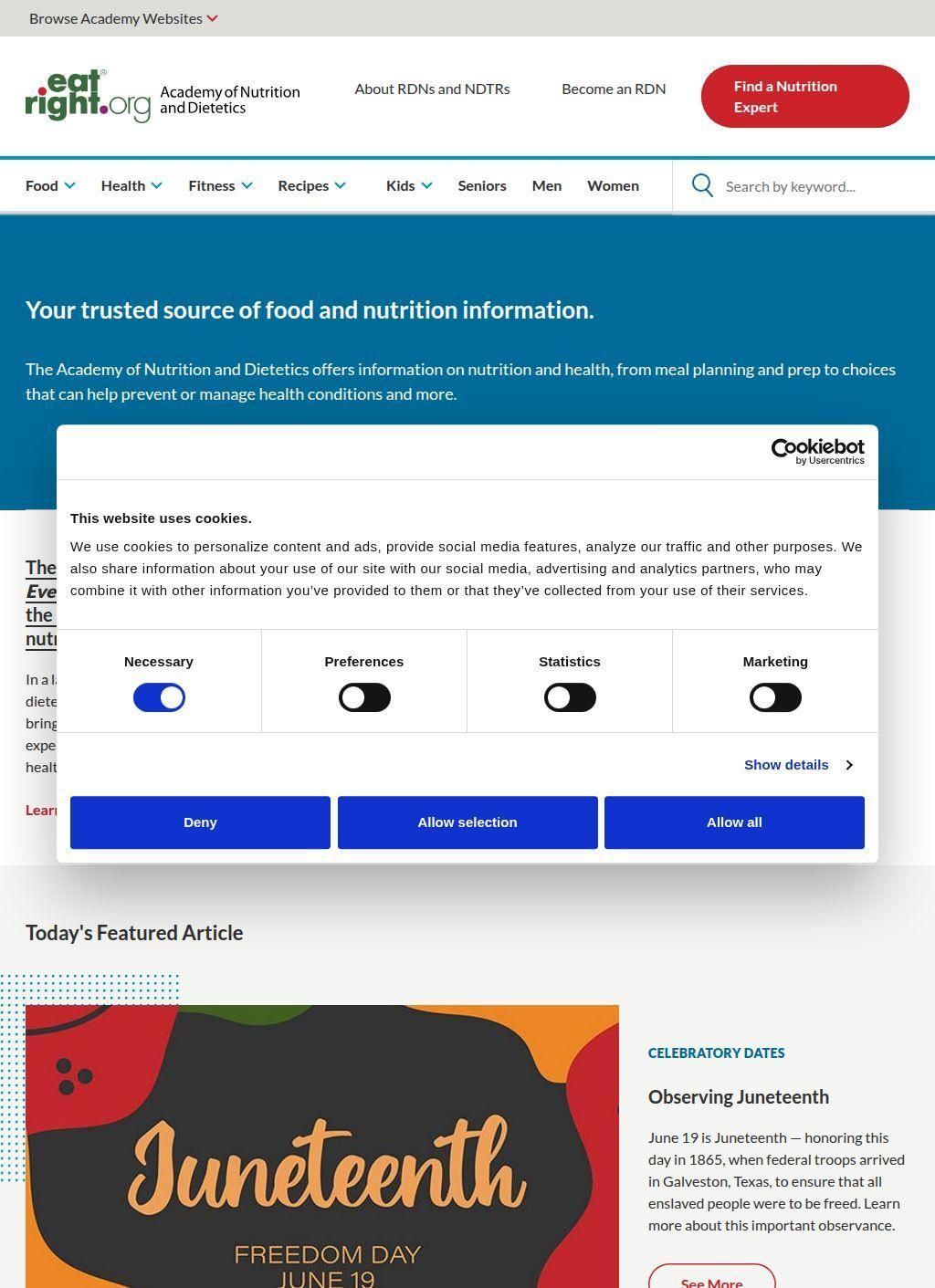
One body in the United States decides who may legally call themselves a registered dietitian nutritionist, and the Academy of Nutrition and Dietetics is that body. That single fact shapes how eatright.org reads. This is not a wellness brand selling a point of view about food. It is the professional home of the people who hold the RDN and NDTR designations, and the consumer site is the public window onto a much larger machinery of credentialing, standards, and advocacy that sits behind it.
Public guidance for everyday nutrition questions
The site splits its attention along a line that becomes clear once you notice it. The general public lands on eatright.org, where the writing is plain and the topics are the ones people actually search for: how to plan meals, how to handle food safely, what to eat during pregnancy, how to feed a baby and then a toddler and then a teenager, what sports nutrition looks like for someone training, and how needs shift for older adults. There is separate guidance broken out for men and for women. Recipes on the site are developed by registered dietitians, a quieter distinction than it sounds, because it ties the cooking content to the same professional standard as the rest of the advice and not sourced from outside the credentialed community.
Recipes developed by registered dietitians
The "Find a Nutrition Expert" database is probably the most practically useful thing on the site. A person can search by location and surface a credentialed practitioner near them, and because the Academy of Nutrition and Dietetics controls who carries the credential in the first place, that search is doing something a generic search cannot. It connects a name in the results to a defined, enforced qualification. For anyone who has tried to figure out whether a so-called nutritionist has any real training behind the title, that loop closing on itself is the most concrete thing the site offers.
Finding credentialed practitioners by location
The "Nutrition Fact Check" campaign is the part of the site that feels like a direct response to the current moment. Food advice online is a swamp of half-truths, supplement pitches, and confident strangers, and the Academy of Nutrition and Dietetics has built a stream of content aimed at countering that with claims tied back to evidence. It is paired with educational videos, which helps, because a lot of the people who absorb nutrition myths are not going to read a dense article but will watch three minutes of someone explaining why a viral claim does not hold up.
Countering nutrition myths with evidence
When the body that defines the credential also says a popular claim is unsupported, that holds a different standing from one more opinion in the feed. The campaign is not flashy and does not need to be. The value is in the source.
Why the source matters for health claims
The public site is restrained to the point of being a little dry. It reads like reference material, which is exactly what it is, and someone arriving expecting personality or a strong editorial voice will find the tone measured and institutional. For what this is, that is the right approach, even if it makes browsing feel more like consulting a manual than reading a magazine. I find this understandable given the audience the Academy of Nutrition and Dietetics is primarily serving, but it is worth noting for anyone who comes in expecting livelier writing.
Member resources and the online store
Beyond the consumer pages, the Academy of Nutrition and Dietetics runs two other platforms that round out the picture. eatrightPRO.org is the member side, built for practitioners who need continuing education, credentialing resources, and the practical tools of running a dietetics practice. eatrightSTORE.org is the online store, where the publications and products on offer are nutrition-related and tied to the same professional base. The separation is sensible. A parent looking up infant feeding does not need to wade through continuing-education catalogs, and a working RDN chasing credit hours does not want consumer recipes in the way.
Policy advocacy at the national level
The reach extends past the website entirely. The Academy of Nutrition and Dietetics represents its members in policy and advocacy at the national level, which puts the organization inside the conversations about food and health rather than only commenting on them from outside. That positioning is why the standards it sets for the RDN credential hold the standing they do in the field. The credential is not a marketing label invented to sell memberships. It is the recognized professional standard for dietetics in the country, and eatright.org is, in effect, the public face of that standard.
Varying depth across consumer topics
Depth varies by topic on the consumer side, and that is about the sharpest criticism available here. Some areas, like food safety and the life-stage nutrition guides, are thorough and clearly organized. Others read more like solid starting points that hand you off, sensibly, to a practitioner you can find through the expert database. That is consistent with the organization's role. The Academy of Nutrition and Dietetics is not trying to replace a one-on-one consultation. It is trying to give accurate baseline information and then connect you with a qualified person when you need more, and it is set up to do exactly that.
From accreditation to federal relationships
Outside reputation on review platforms is limited in scope, which is expected for a professional association rather than a consumer service. The Academy of Nutrition and Dietetics does not live or die by star ratings; its authority comes from the accreditation structure it operates and the policy work it does at the federal level, neither of which shows up in a Yelp listing. People who need to verify its standing can do so through the Commission on Dietetic Registration and through the institutional relationships the organization holds with health agencies and academic programs across the country.
Taken together, the Academy of Nutrition and Dietetics offers something most nutrition sites cannot: information that traces straight back to the professional standard it also enforces. The food-group breakdowns, the meal-planning guidance, the pediatric and senior content, the recipes from credentialed authors, the fact-checking effort, and the practitioner search all sit on the same foundation. There is little here that feels speculative or trend-driven, which for a subject this prone to fads is the whole point. Start with the topic guides for the life stage you care about, then use the "Find a Nutrition Expert" search to locate an RDN and ask them directly. The gap between reliable reading and a qualified human is exactly what the Academy of Nutrition and Dietetics is designed to close.
Business address
Academy of Nutrition and Dietetics
120 South Riverside Plaza, Suite 2190,
Chicago,
Illinois
60606
United States
Contact details
Phone: 312-899-0040