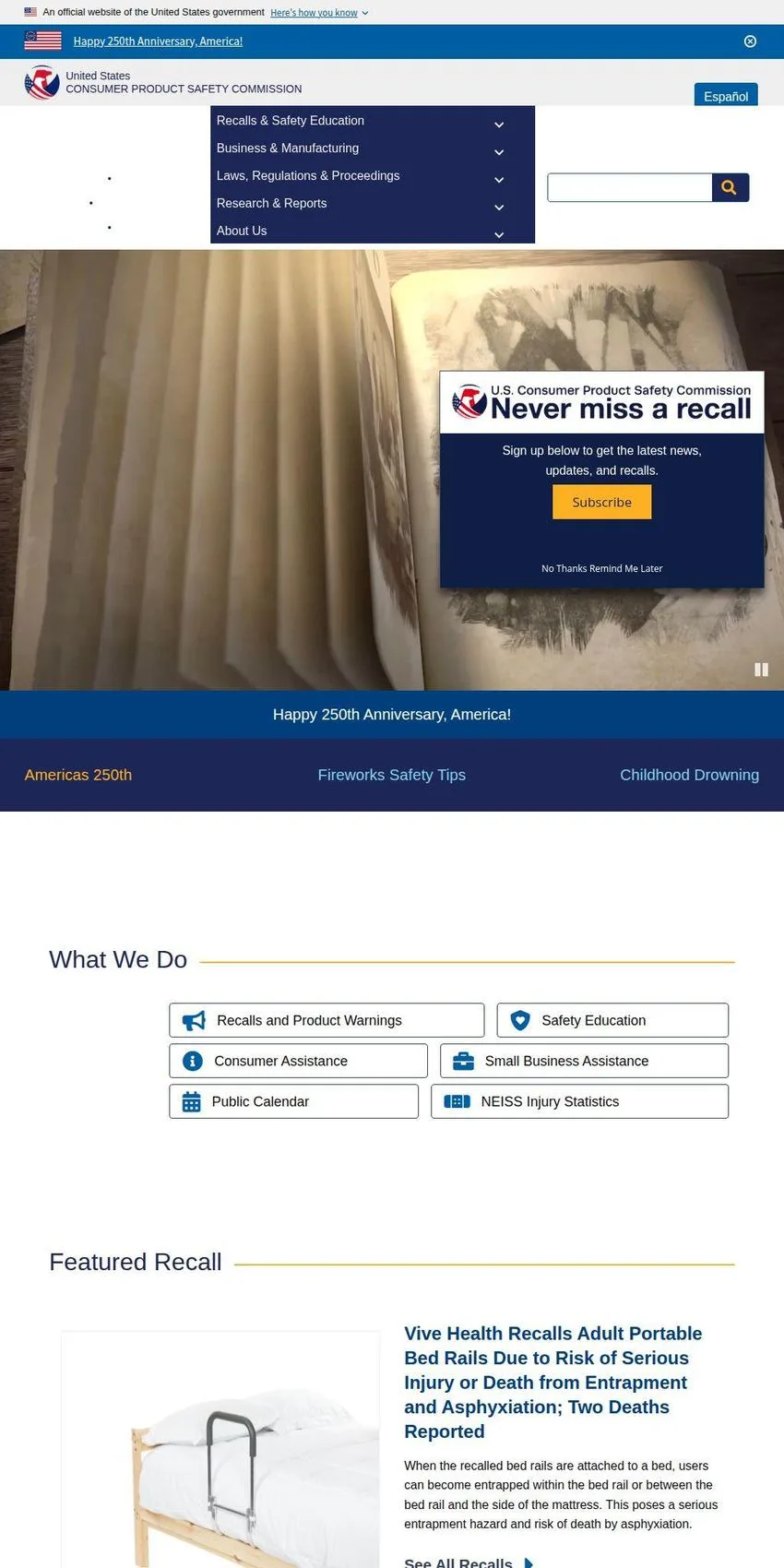
The U.S. Consumer Product Safety Commission is the independent federal agency charged with protecting the public from unreasonable risks of injury and death associated with consumer products. Congress created it through the Consumer Product Safety Act of 1972, and its jurisdiction now reaches thousands of product categories: toys, cribs, electronics, appliances, sports gear, furniture, fireworks, and most of whatever else ends up wrapped under a tree. Cars, food, drugs, and cosmetics belong to other agencies; nearly everything else in an American home falls to the commission.
For gift shoppers the agency matters twice. Before a purchase, its databases show whether a product has been recalled or flagged by other consumers. After one, its standards are the reason a toy sold in the United States has already been tested against specific hazards.
Checking recalls before wrapping a gift
The recall database on the agency's site is public, free, and searchable by product name, brand, category, and date. New recalls are announced jointly with the recalling company, usually several times a week. Each entry follows a consistent format:
- A description of the product with photographs
- The specific hazard and any injuries reported
- How many units were sold and through which retailers
- The remedy offered, whether refund, repair, or replacement
- Contact information for the recalling company
Two details are easy to miss. Selling a recalled product is illegal, which matters for anyone giving secondhand goods, since thrift stores and online resale listings are where recalled items most often resurface. And remedies generally remain available long after the announcement, so a recalled item received as a gift can usually still be returned to the manufacturer for its refund or repair.
Incident reports from other consumers
A companion public database collects safety incident reports filed by consumers, medical professionals, and public safety officials. Manufacturers receive a chance to respond before publication, and the report and the response then appear together. A search there before buying an unfamiliar brand of nursery equipment or a new toy can reveal patterns that have never risen to the level of a formal recall.
Reporting a problem yourself
Filing a report takes a few minutes online or one call to the agency hotline. Reports feed the investigations that produce recalls, so a near miss with a defective gift, even one that caused no injury, adds to the record that protects the next buyer.
Toy standards behind the gift aisle
Toys sold in the United States must meet ASTM F963, a toy safety standard that became mandatory under the Consumer Product Safety Improvement Act of 2008. It addresses mechanical hazards such as sharp points and pinch points, flammability, sound levels, magnets, and chemical content. Compliance is not voluntary and it is not left to the manufacturer's word.
Children's products face requirements that adult products do not. Lead content is capped at 100 parts per million in accessible materials and 90 parts per million in paint and surface coatings. Eight phthalates are restricted in toys and child care articles. Products designed for children twelve and under must be tested at an independent laboratory the agency has accepted, and manufacturers and importers must issue a children's product certificate documenting the results before the goods can be sold.
Age labels and choking hazards
The warning on a toy package naming a choking hazard and an age floor is a regulatory requirement rather than marketing copy. Federal rules ban small parts in toys intended for children under three and require explicit warnings on toys with small parts meant for children between three and six. Balloons, small balls, and marbles carry separate mandated warnings of their own. The agency's shopping guidance asks buyers to treat age grading as a safety boundary rather than a measure of a child's cleverness, a distinction that matters most in households where an older child's gift can drift into a toddler's hands.
Button cell and coin batteries received a dedicated rule after a 2022 law known as Reese's Law. Products that contain them must now use secure, tool-resistant battery compartments and carry warnings about ingestion, a hazard connected to electronics, remote controls, light-up gifts, and musical greeting cards.
Seasonal guidance and contacts
Each November the agency publishes material timed to the shopping season: an annual report on toy-related injuries and deaths drawn from its national sample of hospital emergency departments, along with plain advice for buyers. Recurring recommendations include matching every toy to the age label, buying safety gear such as helmets whenever the gift is a bicycle, scooter, or skateboard, and keeping deflated balloons away from young children. Related pages cover holiday decorating, lighting, and battery hazards.
The commission is led by up to five commissioners appointed by the President and confirmed by the Senate, no more than three from one party. Headquarters is at 4330 East West Highway in Bethesda, Maryland, and the agency runs its product testing laboratory nearby in Rockville. The consumer hotline at 800-638-2772 answers recall questions and takes incident reports on weekdays, with much of the site's material also offered in Spanish.
None of this requires an account or a fee. A recall search before a December purchase costs a minute and draws on the same data the agency uses to police the market.


Business address
U.S. Consumer Product Safety Commission
4330 East West Highway,
Bethesda,
MD
20814
United States
Contact details
Phone: 800-638-2772