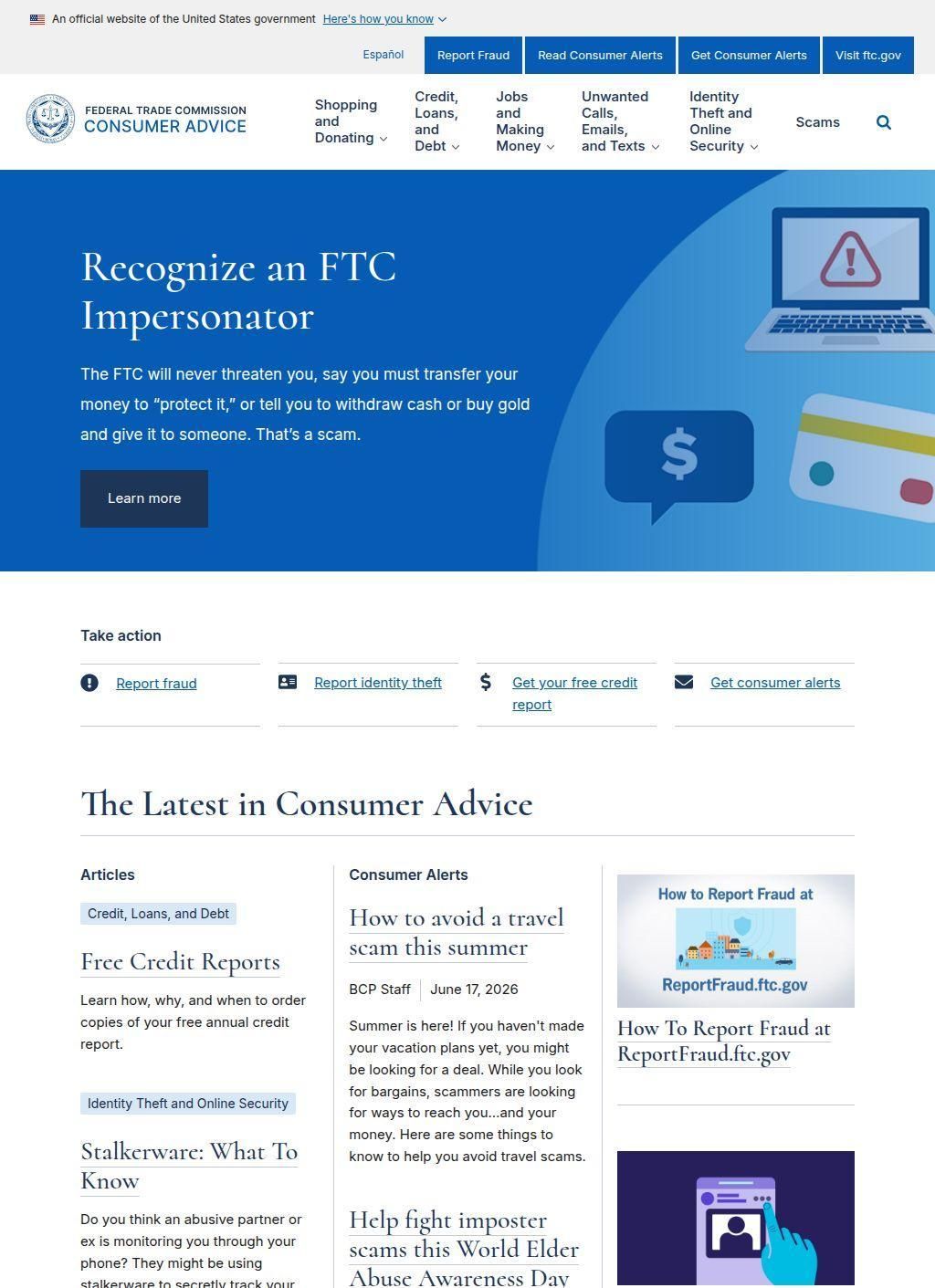
You have a gift card in your hand, a stranger on the phone insisting you read off the numbers, and a knot in your stomach because something feels off. That exact moment, the one where you need a plain answer fast, is what consumer.ftc.gov is built for. The U.S. Federal Trade Commission runs this site as its public consumer education arm, branded Consumer Advice, and it does the unglamorous work of explaining how a scam unfolds before you are halfway into it. The article on gift card scams reads like someone describing the trick step by step, which is more useful than any warning poster.
Spotting scams during the holiday season
The holiday angle is where this entry connects to the season people land here for. Around the shopping crunch, the U.S. Federal Trade Commission publishes pieces on dodging fake online stores, package theft, travel and vacation booking fraud, and the recurring summer travel cons that resurface every year. None of it is padded. An article tells you the specific behavior to watch, what the con artist wants you to do, and the move that protects you. The search index is organized by topic term, so typing in travel or holiday or vacation pulls the relevant cluster instead of burying you in a feed.
Teaching resources for kids and seniors
A large portion of the site is aimed at people who need to teach this stuff to others. Pass It On gives older adults shareable materials they can hand to a friend or relative; scam targeting skews heavily toward that group, and a printed sheet travels further than a link. Youville is an interactive set of privacy and digital citizenship tools for kids roughly eight to twelve, plus their teachers, and it treats children as capable of learning the basics instead of just shielding them. Money Matters rounds that out with financial education material pitched at classroom use.
Ordering free printed materials in bulk
There is also a bulk print order service, run through a separate ordering address, that lets educators, libraries, and community groups request free printed publications in quantity. That is a small detail with real reach. A library can stock a rack of fraud guides without paying for a thing, and the people who walk in without reliable internet still get the information. The U.S. Federal Trade Commission keeps all of this in the public domain and explicitly licenses it for redistribution, so a community newsletter or a senior center handout can lift the text wholesale and stay on the right side of copyright.
Beyond holidays broader consumer topics
The breadth of subjects is wider than the holiday framing suggests. Identity theft, robocalls and unwanted calls, debt collection, privacy and data security, general online safety, financial literacy: each gets its own ongoing stream of articles and consumer alerts. If you arrive worried about one holiday shipping scam and leave having read three pieces on protecting your data, that is the site doing its job. The U.S. Federal Trade Commission also posts enforcement-related guidance, including material tied to the Data Privacy Framework Principles it enforces under Section 5 of the FTC Act, so the advice is anchored to the agency's actual regulatory work and not floating loose.
A word on tone is worth adding, because government writing earns a reputation for being impenetrable. The pages here mostly avoid that. They are short, written in second person, and structured so you can skim for the one fact you came for. Scam reporting is folded in throughout, pointing you toward the channel for flagging fraud you have spotted, which closes the loop between reading about a con and doing something about it. The U.S. Federal Trade Commission gathers those reports, and the practical effect is that an individual complaint becomes part of a larger record the agency works from.
Limits of consumer advice pages
It is fair to note the limits. This is reference material, not a service that intervenes on your behalf or recovers your money. If you have already been defrauded, the U.S. Federal Trade Commission site can tell you the recovery steps and where to report, but the legwork stays yours. The advice is also general by design, so a situation with unusual specifics may need a phone call to a bank or a lawyer that no article can replace. None of that undercuts the value of having a clear, current, free explanation written by the body that actually polices this terrain.
For the holiday category specifically, the U.S. Federal Trade Commission delivers exactly the kind of seasonal reading that prevents a ruined December. Gift card pressure, too-good-to-be-true deals, fake delivery notices, vacation rentals that do not exist: the site names each one plainly and tells you the tell. I find the package theft material especially practical, since it covers a crime that spikes precisely when porches are stacked with boxes. Set against the flood of vague safety listicles elsewhere, the U.S. Federal Trade Commission content has actual authority behind it, written by the agency that drafts the rules.
From website content to community reach
The redistribution license deserves one more mention because it changes how the site functions. A teacher can drop a U.S. Federal Trade Commission article straight into a lesson, a nonprofit can reprint a fraud guide for a workshop, and a local paper can run a consumer alert verbatim during the shopping season. That multiplies the reach far past whoever happens to visit the domain. The U.S. Federal Trade Commission essentially hands its work to anyone willing to spread it, which is a rare posture and a genuinely useful one.
The U.S. Federal Trade Commission delivers the kind of material worth having before a problem rather than after: current, plain-language, and written by the agency that actually prosecutes these schemes. The holiday-specific pieces name the threats that reliably resurface each December, and the teaching tools extend that reach to classrooms and community groups. That combination of authority, clarity, and free redistribution rights makes this the most useful single stop for seasonal fraud awareness.
Business address
Federal Trade Commission
600 Pennsylvania Avenue NW,
Washington,
DC
20580
United States
Contact details
Phone: 1-877-382-4357