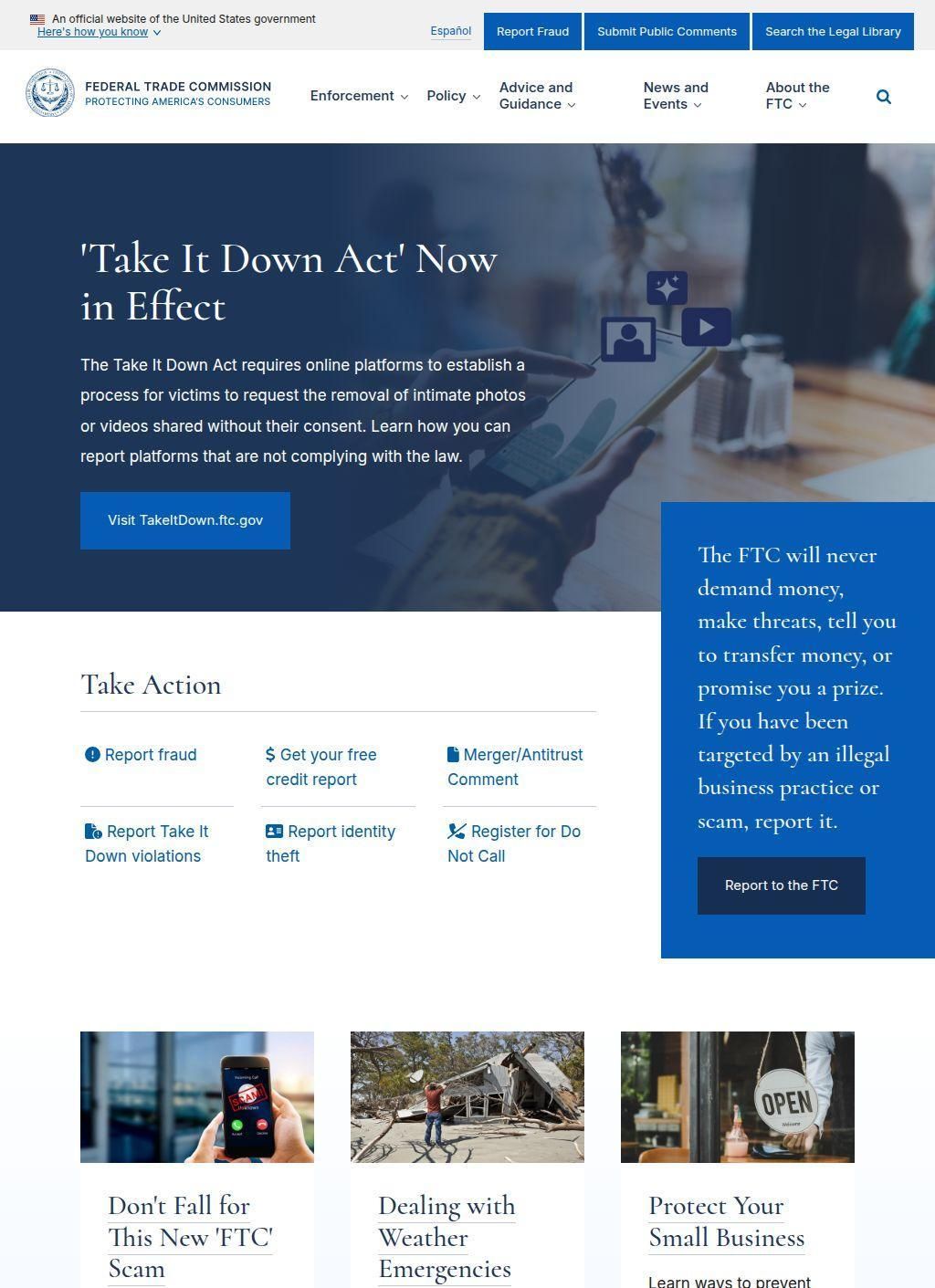
At ftc.gov, the U.S. Federal Trade Commission lays out its two core mandates side by side: competition enforcement and consumer protection. One side handles the legal machinery: merger review, antitrust action, and cases against companies that mislead or cheat the people they sell to. The other side is plain-language advice meant for ordinary readers who never plan to file anything. Most visitors will land on that second side, and it is where the site does its most useful work.
Consumer education library
Take the consumer education library first, since that is what someone hunting for guidance on gift cards or scams will actually use. The material is grouped by the situations people get into: shopping and donating, credit and loans and debt, finding work and making money, the flood of unwanted calls and texts and emails, identity theft, online security, and outright fraud. These read as how-to pages, not legal abstractions. A reader worried about a gift card scam can find a walkthrough of how the trick works and what to do if money is already gone, written for someone who is anxious and in a hurry. The fact that everything is offered in Spanish as well as English widens who can use it, which for a federal agency is the point.
Reporting fraud and identity theft
Action sits right alongside the reading. From the U.S. Federal Trade Commission site a person can report fraud, report identity theft, join the Do Not Call registry, flag a Take It Down violation, sign up for consumer alerts, and request the free credit reports they are entitled to. Those reports do not vanish into a void. They feed the Consumer Sentinel Network, a shared database that law enforcement partners draw on, and a Criminal Liaison Unit routes the serious matters to the Department of Justice. So filing a complaint about a swindle is not purely cathartic; it can become evidence. The agency also runs FTC Refund Programs that return money to people who were harmed, which closes a loop most government advice pages never reach.
Guidance for businesses
The other audience is companies, and the guidance there is just as practical. Businesses get topic pages on advertising and marketing, credit and finance, privacy and security, and rules specific to particular industries, with a deliberate track for small operators who lack a compliance department. A Legal Library collects the statutes, rulemaking records, and compliance documents in one place, and the Registered Number database is searchable for anyone who needs to check one. This is the agency telling firms what the law expects before it has to enforce it, which is more useful than a warning letter after the fact.
Enforcement and policy documents
The enforcement and policy work is documented in the open too. The U.S. Federal Trade Commission runs the Premerger Notification Program for HSR Act filings and reviews mergers, and it publishes the paper trail: Warning Letters, Notices of Penalty Offenses, Advisory Opinions, Federal Register Notices, reports, policy statements, and congressional testimony. An Office of Technology blog tracks how the agency is thinking about tech regulation, which is one of the livelier corners of the site for anyone following where consumer rules are heading. International cooperation agreements round out the picture, a reminder that fraud rarely respects a border.
Related resources for specific audiences
A few connected properties extend the reach. The U.S. Federal Trade Commission points to militaryconsumer.gov for service members and their families and to consumer.gov for plain-spoken basics, and it runs webinars on consumer protection topics for people who would rather watch than read. None of this is buried; the navigation keeps the two audiences from tripping over each other.
Gift card scams and graduation
Listed here under graduation, the connection is narrower than the site as a whole but real: gift cards are a common graduation present, and they are also a favorite vehicle for scammers who tell a target to pay with one. The U.S. Federal Trade Commission has clear, current pages on exactly that, so a relative buying a card or a new graduate who just got one has a reliable place to check what is safe and what to do if something goes wrong. That is a genuine fit, not a stretch.
Why consult the FTC?
What carries the whole thing is that the U.S. Federal Trade Commission is the source other consumer-advice sites cite, not a downstream aggregator paraphrasing someone else. For a reader weighing where to go, a private outfit like the Better Business Bureau is worth a stop for company-specific complaint histories and accreditation, but the BBB is a nonprofit that depends on business membership and cannot return your money or refer a case for prosecution. On the questions of what the law actually says, how to report a crime so it counts, and how to claim a refund, this is the primary authority, and the writing is clear enough that you do not need a lawyer to follow it.
Business address
Federal Trade Commission
600 Pennsylvania Avenue NW,
Washington,
DC
20580
United States
Contact details
Phone: 202-326-2222