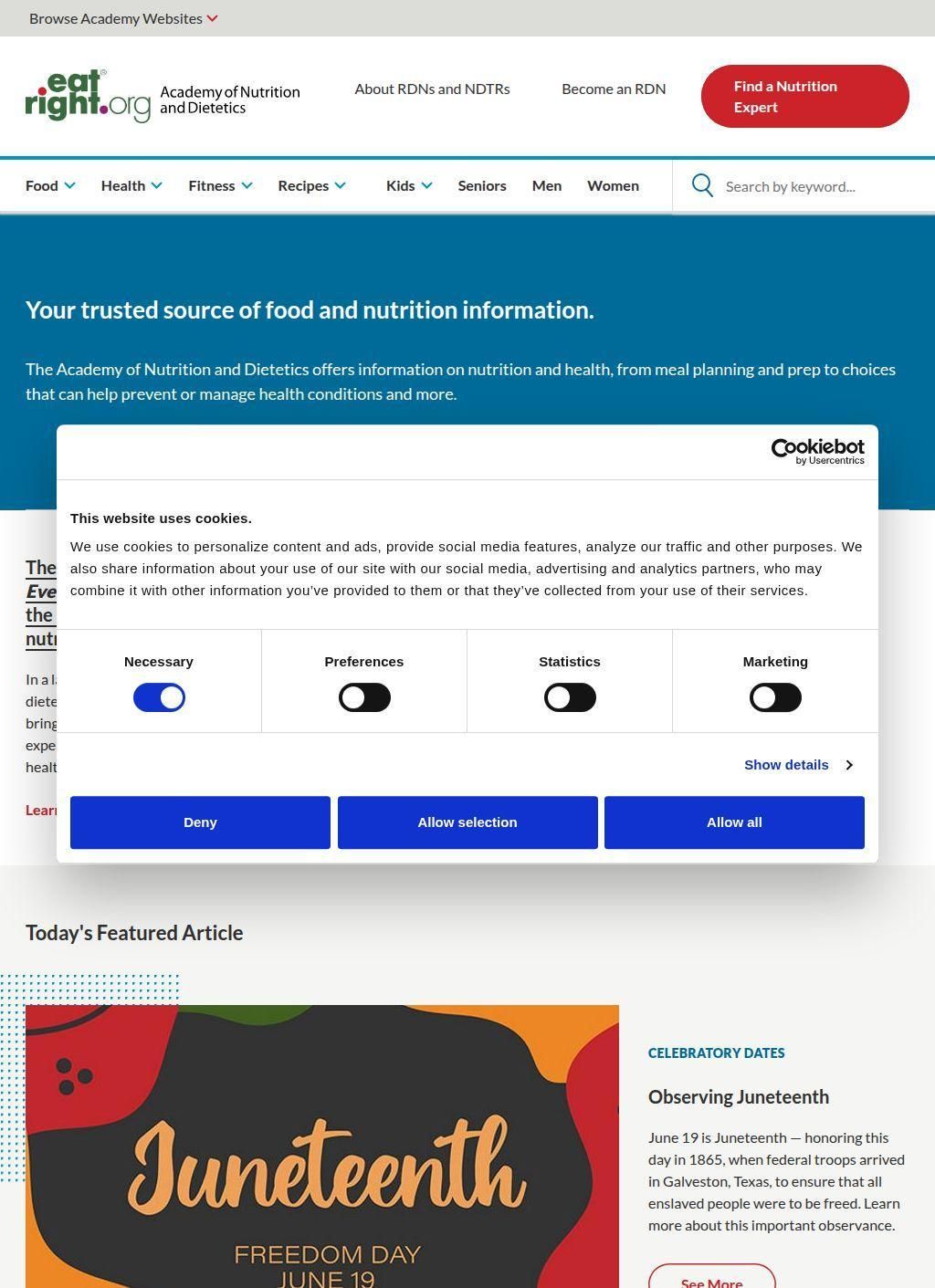
Someone has just been told by a doctor to cut sodium, or to feed a toddler who refuses everything green, or to figure out whether a viral claim about seed oils holds any water. They open a browser, type a question, and land on a wall of contradictory advice from people selling supplements. This is where the Academy of Nutrition and Dietetics earns attention, because the material on eatright.org is written and vetted by credentialed professionals rather than by whoever shouts loudest. The site reads like a reference desk staffed by people who answer to a profession, not to an advertiser.
Credentialed professionals behind the content
The Academy of Nutrition and Dietetics is the largest professional association of food and nutrition specialists in the United States, and the public-facing site is essentially that organization opening its filing cabinet to ordinary readers. The breadth is wide without being scattered. There is plain-language guidance on food groups, home food safety, meal planning, food preparation, and the essential nutrients, plus deeper sections that get into pregnancy and breastfeeding nutrition, eating with specific health conditions, and fueling sports performance. Each of those is a topic where bad information circulates freely, so having one source hold them all under a consistent editorial standard is genuinely useful.
Food groups, pregnancy, sports performance
What pushes the site past being a glossary is the practical layer sitting on top of the science. Dietitian-developed recipes span several meal categories, and nutrition advice that never reaches the cutting board tends to evaporate. The Kids Eat Right campaign organizes content by age, running from infancy through adolescence, and that structure respects how different feeding a six-month-old is from feeding a teenager. Parallel sections speak to seniors, to men, and to women, acknowledging that nutritional needs are not one-size-fits-all.
Recipes and age-specific feeding guidance
The age-banded approach to children's nutrition is the most quietly sensible thing here, since most general advice ignores how fast a child's needs change. A parent does not have to translate adult guidance down to a toddler on their own. The same goes for the life-stage material aimed at older adults, where appetite, medication interactions, and bone health all shift the equation. The Academy of Nutrition and Dietetics treats these as distinct readers with distinct questions, and the writing follows suit.
Distinct nutrition needs across life stages
The Find a Nutrition Expert directory deserves a mention because it closes a loop the rest of the site opens. Reading about a complex condition is one thing; finding a registered dietitian nutritionist nearby who can sit down with your specific situation is another. The directory lets a consumer search credentialed RDNs by location, which turns an information site into a doorway toward actual professional care. That handoff from reading to consulting is something a lot of health sites never bother to build.
Finding registered dietitian nutritionists locally
The Nutrition Fact Check initiative, published under the Academy of Nutrition and Dietetics umbrella, is worth returning to. Nutrition is a field where myths spread faster than evidence, and this section answers specific claims with science-based responses. It gives a reader a place to verify the thing their cousin posted before they reorganize their pantry around it. The value is not in any single article but in having a steady, accountable source that engages with claims directly instead of ignoring them.
Verify claims with science-based responses
Behind the consumer pages sits the larger work of the organization, and the site is honest about that scope. The Academy of Nutrition and Dietetics advocates for the dietetics profession across healthcare and public policy, and it issues official position and practice papers on nutrition topics. Those papers are not light reading for a casual visitor, but they are the documents clinicians and researchers cite as reference standards, which tells you the public content rests on a serious foundation. When a recommendation here aligns with one of those papers, the backing is institutional in a way a typical wellness blog cannot match.
Institutional backing from position papers
The Academy of Nutrition and Dietetics also fans out across companion platforms, each with a clear job. EatrightPRO.org serves credentialed members and working professionals, eatrightSTORE.org carries publications and resources, and eatrightCPE.org handles continuing professional education. A general reader will rarely need those, but their existence shows that the same body feeding the public site is also maintaining the credentialing and education pipeline that produces the experts it points you toward. The ecosystem is coherent rather than bolted together.
Professional platforms for members and educators
If there is a friction point, it is that the sheer number of sections and sibling sites can make a first visit feel like arriving at a campus without a map. A reader who simply wants one answer may have to dig through topic hubs to reach it. The search and navigation do the job, but the depth that makes the Academy of Nutrition and Dietetics valuable is also what can slow a quick lookup. That is a fair trade for the reliability on offer, and it is the kind of complexity that comes with covering an entire field properly.
Comparing depth against general health portals
The obvious alternative most people reach for is a quick scan of WebMD or a similar general health portal. Those sites move fast and cover everything, but their nutrition material is one slice of a sprawling medical operation and often reads as such. The Academy of Nutrition and Dietetics does one domain and owns it, with content authored by the very profession that defines the standards. A parent planning meals, an athlete tuning intake, someone trying to separate a real dietary recommendation from a marketing claim: all of them are better served by a source this focused than by a general portal that treats nutrition as a subcategory. The Academy of Nutrition and Dietetics is worth bookmarking.
Business address
Academy of Nutrition and Dietetics
120 South Riverside Plaza, Suite 2190,
Chicago,
Illinois
60606
United States
Contact details
Phone: +1 312 899 0040