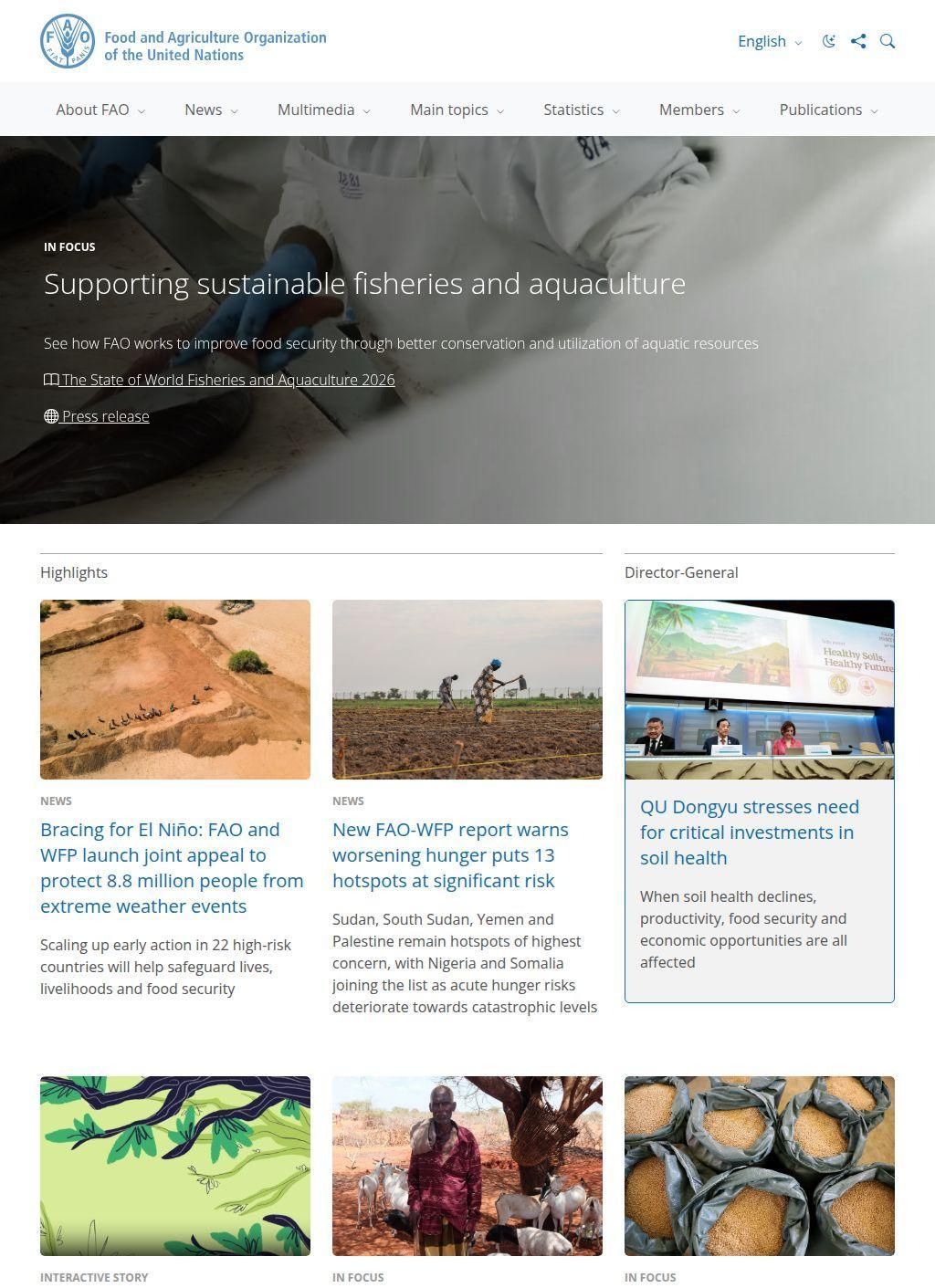
The Food and Agriculture Organization of the United Nations, commonly called the FAO, is the specialized United Nations agency that leads international efforts to defeat hunger. It was founded on 16 October 1945 at a conference in Quebec City, Canada, and its headquarters have long been in Rome, Italy. The agency now counts 194 members, made up of 193 countries plus the European Union, and it maintains an operational presence in more than 130 nations.
Mission to defeat hunger globally
The mandate is broad but clear. The FAO works toward food security, meaning a world in which people have regular access to enough nutritious food to lead healthy and active lives. To pursue that, it operates across agriculture, fisheries, forestry, and nutrition, supporting governments with technical advice, coordinating responses to threats against food production, and gathering the data needed to understand how the global food system is performing.
For most outside users, the agency's greatest value is its data and its publications, which are open to the public.
FAOSTAT database covers production through emissions
FAOSTAT is the centerpiece. It is a free statistical database covering food and agriculture for more than 245 countries and territories. The data spans production, trade, prices, food balances, land use, and emissions, with series that in many cases reach back to 1961. For researchers, journalists, students, and policymakers, FAOSTAT is one of the most widely used sources of comparable cross-country food data anywhere, and it is reached directly from the FAO website at no cost.
Flagship reports shape policy worldwide
Alongside the database, the FAO produces flagship reports that are routinely cited by other international bodies. The State of Food Security and Nutrition in the World tracks global hunger and the affordability of healthy diets. The State of Food and Agriculture examines a major policy theme each year. These reports are drawn upon by organizations such as the World Bank and across the wider United Nations system, which is one reason the agency is treated as an authoritative reference rather than simply one voice among many.
International food standards and Codex Alimentarius
The FAO also stands behind the Codex Alimentarius. Created jointly with the World Health Organization in 1961, the Codex is the body of international food standards, guidelines, and codes of practice that aim to protect consumer health and support fair practice in the food trade. Many national food rules trace back to Codex texts, so the FAO's role here reaches far beyond its own offices and into the food that crosses borders every day.
Why include a government agency here
Why include an intergovernmental agency in a food and drink listing at all? Because a directory that means to point readers toward solid information should not stop at national professional bodies. The FAO supplies the global layer. Where a food science society explains how food is made and a nutrition academy explains how food relates to health, the FAO supplies the worldwide picture of how food is produced, traded, and distributed, and where hunger persists. For a business directory trying to give readers a full range of credible food sources, that global reference rounds out the picture.
Public goods funded by member states
The agency is also firmly non-commercial. It is a United Nations body funded by its members, and its data and reports are public goods rather than products for sale. A reader sent here from a business directory finds statistics, standards, and research, with nothing being marketed. That is precisely the kind of source a careful curator wants near the top of a food and drink section.
Practical applications for researchers, journalists, policymakers
The practical applications are wide. A student writing about global food prices can pull figures straight from FAOSTAT. A reporter checking a claim about world hunger can cite the State of Food Security and Nutrition in the World rather than a secondhand summary. A small organization working on food policy can consult Codex standards to understand the international baseline. None of these uses requires membership or payment, which is part of what makes the FAO so broadly useful.
It is worth being precise about what the FAO is and is not. It is not a regulator that polices food companies, and it is not a consumer-advice service. It is a coordinating and knowledge-producing agency that works with governments and gathers the world's food and agriculture data. Understanding that scope helps a reader use its resources for what they do best, which is supplying reliable, comparable, global information.
From Rome to worldwide reach
The FAO headquarters is located at Viale delle Terme di Caracalla, 00153 Rome, Italy, near the Circus Maximus. The main switchboard number is +39 06 57051. The agency's website at fao.org is the gateway to FAOSTAT, the flagship reports, the Codex Alimentarius, and the agency's country and regional work. Because the FAO is an international body, its real home is Italy, even though its reach and its readership are worldwide.
For anyone building a dependable food and drink resource list, the FAO belongs alongside the national scientific and nutrition organizations as the global reference point. Its data is open, its publications are cited across the international system, and its standards work shapes the food trade across borders. It gives a directory the worldwide dimension that national bodies, however authoritative, cannot supply on their own.
Business address
Food and Agriculture Organization of the United Nations
Viale delle Terme di Caracalla,
Rome,
Lazio
00153
Italy
Contact details
Phone: +39 06 57051