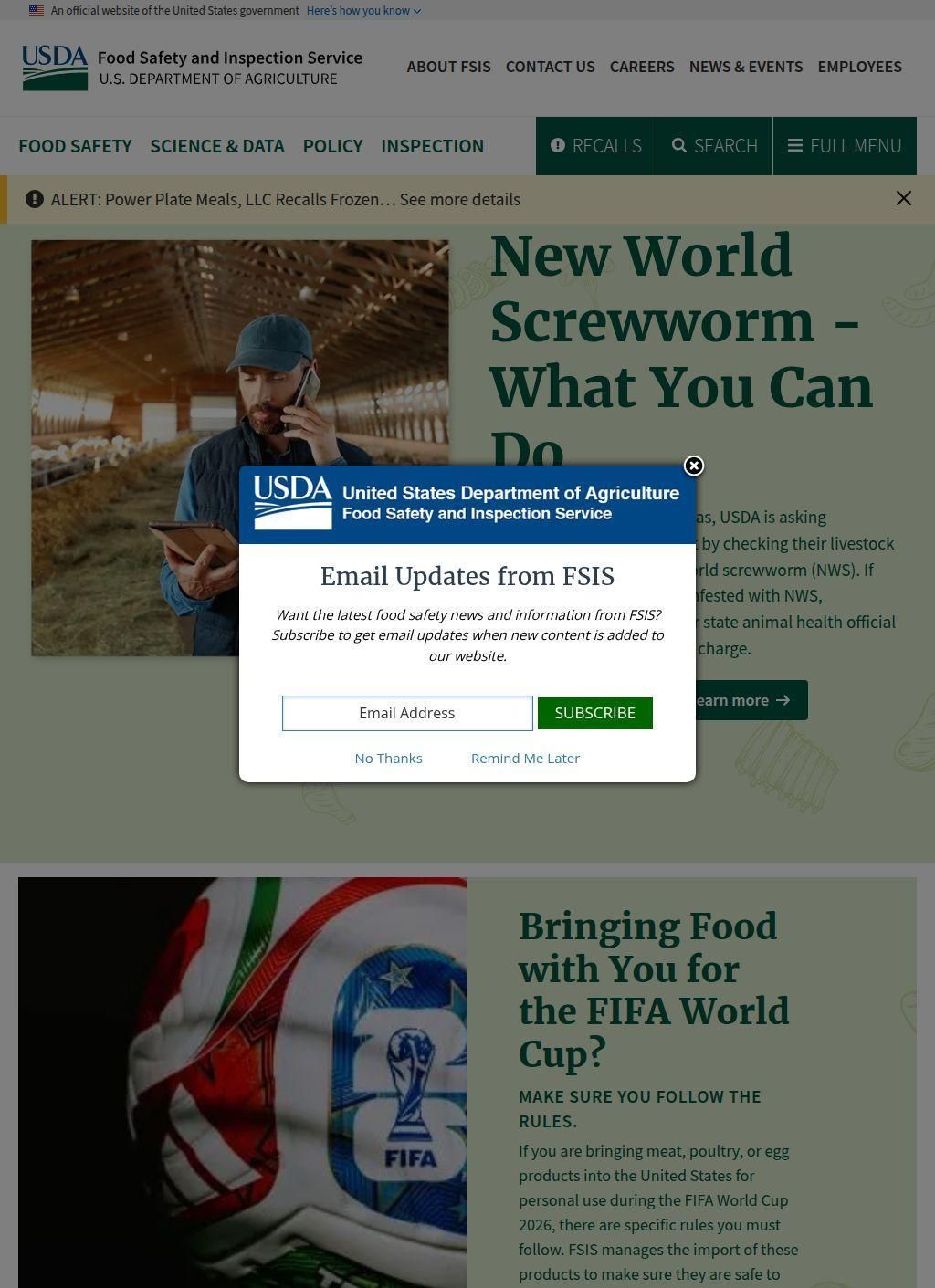
Few federal agencies make their regulatory machinery as readable as USDA Food Safety and Inspection Service does on its public site. This is the public health arm of the U.S. Department of Agriculture responsible for the commercial supply of meat, poultry, and egg products sold across the country, and its job is to confirm those products are safe, wholesome, and labeled the way the package claims. The legal backbone is concrete: the Federal Meat Inspection Act, the Poultry Products Inspection Act, the Egg Products Inspection Act, and humane handling enforcement under the Humane Methods of Slaughter Act. None of that stays abstract once you start clicking through, because the regulatory authority shows up in the form of real tools and real enforcement notices.
Recalls and public health alerts
The section most ordinary visitors land on at USDA Food Safety and Inspection Service is Recalls and Public Health Alerts. Active recall notices carry establishment numbers, lot codes, actual product label images, and best-by dates, so a person standing at the freezer can match what they bought against what was pulled. Beyond the live notices, USDA Food Safety and Inspection Service publishes annual recall summaries broken out by class, by reason, and by total pounds recalled, which gives the data a shape worth studying over time. Anyone who has ever squinted at a vague recall headline elsewhere will appreciate how specific these entries get. The agency also offers email subscriptions for recall alerts, and that one feature probably does more for a typical consumer than any amount of browsing the site directly.
Safe food handling for households
For households, the safe food handling and preparation guidance is where the site earns consistent use. If someone is shipping a perishable food gift or receiving one, the guidance on cold chains and storage is worth checking before the package sits on a porch too long. There are also import rules for bringing meat, poultry, or egg products into the country, written for travelers and individuals alongside trade professionals. The guidance stays practical and avoids drowning the reader in statute language, which is not always the case for a federal agency of this scope.
Compliance resources for food industry
The other half of the site addresses industry. USDA Food Safety and Inspection Service provides compliance and inspection resources aimed at both small operators and large establishments, along with Food Safety Assessment toolkits designed to identify risks in production processes. That assessment framework is one of the more substantive pieces here, giving establishments a structured way to examine their own systems rather than waiting to be told what went wrong. Scientific weight backs it up: FSIS scientists run microbiological and chemical analysis, and a Public Health Veterinarian program oversees food safety systems from production through distribution. Online and mail payment options for regulated establishments round out what is, in practice, a full administrative layer for the industry side of the mandate.
How enforcement actions protect the supply
What gives the operation teeth is enforcement, and the site does not soften it. The agency monitors meat and poultry across storage, distribution, and retail, and can move from monitoring to action: detentions, voluntary recalls coordinated with companies, or court-ordered seizures when a company refuses to cooperate. Reading those powers laid out plainly is a useful reminder that the recall notices visible to consumers are the public face of a much larger inspection machine. USDA Food Safety and Inspection Service addresses four distinct audiences at once: consumers, food industry operators, importers and exporters, and public health professionals. It manages to give each a clear path without the others getting in the way.
Who uses this site and why?
A fair criticism is one of breadth. USDA Food Safety and Inspection Service tries to be a recall bulletin, a consumer kitchen guide, an importer reference, and an industry compliance hub under one roof, and a first-time visitor can feel the sprawl. The site architecture is logical enough once you know the structure, but arriving without a specific question can leave you clicking longer than expected. Someone who only wants to know whether their ground beef is on a list does not need the assessment toolkits, though the site at least keeps those audiences in separate lanes rather than mixing them into a single undifferentiated FAQ.
From recall data to authoritative reference
Used for what it is built to do, USDA Food Safety and Inspection Service delivers. For checking a specific recall or handling a shipped perishable correctly, it is the primary authoritative source, and nothing else carries the establishment-level detail it publishes. For broader nutrition and food labeling questions extending past meat, poultry, and eggs, the FDA site covers the rest of the food supply. The distinction is worth knowing in advance, but it does not diminish what USDA Food Safety and Inspection Service has built here: a genuinely useful public resource that does the unglamorous work of keeping recall data specific, current, and findable.
Business address
USDA Food Safety and Inspection Service
1400 Independence Avenue SW,
Washington,
District of Columbia
20250
United States
Contact details
Phone: 1-888-674-6854