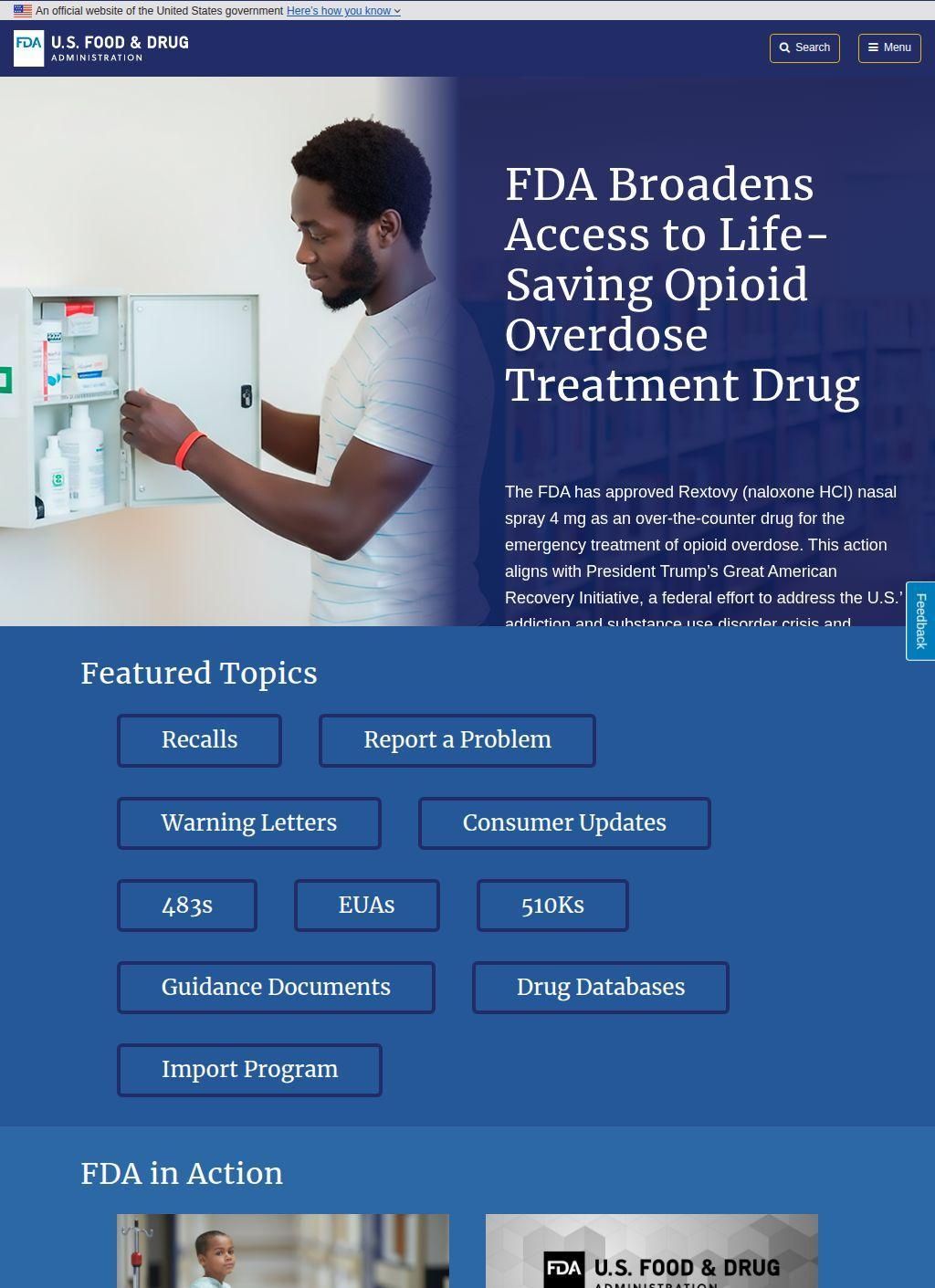
The U.S. Food and Drug Administration is the federal agency, housed under the Department of Health and Human Services, that regulates the safety of food, drugs, medical devices, vaccines, cosmetics, tobacco, and even products that emit radiation. Its website at fda.gov is the public face of all that authority, and for anyone who lands here from a food angle, the relevant material sits inside a broad regulatory operation that touches nearly everything a person eats, takes, or is treated with. The scope is enormous, and the site does not pretend otherwise.
Food safety and labeling guidance
Start with the food safety material, since that is what draws most consumer visits. There are pages on allergens and how the nine major ones must be declared, guidance on foodborne illness outbreaks with the pathogens involved, and detailed explanations of how labeling works: what the Nutrition Facts panel has to show, how ingredient lists are ordered, what claims a manufacturer may and may not print. If you have ever wondered whether a "healthy" claim on a box means anything legally, the answer lives somewhere in these documents. For someone mailing perishable food or thinking about cold chain handling, the safe-handling and temperature guidance is the underlying reference the packaging advice traces back to.
Checking the recall feed
The recall system is probably the most immediately useful thing the U.S. Food and Drug Administration publishes for an ordinary reader. Recalls, market withdrawals, and safety alerts are collected in one running feed, searchable, covering contaminated produce, undeclared allergens, mislabeled products, and problems that stretch well past food into drugs and devices. A shopper who hears a vague news mention of a lettuce or peanut butter recall can come here and find the actual firm, the product codes, the lot numbers, and what to do with the item already in the cupboard.
What does MedWatch track?
That feed connects to MedWatch, the adverse event reporting channel the U.S. Food and Drug Administration operates. It runs in two directions: consumers and health professionals can report a problem with a product, and the agency uses those reports as part of how it decides what to flag next. I find the two-way design genuinely more useful than a static bulletin board, because it means the safety information is partly built from what real people send in rather than handed down in one direction only. It is the kind of infrastructure that only a body with this reach could operate.
The alerts also demonstrate how wide the remit runs. One week the notices might concern a seafood importer, the next a blood pressure medication or an infant formula. For a reader who arrived thinking of the agency purely in terms of groceries, the breadth is a quick education in how much of daily consumption passes under a single regulatory roof.
Databases for industry professionals
Beyond the consumer front, the U.S. Food and Drug Administration maintains a set of databases that professionals lean on daily. The Orange Book lists approved drug products with their therapeutic equivalence ratings. There are drug approval records, medical device databases, and separate sections on vaccines, blood, and biologics. A pharmacist, a researcher, or a compliance officer at a food company can dig into primary regulatory data here without going through an intermediary, which is the whole point of a government reference: the source is the source, not a summary pulled from some trade group's business directory or a secondhand blog post.
Guidance documents and import rules
The guidance documents are a category of their own. These are the written positions the U.S. Food and Drug Administration takes on how a rule should be interpreted, and regulated industry reads them closely because they shape what can legally be manufactured, labeled, imported, or sold. For a company shipping food products, the import and export program pages spell out the procedures and paperwork that determine whether a shipment clears. It is dry material, but it is precise, and precision is exactly what a business needs from a regulator.
The site is organized along two axes that make this sprawl navigable. One sorts by audience: Consumers, Patients, Industry, Health Professionals. The other sorts by product area: Food, Drugs, Medical Devices, Radiation-Emitting Products, Vaccines and Biologics, Animal and Veterinary, Cosmetics, Tobacco. A parent checking a snack ingredient and a manufacturer preparing a submission enter through different doors and reach different depths of the same structure. That dual organization is what keeps a site this large from collapsing into a maze.
Worth naming plainly: the veterinary section covers pet food and animal drugs, the cosmetics pages handle labeling and ingredient safety for personal care products, and the tobacco pages carry the regulatory framework for those products. None of that is food, strictly, yet all of it sits under the same masthead, and the coherence of putting it in one place is part of why the U.S. Food and Drug Administration site works as a reference. You are not bounced between agencies for related consumer questions.
Research data behind decisions
There is also a steady stream of press announcements, scientific research, and published data. The research and data pages matter more than they might seem, because they let a curious reader see some of the evidence behind a decision instead of only the decision itself. For a food business trying to understand why a particular additive is treated the way it is, the underlying science is at least partly on display, and that transparency is not something every regulator offers.
If there is a fair caution, it is the sheer density. The U.S. Food and Drug Administration site is not built for a quick skim; the material is thorough, occasionally legalistic, and a casual visitor can get lost in guidance-document language written for specialists. That is a consequence of the mission, not a flaw in execution. The information is authoritative and current, which is the trade a reader makes for depth. Someone who wants a two-line answer may find the two lines wrapped in careful qualification, because the agency writes for legal precision as much as for readability.
Applying the rules to food gifts
Placed in a food-gifts context, the connection is real even if it is indirect. Anyone assembling perishable hampers, shipping regional specialties, or labeling a homemade product for sale eventually runs into the rules the U.S. Food and Drug Administration writes and enforces: how to declare allergens, how to keep the cold chain intact, what a label may claim. The site is where those rules originate. For consumers on the receiving end, the recall feed and the food safety pages are the practical tools, and they cost nothing to use.
What the U.S. Food and Drug Administration site is worth depends less on whether the agency itself is worth consulting, which it plainly is, and more on what a visitor brings to it. A specialist finds primary data no secondary source can match. A consumer finds recalls and labeling answers that are as official as they come. A food business finds the exact regulatory text it is bound by. The one thing the site will not do is hand anyone a shortcut. Depth is the whole trade here, and for most of what a reader needs from a food regulator, that depth is the point rather than the obstacle.
Business address
U.S. Food and Drug Administration
10903 New Hampshire Avenue,
Silver Spring,
Maryland
20993
United States
Contact details
Phone: 1-888-463-6332