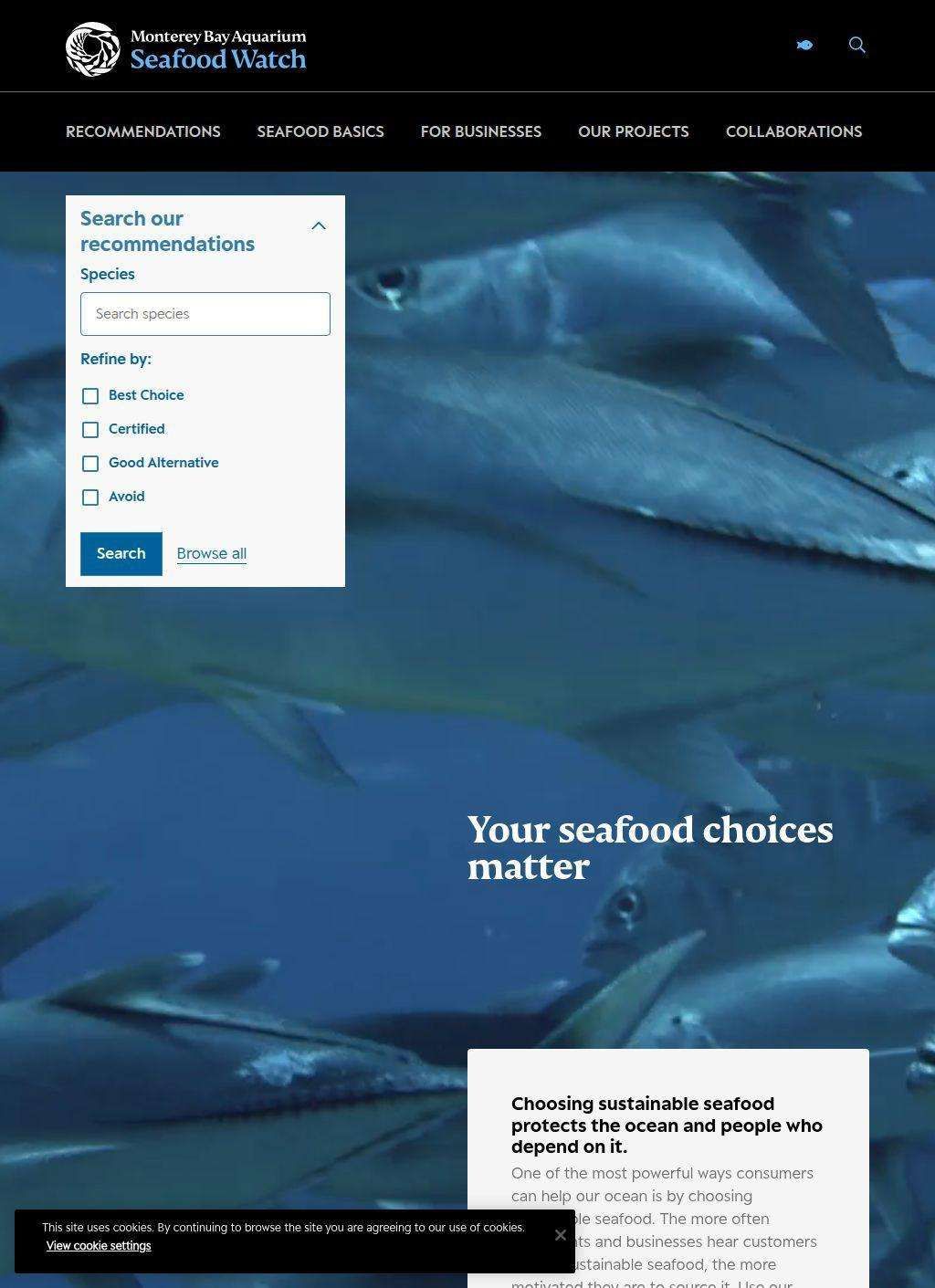
Seafood Watch (Monterey Bay Aquarium) is the sustainable-seafood advisory program run out of the aquarium in Monterey, California, and the site exists to answer one practical question: of all the fish and shellfish a person could buy, which ones come from sources that are holding up and which ones are being fished or farmed into trouble. The answers are sorted into three plain buckets: Best Choice, Good Alternative, and Avoid. That simplicity is the whole point, and it survives the translation from marine science to a shopper standing at a fish counter with a phone in hand.
Searchable database by species
The core of Seafood Watch (Monterey Bay Aquarium) is a searchable database covering hundreds of items, both wild-caught and farmed. You can come at it from several directions, which is more useful than it first sounds: by species if you already know you want salmon or shrimp, by region if you care where the thing was landed, or by the fishing or farming method, since the same species can earn very different ratings depending on how it was caught. A farmed shrimp from one system and a farmed shrimp from another are not the same animal as far as the ocean is concerned, and the ratings reflect that. I find that method-level granularity is the feature that separates this from a static do-and-don't list, because it forces the honest answer that "is tuna okay" has no single reply.
Assessment reports and transparency
Sitting underneath the ratings are the Assessment Reports, the full technical documents for each species and region combination. This is where Seafood Watch (Monterey Bay Aquarium) shows its work. Anyone who wants to argue with a rating can go read the reasoning behind it, the data that fed it, and the criteria applied, which is a level of transparency most consumer-facing guides never bother with. A separate section walks through the aquaculture standards and the assessment methodology itself, so the logic of how something lands in the Avoid column is laid out rather than asserted. The ratings are not frozen either; they get revised as new science comes in, because a fishery that was struggling can recover and a healthy one can decline.
Consumer guides and mobile app
For people who just want a quick answer, Seafood Watch (Monterey Bay Aquarium) puts out a Consumer Guide as the front door. It comes as a downloadable pocket guide you can fold up and carry, a digital version, and a free mobile app for iOS and Android that lets you look up a fish while you are shopping or reading a menu. The pocket guide has been around long enough to be a recognizable object in its own right, and the app is the natural evolution of it. The recommendations span both U.S. and global markets, so the guidance is not limited to one coastline.
Business partnerships for retailers
There is a second audience here that casual visitors might miss. Beyond individual shoppers, Seafood Watch (Monterey Bay Aquarium) runs a Business Program, a partner scheme aimed at retailers, foodservice operators, and distributors who want supply-chain guidance and the option to co-brand around their sourcing commitments. Partners have included major grocery chains and restaurant groups, which is where the program arguably moves more fish than any individual download ever could. A single buying decision by a national chain reshapes demand in a way that a thousand pocket guides cannot, and the program is clearly aware of that effect even if it dresses it in plainer language.
Educational material and conservation focus
Seafood Watch (Monterey Bay Aquarium) rounds this out with educational material and ocean-conservation news, which fits the aquarium parent more than it does a pure ratings service. That framing is worth keeping in mind. This is a conservation organization publishing buying advice, not a neutral price-comparison tool, and the recommendations carry an environmental point of view by design. Someone looking purely for taste, freshness, or value will not find that here; the entire lens is sustainability, and the guide is upfront about it. That is a strength for the reader who shares the goal and a limit for the one who does not, and it is fair to name both.
What holds the whole thing together is the chain from a one-word rating down to a full scientific report. Most sustainability labels ask you to trust a logo. Seafood Watch (Monterey Bay Aquarium) lets you climb all the way down to the assessment and check the footing yourself, then climb back up to a color-coded answer you can act on in a grocery aisle. The database is broad, the methodology is documented, the formats range from a printed slip of paper to a live app, and the advice reaches both households and the companies that supply them. Few resources in this corner of the food world combine reach and rigor in the same place.
The harder thing to settle is personal. If you buy seafood without much thought, the information here is thorough enough that consulting it and then ignoring what it says becomes an active choice rather than an uninformed one. That is probably the most a free public guide can accomplish, and this one accomplishes it.
Business address
Monterey Bay Aquarium Foundation
886 Cannery Row,
Monterey,
California
93940
United States
Contact details
Phone: +1 831-648-4800